2017 Cyber Forecast: Blackmail Using Media and Sensitive Data Will Grow

The end of the year is drawing nearer, and with that comes a handful of traditions: family gatherings, eggnog by the fire, and everyone’s annual list of cybersecurity “predictions.” While it’s a bit semantic, I’m personally not a big fan of the term “predictions.” As someone who lives in the intel world, it’s more about looking at the data and making forecasts using probabilities. In all of the cyber threat intelligence that we provide our customers, we include a confidence level based on what we’re seeing and the probability of that threat impacting a specific customer.

I start out with the above just to level set the rest of this blog (and the next several blogs around 2017 cyber forecasts). When it comes to identifying trends and making a forecast on probability of what threats make waves in 2017, based on the success of ransomware attacks I have moderate confidence that we will see growth of more traditional extortion-related cybercrime.

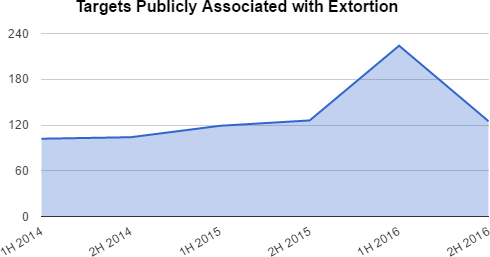
SurfWatch Labs has seen a steady growth in the number of targets publicly associated with extortion, blackmail and ransoms over the past few years, and we expect that number to rise even higher in the coming year.
2016-12-08_extortion
Extortion-related crimes are on the rise (note: 2H 2016 data includes intelligence collected through December 7).

One of the best and most recent examples of malicious actors using extortion is the hacking group known as TheDarkOverlord, which has breached, attempted to extort and then publicly shamed a variety of organizations over the second half of 2016.

The latest incident is the November breach of Gorilla Glue. TheDarkOverlord claimed to have stolen more than 500 GB of data, including research and development material, intellectual property, invoices and more. The group then offered Gorilla glue its signature “business proposition.” As we wrote in a SurfWatch Labs blog earlier this year, the proposition is simple: pay the blackmail or face further data leaks and public shaming. After what TheDarkOverlord described as “a moderate dispute” with Gorilla Glue over payment — we’re guessing Gorilla Glue refused to pay — TheDarkOverlord shared a 200 MB cache of files with the media to help spread the story.

The evolving use of the media is actually one of the more interesting tactics used by TheDarkOverlord and other successful extortion groups this past year. Extortionists have referenced news coverage in their demands, prompted users to research past victims, and impersonated cybercriminals with established media coverage — all in an effort to lend credibility to their threats.

For example, back in April CloudFlare reported that a group using the “Armada Collective” name was blackmailing businesses with an extortion email that read, in part:

We are Armada Collective.

http://lmgtfy.com/?q=Armada+Collective

Your network will be DDoS-ed starting [date] if you don’t pay protection fee – 10 Bitcoins @ [Bitcoin Address].

If you don’t pay by [date], attack will start, yours service going down permanently price to stop will increase to 20 BTC and will go up 10 BTC for every day of attack.

This is not a joke.

The link in the email led to a Google search of the group, allowing victims to quickly see that some security researchers had described Armada Collective as a “credible threat.” Except the attackers were not part the original Armada Collective. They were copycats simply exploiting the original group’s already established name. As CloudFlare later discovered, there was not “a single incident where the current incarnation of the Armada Collective has actually launched a DDoS attack.” Despite the lack of follow through, the group managed to extort hundreds of thousands of dollars from the victims.

Leveraging the media in that manner is something the SurfWatch analyst team has observed more frequently over the past year. However, news outlets and victims are starting to become more skeptical of claims. That’s one of the reasons threat actors such as TheDarkOverlord have evolved their tactics to establish a more direct and somewhat dysfunctional “relationship” with the media. Bloggers and news outlets get access to a direct source of stolen data that can help help generate headlines. Extortion groups receive the platform necessary to incite worry in the partners and consumers of the victim organization, adding pressure to pay extortion demands.

With cybercrime events seeing more mainstream coverage each year and extortion proven to be a successful, low-effort tactic, expect that dysfunctional relationship to continue to develop in the coming year. Extortion has proven particularly useful when it comes to the theft of sensitive customer data as it provides multiple additional ways for a threat actor to monetize information. If the victim organization doesn’t provide immediate compensation via an extortion payment, individual customers may then become targets of blackmail — sometimes years into the future.

Adultery site Ashley Madison announced its data breach in the summer of 2015, but individuals exposed in that breach were still being sent blackmail letters and emails nearly a year later. Some victims reported that when they didn’t pay, the blackmailers then followed through on their threats by sending letters about the individuals’ alleged infidelity to family, friends, and workplaces.

More recently, hackers stole customer information from Valartis Bank Liechtenstein and were reportedly threatening individual customers — including politicians, actors and high net worth individuals — that their personal information will be leaked if they do not pay 10 percent of their account balances in ransom.

These extortion and blackmail attempts are not nearly as prevalent as ransomware, but they follow the same principle of quick and easy monetization via the victims themselves. The past year has proven that the media can be successfully used as a tactic to better extort both organizations and individuals, particularly when it comes to sensitive information that may lead to brand damage or embarrassment. That trend will likely grow in 2017 as threat actors look to take advantage of every avenue when attempting to monetize future data breaches.

Controlling What You Can Control: Using the Threat Triangle to Gain Focus

With cyber-attacks on the rise and organizations looking for more effective ways to fend off malicious actors, cyber threat intelligence has emerged as a buzzword in cybersecurity. Unfortunately, some of the information being marketed as cyber threat intelligence isn’t backed up by much actual intelligence; rather, it’s just another threat feed to be added to the already large pile of data that needs to be evaluated.

Part of the problem with good threat intelligence, I recently wrote, is that it’s time consuming. Effective cyber threat intelligence shouldn’t just add to the ever-growing list of concerns facing your organization, it should provide actionable insight into how to best focus security resources to achieve solutions. Evaluating those specific threats, determining their relevance and coming up with practical solutions unique to your organization is hard work.

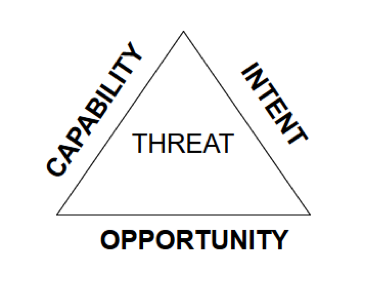
threat_triangleThere are many ways to evaluate threats, but I tend to revert to my Navy training when thinking about the cybersecurity of our customers. Our rules of engagement dictated evaluating threats from three avenues: the capability, intent and opportunity to cause harm.



Taken individually, each has seen an overall increase over the past few years. Taken together, the add up to what Europol recently characterized as the relentless growth of cybercrime.

Let’s briefly take a look at each pillar:

  • Capability of Threat Actors: As SurfWatch Labs noted in its recent report, officials have estimated that the bulk of the cybercrime-as-a-service economy may be powered by as few as 200 individuals, yet those services can put sophisticated cybercrime tools at the fingertips of a vast pool of actors. Europol agreed, writing in its report that “the boundaries between cybercriminals,  Advanced  Persistent  Threat  (APT)  style  actors  and other groups continue to blur.” Clearly the capability of threat actors continues to evolve, putting more organizations at higher risk.
  • Intent of Threat Actors: Cybercrime tends to be driven by either profit or the desire to cause harm to an organization. The growth of dark web marketplaces, the widespread adoption of successful tactics such as ransomware, and the increased focus on cybercrime by the media, government officials and regulators has widened actors’ abilities to monetize cybercrime and directly impact an organization’s brand and bottom line.
  • Opportunity for Threat Actors: A recent study found that 89 third-party vendors access a typical company’s IT system each week. In addition, the technology footprint of organizations continues to grow as more as-a-service solutions are implemented to increase productivity and more digital services are offered to customers. This provides threat actors with an expanding number of avenues that can be exploited — some of which are not directly under your control.

Despite this widely reported growth in the capability, intent and opportunity of threat actors, many individuals still feel as though they will never be targeted. A study released last month from the National Institute of Standards and Technology found that many people still hold the view that cybercrime will never happen to them and that data security is someone else’s responsibility. People feel overwhelmed by cyber threats, and as a result, they engage in risky behavior.

Simplifying Security, Control What You Can Control

The good news is that out of those three aspects used to evaluate cyber threats, organizations essentially have control over only one: opportunity. The capability and intent of threat actors are largely external to your organization; however, a real and measurable impact can be made when it comes to limiting the opportunities for cyber-attacks.

Unfortunately, many organizations have not done enough to close the opportunity window on cyber-attacks. That was a central theme of SurfWatch Labs mid-year report: despite claims of “sophisticated” attacks, the bulk of cybercrime observed has exploited well-known attack vectors. Europol’s September report also found that organizations were not helping themselves — in many cases providing ample opportunity for cybercriminals to exploit.

“A large part of the problem relates to poor digital security standards and practice by businesses and individuals,” Europol noted. “A significant proportion of cybercrime activity still involves the continuous recycling of relatively old techniques, security solutions for which are available but not widely adopted.”

This brings us back to the importance of evaluated cyber threat intelligence. Cyber threat intelligence should directly address that opportunity and provide solutions to close — or at least to severely limit — cybercriminal avenues of attack. What vulnerabilities are being actively exploited in your industry? What social engineering techniques are being leveraged in similar campaigns? How are threat actors monetizing the information and what is the potential impact if our organization faces a similar breach?

The answers to questions like these are a large part of the hard work that is the intelligence portion of cyber threat intelligence. Those answers can help to shine a light on paths that may significantly reduce your organization’s potential cyber risk.

Cyber threat intelligence, if done right, can help to limit the opportunity for threat actors to cause harm. This renders their capability less capable and their intent harder to pull off — at least against your organization.

Healthcare Databases for Sale on Dark Web, but What Else is Being Sold?

The recent theft and potential sale of various healthcare databases has once again put the sector at the forefront of cybercrime — and makes many wonder how their information is affected by criminal activity on the dark web. While healthcare-related data is not nearly as prevalent on the dark web as other sectors like financial services, SurfWatch Labs has observed a variety of items being offered up for sale in addition to this week’s headline-making healthcare databases.

As previously noted, common threat intelligence found on the dark web includes compromised credentials, stolen financial information, stolen intellectual property, threats stemming from an organization’s supply chain, and information on a wide range of hacking services and other cybercrime tools. These same categories also apply to healthcare organizations.

Over the past year SurfWatch Labs has observed direct healthcare breaches, third-party breaches that have impacted healthcare organizations’ employee accounts, fraudulent prescriptions, and other healthcare-related cyber threats.

What’s Being Sold on the Dark Web Now?

This week, several healthcare databases were put up for sale on the dark web by an actor going by the name “TheDarkOverlord” — along with a hefty price tag for that information.

On Monday, after previously posting three different databases that contain names, addresses, Social Security numbers, birth dates and some phone numbers of 655,000 individuals, the hacker told the Daily Dot that he was sitting on a “large” number of other databases. On Tuesday he followed through on that claim, adding for sale a database of 34,000 records from a New York Clinic as well as a health insurance database with 9.3 million patients, which he said was stolen using a zero-day vulnerability “within the RDP protocol that gave direct access to this sensitive information.” On Wednesday he again made headlines by naming one of the companies breached, Midwest Orthopedic Clinic in Farmington, Missouri, and said that the owner “should have just paid up to prevent this leak from happening.”

Healthcare_database2_cropped
According to the post, the 2GB file contains 9,278,352 records and is selling for 750 bitcoin (around $485,000), a far higher price than is typical for items sold via dark web markets.

A posting of more than 9 million records is on the extreme end of the price spectrum, and it could be that the actor is trying to spin up some media attention in order to better extort potential victims or drive future sales — if he is indeed sitting on many more databases to sell.

More typical of the type of healthcare-related information found for sale on the dark web is counterfeit documents and other identity information that can be used for different types of fraudulent purposes, including but not limited to medical. Although this information does not sell for hundreds of thousands of dollars and make national headlines, it is much more prevalent.

For example, fraudulent medical cards from around the world are available for approximately a few hundred dollars.

In the posting below, a vendor is selling a Quebec Medicare card template for $700. “Why is it so good?” the vendor asks rhetorically. “Because it has the latest security features, and is a valid photo ID. Most places will trust the Medicare [card] before they trust the DL [driver’s license] because almost no one makes them.”

Healthcare_Card2_cropped
The vendor is also selling driver’s license templates, but fraudulent Medicare cards are an easier option for the buyer, he wrote. With this card, all the buyer needs is a hologram overlay (which he conveniently also sells) and an embosser.

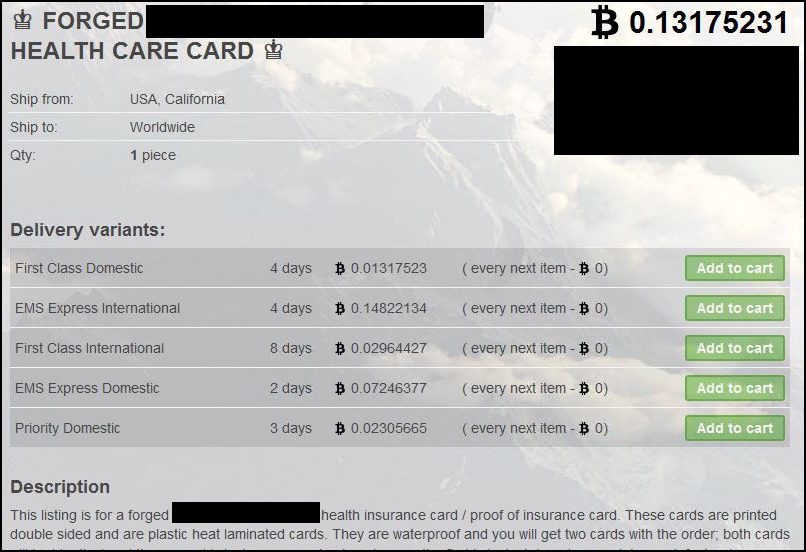
Likewise, non state-sponsored health cards are available. The listing below, from a now-defunct dark web marketplace, is selling a U.S. health insurance card for $40.

Why? “These are to provide proof that you have health insurance in the United States,” the seller wrote, adding that an insurance card like the one provided is an excellent way to round out a fake identity. “If a fake ID is questioned, this can be pulled out to back it up and eliminate any question. [It] may save you. In addition it may be used as a secondary form of ID to open up a PO box under a false identity.”

Healthcare_Card3.jpg
Insurance cards like the one for sale here have a variety of cybercriminal uses ranging from direct medical identity theft to verification purposes in order to perpetrate other forms of fraud.

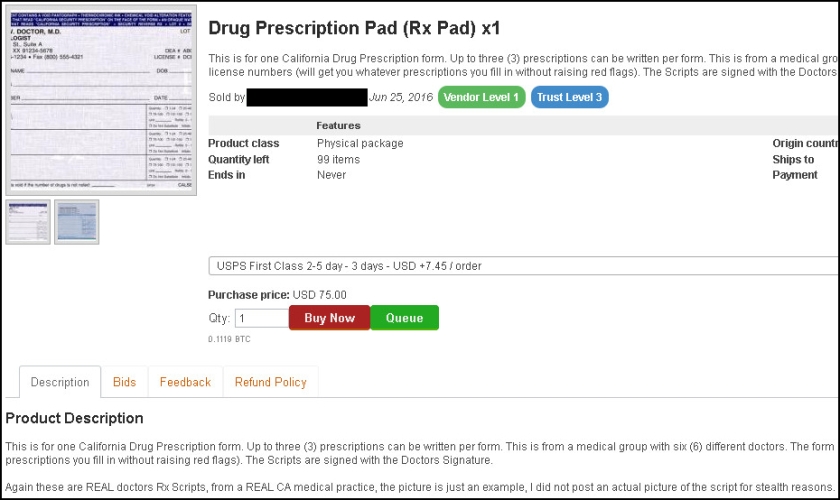
Some items for sale on the dark web leverage physicians’ identities. The posting below is from a vendor who is currently selling a signed California drug prescription form from a medical group with six different doctors. “These are REAL doctors Rx Scripts, from a REAL CA medical practice,” the vendor wrote. “These are extremely hard to come by.”

The form, which includes up to three prescriptions, is selling for $75, and the vendor will even fill out the script for an extra $100 if the buyers are unsure how to do so.

Healthcare_prescriptions_cropped
“The form contains Doctors Names, DEA numbers, and CA license numbers,” the listing reads. “These are signed prescriptions you can fill out yourself for pharmaceuticals in CA, I would like to get rid of these ASAP.”

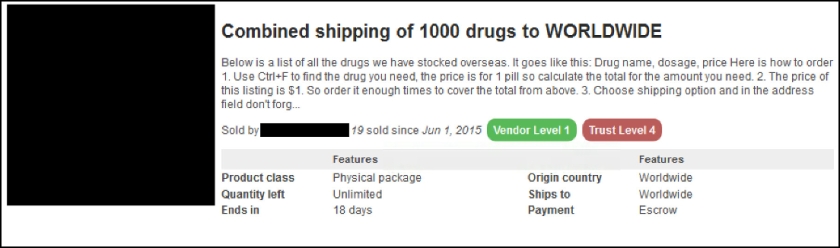
Additionally, the dark web is often associated with illegal drugs – and for good reason. Reporting on dark web markets such as Silk Road tends to focus on hard drugs; however, prescription drugs are readily available. They can be purchased from a variety of sellers on nearly every dark web marketplace.

Healthcare_drugs
This vendor is selling a wide wide range of prescription drugs in different dosages.

Utilizing Cyber Threat Intelligence

In addition to the postings from open marketplaces shown above, there is information to be gained from the private cybercriminal forums and markets on the dark web. As more researchers and law enforcement turn to the dark web for intelligence gathering purposes, cybercriminals have begun to take more precautions. Some markets require a referral to gain access. Some require a user fee. This chatter, both the public postings and more restrictive groups, can provide important insight into the most active cyber threats facing your organization.

For example, SurfWatch Labs has previously observed certain forum members requesting health insurance records from specific companies – presumably to assist in perpetrating insurance fraud as one actor was specifically looking for “high cost treatments.” Knowing which actors are targeting an organization, what those actors are looking for, and other chatter around potential cyber threats can be invaluable when it comes to planning, budgeting and implementing a company’s cyber risk management strategy.

This type of dark web threat intelligence provides direct insight into the malicious actors that target healthcare organizations, and it goes beyond the big ticket items that generate news headlines and spark a national conversation. Those stories are important, but in many ways the dark web shines a light on a cybercrime problem that is much more insidious: death by a thousand cuts.

With so many different threats out there, knowing which threats to focus on is critical. In many ways cybersecurity is simply about effective prioritization, and to that point, cyber threat intelligence and the dark web is a vital aspect.

Top 5 Items for Sale on the Dark Web, and What Businesses Can Learn From Them

In April 2016, the dark web market Nucleus went offline. Before its disappearance, Nucleus had become the number two most popular market on the dark web, hosting tens of thousands of listings for a variety of illicit goods and services. The debate continues around why Nucleus vanished; however, it was just one of the many different markets where users could go to anonymously purchase credentials to customer accounts, stolen payment card data, pirated software, counterfeit currency and goods, malware, hacking services and more.

pic 1
Screenshot of Nucleus Market before it went offline in May.

Knowing this can be quite useful to businesses and threat researchers. It can be leveraged for valuable cyber threat intelligence including the kind of data being bought and sold by cybercriminals, tools and services that are commonly used, and vulnerabilities that are being actively exploited. Most importantly, the dark web provides much needed context. But with the huge number of threats out there, some legitimate and some not, where should organizations focus their resources? Threat intelligence from the dark web can help provide businesses with that important insight. With that in mind, here are five of the most common items for sale on the dark web, and how that information can help organizations combat cybercrime, according to SurfWatch Labs data.

1.Stolen Credentials

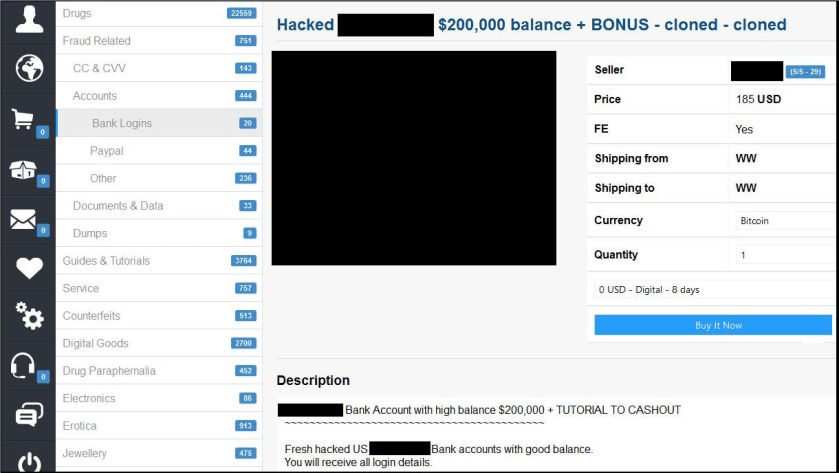
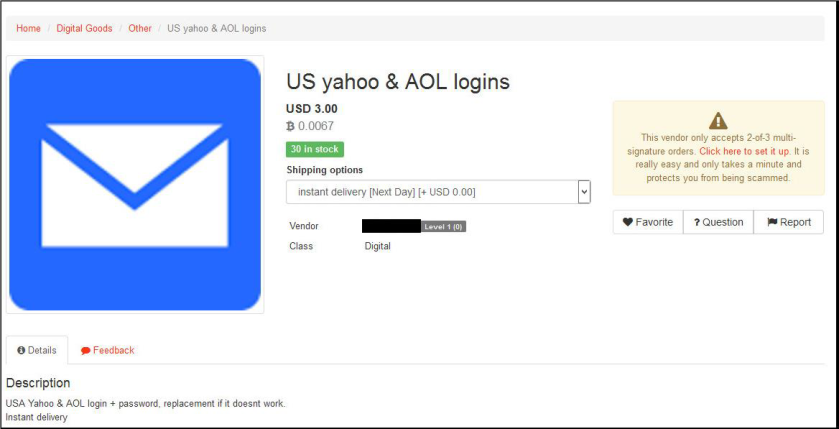
Although a wide variety of cybercrime-related items are for sale on the dark web, stolen credentials are among the most prevalent. When looking at the most popular dark web market in 2016, credentials trade accounts for nearly a quarter of the data collected by SurfWatch Labs. Cybercriminals initially get this information by using phishing messages, malicious applications, and other methods to get malware such as keyloggers installed on victims’ devices. These stolen usernames and passwords often end up for sale on the dark web where other malicious actors then use them for a variety of purposes. Although online banking accounts are a natural target, other types of credentials readily available for purchase include employee and personal email accounts, social media accounts, eBay and PayPal accounts, and other popular services such as Netflix, Uber, and more.

How this can help your organization: With the huge number of data breaches and stolen credentials out there, it is likely that some employees have had their usernames and passwords compromised, and in many instances those include work-related email addresses. Monitoring the dark web for stolen credentials related to your brand and your employees can allow you to educate users, prevent fraudulent logins and stop a future attack from spreading.


pic 2


2. Fraud and Stolen Identities

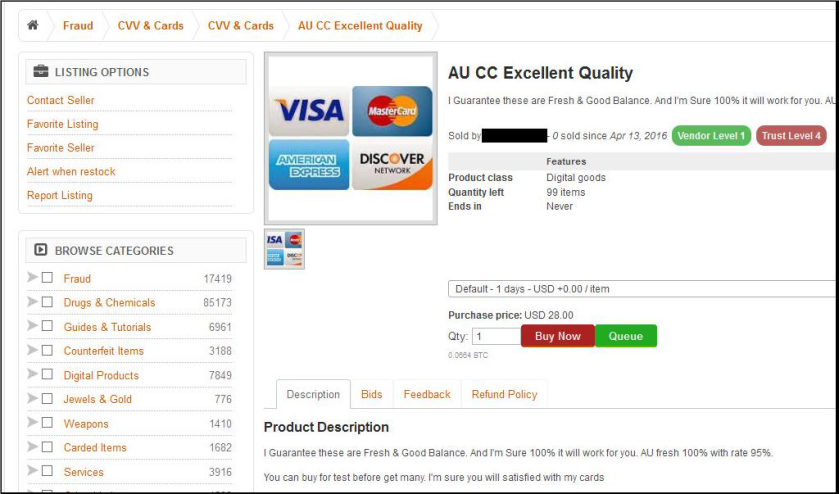
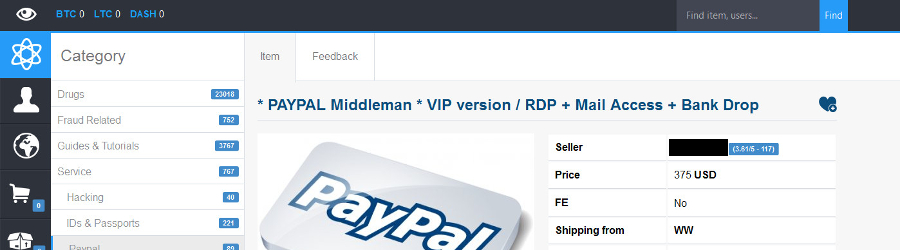
When a point-of-sale data breach occurs, that stolen payment card information often ends up for sale on various dark web markets. Cybercriminals act very quickly to monetize those accounts. The longer a stole card is on the market, the less valuable it becomes due to the likelihood of it being tied to a data breach, theft, or other fraud — and cancelled by the bank or cardholder. Other items for sale related to fraud include counterfeit documents such as passports and driver’s licenses as well as personal information needed to open lines of credit such as Social Security numbers, dates of birth and other identifiers. Like traditional crime, cybercrime is largely driven by money, and fraud and stolenidentities have traditionally been the go-to methods for turning a quick profit. However, it is not just the occasional thugs perpetrating these acts. It is often professional cybercrime rings run by gangs in other countries that have been perfecting their techniques for years.

How this can help your organization: Many point-of-sale data breaches aren’t discovered until the stolen payment card information shows up for sale or fraudulent charges begin occurring on enough cards to pinpoint a source of the compromise. By finding the stolen information sooner rather than later, retailers and financial institutions can shorten the shelf life of stolen cards and reduce potential losses.

pic 3


3. Intellectual Property

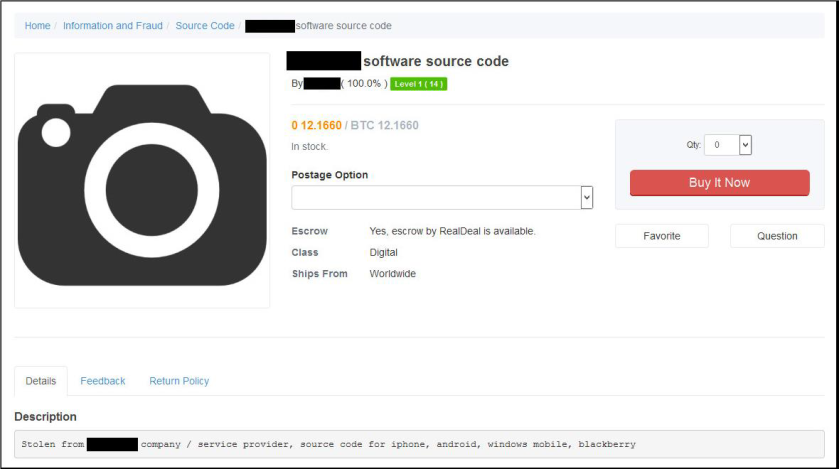
Media piracy is a popular practice on the dark web. Stolen ebooks, music, movies and other forms of entertainment are sold at a fraction of the cost — with none of the profits going to the creators. In addition to piracy, even more damaging forms of intellectual property are bought and sold on the dark web. This may include source code, stolen customer lists, trade secrets and other sensitive data stolen from organizations. A report by the Commission on the Theft of Intellectual Property stated that stolen intellectual property costs the United States as much as $300 billion each year, and the Center for Responsible Enterprise and Trade estimates trade secret theft costs between one and three percent of the GDP of advanced economies. Not all of that is sold on the dark web — much of it is nation-state espionage — however, of all the items for sale on the dark web, intellectual property tends to be the most impactful and have the most long-term consequences for organizations.

How this can help your organization: Finding intellectual property such as source code for sale on the internet is a significant cause for concern. Unlike payment card information, which can be stolen from a variety of locations, intellectual property is a likely indicator of either an intruder gaining access or an insider selling valuable information. Media piracy, which is the most common form of intellectual property for sale, can lead to a significant loss of income, particularly if that item finds it’s way onto popular torrent sites where users freely share stolen material.

pic 4


4. Supply Chain Threats

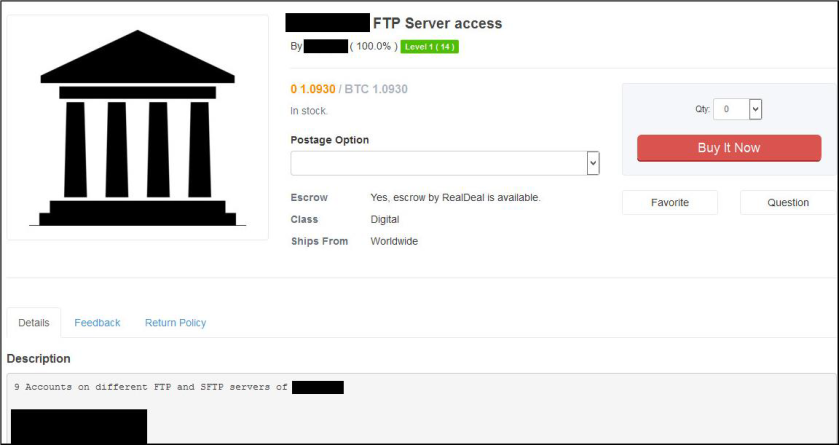
Effective threat intelligence should include all the cyber risks facing an organization, including risk faced by third-party partnes and vendors. Vendors may have their own credentials or intellectual property for sale on the dark web, or there may be relevant vulnerabilities that are being actively exploited by malicious actors. Those potential issues may move down the supply chain and impact other organizations along the way. For example, in April 2016 SurfWatch Labs threat intelligence analysts uncovered a breach into web hosting provider Invision Power Services, whose customers include professional sports leagues as well as major media and entertainment companies. A malicious actor indicated plans to infect those brands’ users with malware. Although these incidents are often not the direct fault of those companies, the fallout from customers, investors and regulators does tend to fall directly at the feet of those organizations.

How this can help your organization: Vendors and the supply chain are among the most common causes of data breaches, yet they’re often a blind spot when it comes to an organization’s cybersecurity practices. Having insight into potential issues not just within your organization, but with your partners can help to give a more complete picture of your organization’s risk and help alert you to any potential issues before they make way down the supply chain and into your business.

pic 5


5. Hacking Tools and Services

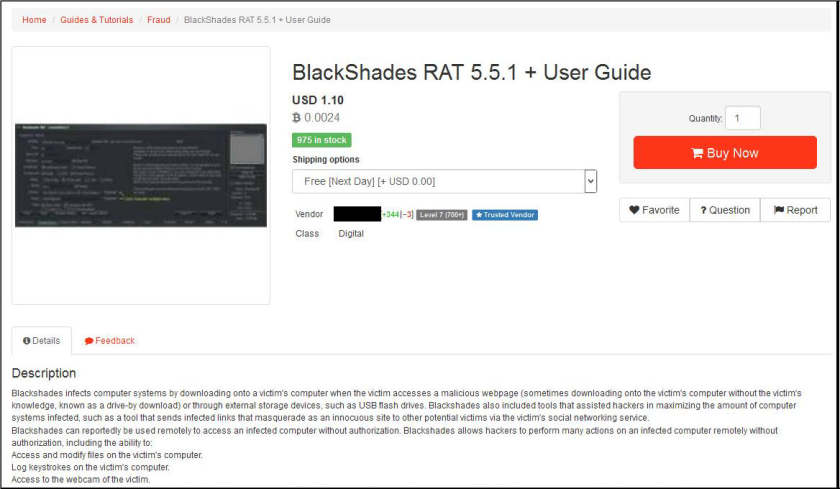
In addition to stolen items, malicious actors can purchase many different types of hacking tools and services. One popular market actually began by specializing in selling zero-days and other rare exploits. For example, one user was previously selling a new way to hack Apple iCloud accounts for $17,000. Other items for sale include exploit kits, keylogging malware, phishing pages, remote access Trojans, hacking guides and more. The cybercrime tools purchased may even come with subscription services, easy-to-use interfaces, technical support and other features often associated with legitimate software. In addition, cybercrime services are for sale including distributed denial-of-service attacks, doxing and help hacking accounts. The cybercrime-as-a-service model has segmented the market so that actors can specialize in their own field, whether that is running a botnet, creating exploit kits or stealing credentials. All types of cybercrime tools and services are available — for a price.

How this can help your organization: Knowing what tools are readily available and popular can help organizations defend against common attack methods. In addition, new exploits that are put up for sale or modifications to existing tools can provide insight into how cybercriminals are evolving their attacks in order to evade detection. This context, combined with other dark web threats, can help provide the necessary threat intelligence to help effectively guide your organization’s cyber risk management strategy.

pic 6

The Tribal CISO

Throughout my career I have been through more “Leadership” or “Managerial” training than I can remember, from the lead by example style when I was in the military to the corporate leadership (aka managerial) style that has more of a scientific approach. I have seen many styles come and go, and there are certainly no shortage of articles and trends that are published on a daily basis. Many times those of us who have been through the drill enough know what works and what doesn’t — in the words of Kenny Rogers when to hold them and when to fold them.

We tend to focus on the results we have achieved in the past with a given scenario, learning from our mistakes and ensuring we highlight successful efforts.  In my observations we tend to do the same thing when it comes to implementing various frameworks whether it’s ISO, NIST, CoBIT, FAIR, ITIL, CERT-RMM, Diamond Model or Octave. You name it there is certainly a framework for it. Some people pluck the goodness from multiple frameworks and create their own; others will kneel to the altar of the chosen framework and swear allegiance to it for all time.

Leadership and management styles or skills can be viewed in much the same manner as there is always an interesting conversation when you ask someone the difference between leadership versus management, leading versus directing, mentorship versus oversight. The most glaring difference, however, is that one styles “Leadership” as more of a social mechanism and “management” as more of tools for your toolbox.

James Altucher published an article on the 10 things he thinks you should know in order to become a great leader, and there is a section that particularly caught my eye. Specifically he states:

Below 30 people, an organization is a tribe. 70,000 years ago, if a tribe got bigger than 30 people there’s evidence it would split into two tribes. A tribe is like a family. With a family you learn personally who to trust and who not to trust. You learn to care for their individual problems. You know everything about the people in your tribe. At 30 people, a leader spends time with each person in the tribe and knows how to listen to their issues. From 30-150 people you might not know everyone. But you know OF everyone. You know you can trust Jill because Jack tells you can trust Jill and you trust Jack. After 150 people you can’t keep track of everyone. It’s impossible. But this is where humans split off from every other species.

We united with each other by telling stories. We told stories of nationalism, religion, sports, money, products, better, great, BEST! If two people believe in the same story they might be thousands of miles apart and total strangers but they still have a sense they can trust each other. A LEADER TELLS A VISIONARY STORY. We are delivering the best service because…. We are helping people in unique ways because…. We have the best designs because…. We treat people better because…. A good story, like any story ever told, starts with a problem, goes through the painful process of solving the problem, and has a solution that is better than anything ever seen before. First you listened to people, then you took care of people, but now you unite people under a vision they believe in and trust and bond with.

How does this relate to the CISO role or anything else for that matter?

In my humble opinion, this topic and where you fall in it will decide if you will build and/or operate a successful cybersecurity program. Over the years I have built and run multiple teams performing all kinds of functions and not just in the technology space, but also in the military, emergency response, heck, even running a kitchen staff when I was in high school, and — success or failure — it always felt “right.”

Here’s why. As Mr. Altucher defined so well, I have a tribal leadership style and as I think back in time as I write this I have set up my cybersecurity programs both past and present in the tribal manner, but never really defined it that way until now. In business terminology, in each instance upon walking through the door for a new organization I have always assessed the landscape of the cybersecurity products, services, programs and projects. Usually reorganizing employees and operations to be collaborative, efficient, and effective. However, in another view I was also organizing the cybersecurity program into multiple tribes.

These tribes sat together, supported one another, collaborated together, gave and received advice and supported each other’s decision. They received mentorship as well as the vision for the tribe on what mission success should look like.  I backup my tribes and they back me up, always seeking out facts and making sure everyone’s covered.

For those of you with military or police and fire types of background, you can certainly relate to what I am talking about. When you think about this concept and observe your own current corporate culture, are you tribal? Are the functional teams supporting one another, giving and receiving advice and collaborating freely? Are you backing your tribes up and are you backing them up?

If not here are some advisory tidbits I would recommend:

  1. View your leadership style through a social aspect. Treat your management style as tools for your tool box. Do not treat your tribes as tools.
  2. Do you differentiate between program and projects? Programs have outcomes and projects have outputs. I lead my tribes as a program and want a successful outcome. Therefore, my tribes don’t have milestones or deadlines; they have only mission success or not.
  3. Keep your tribes small and focused. I commonly use the term “high speed and low drag.” This supports organizational resilience. When you’re breached and need to pivot, this is the optimum way; empire building does not mean success.
  4. Do not build your tribes solely around a standard or framework. If you focus solely on industry standards or cybersecurity frameworks you will fail. Build your tribes based on outcomes and whatever means mission success in your organization. Do not try and build a tribe into columns, rows, and cells.
  5. Be willing to change. If you are in your workspace as you read this and as you survey the landscape around you it feels like a scene from the movie Office Space, you should reflect on that for a few minutes and maybe think about some ways to change it.
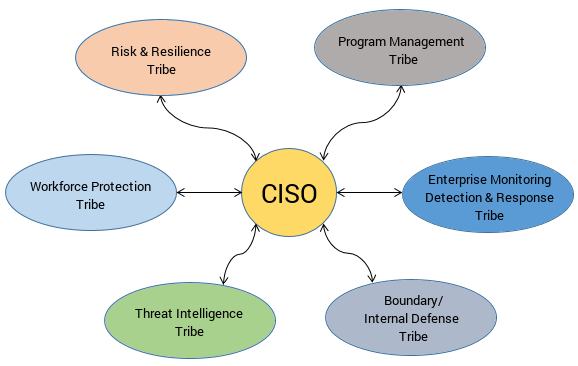
  6. Observe the below simple diagram:
    1. It is not a top down org chart; it is a tribal “system.”
    2. Each tribe would have its own products and services they would be responsible for as well as the mission goals and outcomes.
    3. From an operations standpoint you are leading an ecosystem with an environment that changes every day, hundreds of times a day. Define what “normal” looks like and observe and react when something “abnormal” occurs.

Tribal_CISO

Nucleus Market Vanishes – Now What?

Over the past year, the number two Dark Web market in terms of activity was Nucleus. As of late 2015, this market had more than 25,000 vendor listings, but on April 13 of this year, Nucleus disappeared.

While it’s not the first time Nucleus has been down and it’s not uncommon for Dark Web markets to go offline, we are now one month into this “downtime.” As recently as May 8 there are still more than 5000 Bitcoins in the Nucleus wallet (a value of more than $2.25M USD). Here are some possible explanations:

  1. Exit Scam? There is a lot of talk from Nucleus Market buyers and sellers of an “exit scam.” Exit scams occur when the marketplace vendor wants out of the game and closes up shop, but doesn’t tell users and continues to accept payments in Bitcoin. If this is case, the owner of Nucleus Market may have pulled off quite the heist. However, there is a substantial quantity of bitcoins associated with the Nucleus Market and they continue to build each day. Since the market went offline there have been no withdrawals from the Nucleus wallet; however, there has been continuous deposits. Is the owner planning to grab that money and run? Or not?
  2. Hacked? Another possibility is that Nucleus was hacked and subsequently brought down. Legit business aren’t the only ones being victimized. There is some speculation that an actor who goes by the handle “theDmaster” exacted revenge on the market after he was kicked out. If this occurred, it’s possible that a) the access to the Bitcoins has been blocked as part of the attack or b) that the owners of Nucleus are in fact trying to get the market back up and running and thus have not run off with the Bitcoins.
  3. Busted? It’s also possible the Nucleus market was busted by law enforcement and/or the site’s owners are in hiding. The alleged administrators of Nucleus recently posted a comment about Interpol seizing their servers and that they were now working with Dream Market (another dark web marketplace) but this could just as easily be a plug from  competitor Dream Market in the hopes of winning Nucleus market customers.

Investigations will of course continue into Nucleus Market but how does what we know now impact dark web trade?

Before its disappearance from the Dark Web, Nucleus market was one of the top places to go for:

  • Drugs and paraphernalia
  • Fraud related activity (such as payment card information, stolen accounts)
  • Guides & tutorials (How to card; Get rich quick schemes; Black Hat SEO; Drug manufacturing)
  • Services (such as hacking for hire, fraud related services)
  • Counterfeits (i.e. money, apparel, tickets, etc.)
  • Digital goods, media piracy
  • Electronics
  • Erotica
  • Jewelry
  • Lab supplies
  • Weapons

Nucleus vendors now need to get their wares ready for sale on other markets. There has been significant buyer and vendor chatter about moving to AlphaBay, Dream Market, Hansa, Oasis, Valhala, Acropolis and new markets such as LEO. If they do, these vendors must re-establish street cred on the markets where they set up shop. It may also take time for buyers to find their preferred vendors.

What does this mean for you?

First, recognize there is no honor among thieves. Second, and more importantly, this highlights the “intelligence challenge” of dark web surveillance as markets and vendors disappear and sometimes reappear. By tracking the commodities being sold on the black markets, organizations can gauge the underground market economy and get an idea of what commodities are being actively sold, what prices they are being sold for, and how much volume they are moving. No different than a legitimate business, you can get a sense of what commodities are the top desired items and therefore gain an understanding of what the future targets may be. Most importantly, you will know if you look similar to those targets.

When markets such as Nucleus cease operations, the actors who were operating in that area will quickly scatter to new locations and start anew. From an intelligence perspective this creates an instance where past history measurements lose some steam and causes a moment of chaos until the market places begin to settle down.

While the Nucleus Market going offline is most impactful to the users who lost their money, it does illustrate the need for continuous monitoring of the black markets to understand the potential fraud footprint and how it shifts. For organizations that have to continuously battle a large fraud footprint, it is critical to maintain situational awareness of the ebb and flow of market change.

“Actionable” Information vs. Practical Cyber Threat Intelligence

I am a practical guy. I don’t like to waste a lot of time and tend to gravitate to things that work, whether I originally thought up the idea or if someone else did. I’m of the “if it works then it works” mantra. Much of that attitude stems from joining the military and being thrust into a culture that demands outside-the-box-thinking. Assess the problem and work through scenarios, use past experience and lessons learned, use the right tool for the right job and lastly, be mission oriented.

When it comes to cyber threat intelligence (CTI), the key value can be unlocked by making it practical. What are the answers to the “so what” questions? Why would anyone want to spend budget on this? CISOs and like roles have a lot of headaches. How does this help that headache? How do I make this stuff useful to decision makers? Who are the decision makers? Why would they care?

The problem is the value from CTI is being misrepresented. What I’ve noticed is that there is an overwhelming drum beat towards tools — tools that will sprinkle pixie dust over your threats and make things “actionable.” But getting an avalanche of data is not the same as evaluated intelligence — and yet they get confused way too often.

Information is raw and unfiltered. Intelligence is organized and distilled. Intelligence is analyzed, evaluated and interpreted by experts. Information is pulled together from as many places as physically possible (creating an unnecessary and unrealistic workload for any analyst team to organize, distill, evaluate, etc.), and may be misleading or create lots of false positives. Intelligence is accurate, timely and relevant.

The reality is that “actionable” really just means a new alert/alarm/event that you now have to whack-a-mole. In some of the presentations I’ve given I’ve talked about the “actionable, actionating, actionator.” Sounds ridiculous right? That’s the point. But this is more common than it should be. And because of this teams are getting dragged away from productive efforts and into areas that are less productive.

This should not be surprising as many of the CTI vendors are tool builders, and no surprise, they push tools to solve the problem. However, here is where I will deviate, my background is that of a CISO, Program Manager, Team Builder. I am seeing a big disconnect between threats that are present in our industries and the practical application of resources — combination of people, process and technology — to reduce the likelihood of those threats from becoming a reality.

You see there’s a big difference between security tools and programs. Security tools (or feeds) are bolt-on and output-driven while security programs encompass people, process and technology … and they are OUTCOME-driven.

Threat intelligence should be outcome-driven vs. output driven. In my previous role as a CISO, I wanted and needed to know about threats that were specific to my organization. I needed to know what capability, opportunity and intent those threat actors had, along with a plan to ensure we were well-positioned before an event occurred (and in case we were not ready, that we had an effective plan in place as we moved from event to incident to breached).

So as you look at the many “threat intelligence” options out there, ask yourself this: will this intel drive the organization to make the right decisions and take the right actions?

Don’t try to bite off more than you can chew and start simple by focusing on evaluated intelligence. From there make your risks learnable by separating out random (or un-analyzed) risks from what is more likely so you can reduce your uncertainty — and then tie those learnable risks to the characteristics of your business.

WEB HOSTING PROVIDER TO MAJOR SPORTS LEAGUES, MEDIA AND ENTERTAINMENT COMPANIES BREACHED BY ALPHALEON

This real-life case study will contain some info, but not all – to protect individuals’ personally identifiable information – as well as our intelligence collection sources – with our goal of highlighting the importance of having visibility into your supply chain cyber risks. In the beginning of April 2016 SurfWatch Labs threat intelligence analysts uncovered a breach into web hosting provider Invision Power Services, whose customers include some professional sports leagues as well as major media and entertainment companies.

The actor, going by the name AlphaLeon, is associated with both the AlphaBot and Thanatos trojans – early strains of these pieces of malware appear to date back to early 2015. AlphaLeon has been known to sell access to these trojans on the dark web. While the actor has not been a seller for very long, the group’s experience and presence indicates they have been active in this space for more than five years – including multiple dark web and open web forums.

After discovering information related to the latest activity of this actor, we alerted Invision Power Services (IPS) who had not yet detected this compromise. We worked with them to validate that the actor appeared to have established a presence within the managed hosting environment that Invision Power Services operated via Amazon Web Services (AWS).

It is our understanding that IPS is still working through their own internal investigation into the incident and additional information may be uncovered, but it appears that the initial cause of the compromise was most likely the result of unpatched software. AlphaLeon indicated that this access, which affected multiple high level brands, would allow them to install Exploit Kits with the purpose of infecting users visiting these sites with their trojan. This would grow the group’s botnet further, which would in turn be sold via various underground markets. The trojan appears to be capable of:

  • Stealing banking credentials and bitcoins
  • Gaining (and selling) webcam access
  • Delivering ransomware
  • Sending spam
  • Stealing gaming credentials
  • Distributed Denial of Service

As of the date of this post it does not appear that AlphaLeon has initiated this specific campaign.

This case study highlights three primary things:

  1. This is a classic case of supply chain risk management. Invision Power Services is a supplier to some of the largest brands. These companies entrusted their web hosting provider to perform a reasonable service based on whatever contractual agreements were in place. Even if the impacted companies are not at fault, they still have their own customers and their brand and reputation to protect. If you are going to outsource a service that has cyber risk tied to it, you are outsourcing a portion of your brand and reputation in some way shape or form and you need to keep some eyeballs on that supply chain.
  2. Having a dark web intel capability is an important component of your overall cybersecurity efforts. In this situation, a bad actor was observed in a dark web forum. This source was key to gaining intel that was not available through normal open channels. The dark web is certainly not the only source you should be pulling from in your intel efforts, but it is an important area for which you should have a collection capability.
  3. The intel process works. SurfWatch Labs analysts observed discussions that concerned us, we notified the victim hosting provider, they confirmed the issue and started to react. That is what is supposed to happen.

As you outsource capabilities to other vendors, your cyber risk exposure expands. Make sure you cast a wide net in regards to your intelligence collection capabilities. It is critical to understand this and to keep a watchful eye on not only your internal environment, but that of the vendors you do business with.