Greater Interconnectivity Means a Greater Level of Presence and in Turn More Risk

Technology advances continue to push boundaries — remember when a phone was just a phone?! More “smart” devices, more interconnectivity between businesses and customers, businesses and suppliers, businesses and partners … all of this speeds transactions and the way business is conducted. Information is shared, items are purchased — all with the click of a button these days.

Inherent in all this productivity goodness is that your digital presence is expanding across many channels that are outside the traditional company boundaries. With this expanding presence comes greater risk. It’s become much harder to have visibility of the level of risk your organization faces across the many digital channels. You of course have physical risks that have been around in the past, but now can be tied into cyber activity. You have cybercriminals (and potentially other types of adversaries) looking to exploit weaknesses for financial or competitive gains.  Social media. Your supply chain. Insider risks (whether malicious or negligent). On and on …

The more connections you have, the more presence you have, the more opportunity that exists for malicious actors. This isn’t to say close your business off from the world. That’s obviously not realistic and not a good way to do business. But there two essential things you can do to minimize this issue:

  1. Get an understanding of your level of presence and the level of risk associated to different areas. Having this intel sets the stage for how to stay on top of your risk and proactively address it.
  2. Identify people, processes and technology to help continuously monitor and manage these risks — so they don’t become larger issues for your business.

Some questions to pose to your organization as a starting point:

  • Who in the organization has accountability for digital risk? Corporate security? Info security? Risk management? Legal? Compliance? Executive suite and/or board level? Brand officer?
  • What about “smart” building devices? Who owns these?
  • What about “smart” devices brought in by your employees? How are these managed? And by whom?
  • How does digital risk play into the organization’s overall risk management process?
  • What processes are in place to limit the risk?
  • What processes are in place to address a threat?

This list isn’t exhaustive, but you get the idea of how you need to think about this issue.

We recently announced a strategic partnership with PlanetRisk to deliver comprehensive cybersecurity and enterprise risk analytics and visualization for Fortune 1000 and government customers. Together we’re hosting a live webinar discussion on How to Mitigate Risk from Your Expanding Digital Presence.

I look forward to seeing you on the webinar. For more information and to sign up for the webinar, visit: http://info.surfwatchlabs.com/Webcast/How-to-Mitigate-Risk-from-Your-Expanding-Digital-Presence/05102017


Talking Strategic, Operational and Tactical Threat Intelligence

Cyber threat intelligence has become increasingly popular over the past few years. With that rise comes a variety of questions around the different types of intelligence that is available and how that intelligence can be best implemented by organizations looking to mitigate their cyber risk.

According to SurfWatch Labs chief security strategist Adam Meyer, there are three main types of threat intelligence — tactical, operational, and strategic — however, a focus has recently emerged on strategic threat intelligence.

“Strategic is where a lot of the business alignment can happen,” Meyer said this week on the Cyber Chat podcast. “You’re translating the capabilities out there, intentions out there, of adversaries — how they’re targeting things — and comparing it against you as an organization.”

That type of intelligence has proven to be a good starting point to answering a key question that organizational leaders may have: “Are we well-positioned for cyber risk or are we not? And if not, why not?”

On the Cyber Chat podcast, Meyer discusses a variety of topics related to cyber threat intelligence, including:

  • the difference between tactical, operational, and strategic threat intelligence,
  • how that intelligence can help manage an organization’s cyber risk,
  • what organizations should look for when evaluating threat intelligence,
  • and how threat intelligence will likely evolve in the coming years.

“The intent is to deliver finished and evaluated intelligence and put it on the desk of the decision maker. That helps them make better decisions,” Meyer said. “If you’re not doing that, you’re not technically in my book doing intelligence.”

Listen to the full Cyber Chat podcast below:

Cybersecurity Rant Part Deux – The Threats Aren’t As Complex As We Make Them Out to Be

Last summer, after being inundated with false claims from fellow security vendors, I let loose in a “cybersecurity rant” blog. As we approach RSA, the FUD dial is being turned up again and instead of just throwing up my hands and yelling “GREAT SCOTT!” I thought it would be healthier to air my frustrations with the goal of us focusing on what’s really important.

If you read a lot of what comes out in the news or from the cybersecurity vendor community, there is an overwhelming focus on the sophistication of threats. Having been in this space for 10+ years I’ve been guilty of playing into this FUD as well. Certainly some of this does exist, but as my colleague Adam Meyer recently wrote in a SecurityWeek article if we look at what the intel is telling us, many of the cyber threats we face are, in fact, not sophisticated at all.

Ransomware, extortion, exploit kits, data breaches, DDoS attacks and more. These are some of the hot threat trends from the past year and moving into 2017. But when looking at these threats and how many of them are actually carried out, the intel points to security basics running amok. Patching software, enforcing better credentials management, backing up important data on a regular basis, segmenting your networks so that attackers don’t have freedom of movement once they break in, etc. This is all stuff that has been talked about for years. It’s not new. And yet, the same things keep happening over and over again.

Let’s use passwords as an example. It’s always a balance of security vs. usability when it comes to passwords, but more often than not usability wins out at the risk of poor security. Many big breaches from the last year were driven by used previously stolen credentials. So if my password is Sam123 and I’ve used it across my business email, personal banking, etc. and my credentials are compromised in one place, they’re compromised in the other place as well (unless I change ’em up). Pretty basic right?

It’s human nature to look for that shiny new whiz-bang toy that does something cool as opposed to the basic toy that isn’t fancy, but just works. I’m not saying we shouldn’t worry about the more sophisticated and targeted threats, but before tackling these challenges, why do we as an industry keep overlooking fundamental basics.

Working for a company that delivers cyber threat intelligence, I’m quite fortunate because I have access to a wealth of intel and an experienced analyst team. I’m constantly learning not only about threats, but the path those threats take in order to wreak havoc. It’s what we refer to here as the adversary’s “avenue of approach.”

There are always variances in how a threat works its way into/through an organization, but the common denominator is that it always exploits the organization’s level of presence — whether through an employee who’s active on social media, poor credentials, poor patch management, a supplier with weak security practices who has access into your network, etc. etc. etc.

At the end of the day I’m just a marketer with some industry awareness and expertise, not a cyber expert. I can’t code. So while some of this to me is still complex, overall we’re not talking about sophisticated security practices … we’re talking about the fundamentals.

As a sports junkie, I’ll wrap this up with a baseball analogy …

In baseball, to win the game you must score more runs than the other team. Trying to hit home runs is one way, but the more guys you get on base, the more runs you can score. Keeping it simple and making good contact results in a greater likelihood that you will get a base hit. Do that consistently, and you’ll score plenty of runs. My point here is instead of swinging for the fences, if we focus on what’s in front of us, we’ll be in pretty good shape and change outcomes for the better.

2017 Cyber Forecast: Threat Intel Will Play Major Role in Helping Organizations Manage Risk

There are a lot of cybersecurity trends to reflect on as we kick off the new year — the growth of ransomware and extortion, the emergence IoT-powered botnets, the evolving cybercriminal landscape — but I believe the biggest risk trend to watch in 2017 may revolve around how organizations react to dealing with those new threats as their attack surface continues to expand.

The digital presence of many companies has extended on a variety of fronts, including social media, customer engagement, marketing, payment transactions, partners, suppliers and more. That increased exposure clearly has benefits for organizations. However, it also makes it difficult for organizations to track, evaluate and take action against the constant barrage of the growing threats — many of which are at least one step removed from the direct control of internal security teams.

That theme was evident in SurfWatch Labs’ new report, Rise of IoT Botnets Showcases Cybercriminals’ Ability to Find New Avenues of Attack. Our threat intelligence analysts have observed and evaluated data connected to hundreds of incidents that emanated from outside of organizations’ walls over the past year, including:

  • accidental exposure of sensitive data by third-party vendors
  • shoddy cybersecurity practices causing breaches at vendors that house organizations’ data
  • vulnerabilities in software libraries or other business tools being exploited to gain access to an organization
  • vendor access being compromised to steal sensitive data
  • credentials exposed in third-party breaches causing new data breaches due to password reuse

It’s clear that organizations are struggling with these expanding threats. Not only are organizations at risk from threats trying to break down their front door, those threats are increasingly coming through side doors, back doors, windows — any opening that provides the path of least resistance. For example, a 2016 survey of more than 600 decision makers found that an average of 89 vendors accessed a company’s network each week and that more than three-quarters of the respondents believed their company will experience a serious information breach within the next two years due to those third parties.

SurfWatch Labs’ annual cyber threat report echoed that concern, finding that the percentage of targets publicly associated with third-party cybercrime nearly doubled from the second half of 2015 to the second half of 2016.

“Cybercrime is increasingly interconnected, and issues at one organization quickly moved through the supply chain to impact connected organizations in 2016,” the report noted. “That interconnectedness is evident in the growing pool of already compromised information being leveraged by threat actors, the expanding number of compromised devices and avenues to exploit compromised data, and the way in which data breaches and discovered vulnerabilities ripple outwards – sometimes several layers deep through multiple vendors – to touch unexpecting organizations.”

That interconnectedness is pushing organizations to try to gain more context around the growing number of threats so they can better prioritize actions. As I wrote in a previous blog, organizations are spending more money than ever around cybersecurity, yet they are not necessarily becoming more secure.

Cyber threat intelligence can help to peel back that layer of uncertainty and guide those tough cybersecurity decisions by answering questions such as:

  • What is the biggest cyber threat facing my organization and what steps can be taken to mitigate that risk?
  • Which threats are active within my industry and impacting similar organizations?
  • Have any vendors or suppliers suffered a data breach that may impact my organization in the future?
  • Is any information related to my organization being sold on the dark web?
  • Is my organization at risk from employee credentials exposed via third-party breaches?
  • What new and old vulnerabilities are currently being exploited by threat actors?
  • And other questions unique to your organization …

That context is what many decision makers say is lacking within their own organizations. Going back to that 2016 survey of key decision makers — more than half of them believed that threats around vendor access were not taken seriously and almost three quarters believed that the process of selecting a third-party vendor may overlook key risks.

A smart and thoughtful approach to cybersecurity that provides the necessary context can help to both shine a light on those new risks and filter out the excess chatter so your organization can focus on practical and relevant solutions that have an immediate impact on your cyber risk.

Cyber threat intelligence came a long way in 2016, but many organizations remain overwhelmed by the number of cyber threats and are continuing to experience data breaches. Expect the use of relevant and practical cyber threat intelligence to see continued growth in 2017 as organizations more to address their blind spots and more effectively manage their cyber risk.

2017 Cyber Forecast: The IoT Problem is Going to Get Worse

The new year is underway, and one of the biggest causes of concern carrying over into 2017 is the threat posed by the growing number of compromised Internet-of-Things (IoT) devices. As I stated in my previous cyber forecast blog on extortion, I prefer to base my “predictions” around actual intelligence and verifiable data. IoT-related security threats have been talked about for the past few years, but they have been relegated to the periphery of the cybercrime conversation due to the fact there wasn’t much threat data around real-world attacks. However, the second half of 2016 saw those concerns move front-and-center due to a series of incidents tied to the Mirai botnet:

  • In September, both KrebsOnSecurity and French hosting provider OVH were hit with massive DDoS attacks, reportedly hitting 620 Gbps attack and 1 Tbps in size.
  • Those attacks were quickly tied the Mirai botnet, the source code of which was subsequently released by a user on Hackforums.
  • A few weeks after the source code went public, DNS provider Dyn was hit with what appears to have been an even larger DDoS attack – causing major sites such as Twitter, Netflix, Reddit, Spotify and others to be disrupted across the U.S. and Europe.

Those attacks will certainly lead to increased scrutiny within the IoT marketplace both now and in the future, but in the meantime cybercriminals are focusing their attention on finding new ways to leverage the numerous vulnerable IoT devices for their own malicious purposes. The past few months have seen various hacking groups fighting to take control over their share of those compromised devices, as well as companies such as Deutsche Telekom and others suffering outages as those groups tried to expand their botnets by attempting to infect customers’ routers with Mirai. One group has even been observed selling IoT-powered DDoS services that claim to provide as much as 700 Gbps in traffic.

All of that activity has led to one of the clearest trends in SurfWatch Labs’ data over the past few months: an enormous rise in threat intelligence surrounding the “service interruption” category.

serviceinterruption_cfs
This chart from SurfWatch Labs’ 2016 Cyber Threat Trends Report shows a sharp increase in the amount of threat intelligence related to the service interruption category in Q4 2016.

“Over the past two years, the ‘service interruption’ tag has typically appeared in approximately 16% of the negative CyberFacts collected by SurfWatch Labs,” SurfWatch Labs noted in its annual cyber trends report, Rise of IoT Botnets Showcases Cybercriminals’ Ability to Find New Avenues of Attack. “However, that number jumped to more than 42% over the last half of the year due to growing concern around IoT-powered botnets such as Mirai.”

The problem of botnets powered by compromised IoT devices goes beyond just service interruption. It reflects many of the larger cybersecurity issues facing organizations in 2017:

  • an expanding number of vulnerable devices
  • the problem of default or easy-to-guess credentials
  • the difficulty of identifying vulnerabilities and patching them in a timely manner
  • questions of who along the supply chain is responsible for security
  • and issues outside your organization’s direct control that impact your cyber risk

Compromised IoT devices are a perfect example of the interconnectedness of cybercrime and how the poor security of one component by one manufacturer can led to hundreds of thousands of devices being vulnerable.

The sudden surge in concern around IoT devices reminds me of similar cyber risk discussions that have occurred around ICS/SCADA over the last few years. In both cases, the devices were often designed without cybersecurity in mind and those cybersecurity implications are now leading to serious potential consequences. However, unlike ICS/SCADA devices, IoT devices are primarily consumer focused. As we noted in the 2016 Cyber Trends Report, the potential of having multiple devices per household for any developed nation means that collectively these vulnerable devices are the largest digital footprint in the world not under proper security management.

DDoS attacks have always been a staple of cybercrime, but the expanding number of potentially compromised devices, along with cybercriminal tools designed to easily exploit those devices, has created growing concern around the tactic. Due to these concerns, I forecast with moderate confidence that IoT-driven botnets will affect a greater number organizations in 2017 as suppliers, manufacturers, regulators and the security community all continue to wrestle with this ongoing issue.

Cybersecurity Budgets: Does More Money Equal More Secure?

I’ve read report after report showing that security budgets were increasing, yet the number of breaches at companies of all sizes also continues to climb. This leads me to believe that somewhere there is a breakdown in how cybersecurity programs are being run — where allocating more spend and focus on cybersecurity oftentimes does NOT actually produce better outcomes.

There is an abundance of information out there that backs this up — this isn’t just me pontificating. Here are some highlights:

On security budgets increasing:

On cybersecurity issues increasing:

I think this can all be summed up best in a report by Morgan Stanley from this summer called Cyber Security: Time for a Paradigm Shift, where they stated:

“Companies are spending more to safeguard their digital assets, but cybercrimes are still growing in frequency and severity. What’s needed now isn’t more security, but better security.”

Now to be clear, this is not meant to serve as a doom and gloom piece. Certainly, there are pockets of goodness here and there and a lot of people are working hard on many good efforts, but holistically, the state of cyber security still has a long road ahead of it. And the question becomes how can we ensure that as we spend more effort and budget on cybersecurity, that we are at the very least impacting the cybersecurity outcome in a similar level of uptick?

I recognize that my own observation is just my perception, which is based on what I personally read and do each day. As such I wanted to get some additional input from my peers, so I did some crowdsourcing through LinkedIn:

We all see the news reports regarding how security budgets are increasing each year but yet for some reason nothing ever seems to get better. Why is that? I have my own specific thoughts on the question but wanted to share and see if anyone had an answer of their own.”

A wide range of opinions followed as to why cybersecurity continues to be a challenge and where we as a community need to focus our efforts.  The responses (summarized and paraphrased) to date have been interesting to say the least:

  • A handful of opinions appeared to point some attribution to cybersecurity vendors. My interpretation of those comments is that the vendor-driven FUD has generated a sense of urgency for organizations to purchase specific solutions and therefore fatten the vendor pockets — or at a minimum create a very complex marketplace which presents a challenge to those trying to navigate it.
  • Several opinions revolved around the idea that although budgets have risen, the volume and sophistication of threats are either out-pacing or out-maneuvering those security professionals who are trying bring more resources to bear.  
  • A handful of opinions appeared to state that security departments are underfunded and have an uphill battle for additional resources as security is generally viewed as a cost center as opposed to a revenue generator. Additionally, one individual stated that a potential area to look at is what budget is being used to cover past investments, therefore allowing fewer resources to be applied to emerging risks and in turn giving the appearance or possibility of a gap.
  • Poor leadership was mentioned several times, with comments stating that there are those that promote waste and will buy any new flashy thing that hits the street and that ensures that investments are not as strategic as touted to be.
  • I also had a few individuals who seem to disagree with the question and stated I was irresponsible or I was performing a disservice for even asking such a thing.  

The crux of all the input, with the exception of few outliers, revolves around a more simplified question of are we allocating “resources” to all the proper areas? Well, I think the answer to this really depends on your reality, which is ultimately your perception based on your experiences.

Everything you see or hear or experience in any way at all is specific to you. You create a universe by perceiving it, so everything in the universe you perceive is specific to you.” – Douglas Adams

I raise the perception/reality point to highlight that the responses to my Linkedin question are based on individuals’ experiences. Some folks have worked for or alongside poor leaders, have had poor experiences with vendors, or have had to do the budget defense drills. Some apparently don’t even see an issue and took offense to the question. These perceptions are also what drive a lot of these research reports that I listed above. Many of these are survey-based and while the survey structure and questions I am sure follow best practices for research processes, these surveys are being answered by people whose perceptions are their own reality.

My perception is based on my current role as head of the SurfWatch threat analyst team and from my previous role as CISO for a major transportation authority as well as a similar position for a DoD entity, where I tried to take an outcome-based model as much as reason dictates. Outcomes can be measured, they can be defended, and they can give you insight. Theoretically, if I apply more resources to a given defined problem the outcomes should change in some manner either good or bad. If the outcome does not change after putting more focus on that area, then I am going to start questioning a few things:

  1. Was the problem defined correctly?
  2. Was the problem measured correctly?
  3. Were the resources applied correctly?

Following these three key questions are a few more that hopefully prompt you to think about changing your perception/reality:

Problem Definition: The Art of The Plausible

  1. Do you use some type of analytical process to identify threats to your organization? And I don’t mean you base it off of news chatter, I mean you use a defined set of analytic inputs and analysis to determine what is true and what is not.
  2. If you have, have you analyzed what an actor’s capabilities and intentions are?
  3. If you do know what their capabilities and intentions are, have analyzed their tactics, techniques and procedures?

Problem Measurement: The Art of The Possible

  1. Have you observed using both internal and external data collection efforts any indications of previously defined threats or new undefined threats?
  2. What is your false positive rate for observing defined and undefined threats? Meaning you detected a threat, but investigation determined the threat to be untrue.
  3. What is your false negative rate? Meaning you did not detect a threat and post incident analysis determined the threat to be true.

Resources Applied To The Problem: The Art of Reality

  1. If you lead a cyber program, do you have a list of defined products and services that you deliver to the organization?
  2. Do you know what the exact budget allocation for labor and material is for every single one of those products and services?
  3. Have you defined policy, process and procedures for each one of those products and services?
  4. Can you identify what products and services specifically are applied to a defined threat?

The bottom line here is I believe that security spend is increasing and that many people and organizations are working hard and doing good things. But I also believe that we do not use intelligence enough to help define the problem area. If we can measure the problem, we know what resource to apply to it to change an outcome for the better. Instead, generally speaking we as a community deploy capabilities based on what we perceive to be the problem and hope that the outcome does not change for the worse.

As a former CISO, I have personally used intelligence-driven, analytical processes to identify what is true and then apply resources to address the “known knowns.” It takes diligence and determination, but by leveraging intel to drive our cybersecurity strategy, we can start to see a light at the end of what can be a long, dark tunnel.

2017 Cyber Forecast: Blackmail Using Media and Sensitive Data Will Grow

The end of the year is drawing nearer, and with that comes a handful of traditions: family gatherings, eggnog by the fire, and everyone’s annual list of cybersecurity “predictions.” While it’s a bit semantic, I’m personally not a big fan of the term “predictions.” As someone who lives in the intel world, it’s more about looking at the data and making forecasts using probabilities. In all of the cyber threat intelligence that we provide our customers, we include a confidence level based on what we’re seeing and the probability of that threat impacting a specific customer.

I start out with the above just to level set the rest of this blog (and the next several blogs around 2017 cyber forecasts). When it comes to identifying trends and making a forecast on probability of what threats make waves in 2017, based on the success of ransomware attacks I have moderate confidence that we will see growth of more traditional extortion-related cybercrime.

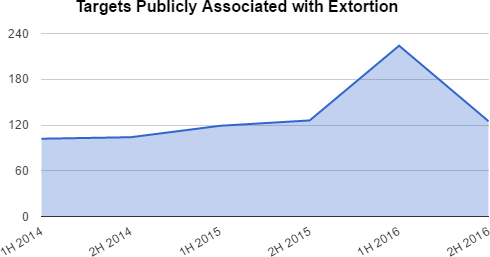
SurfWatch Labs has seen a steady growth in the number of targets publicly associated with extortion, blackmail and ransoms over the past few years, and we expect that number to rise even higher in the coming year.

2016-12-08_extortion
Extortion-related crimes are on the rise (note: 2H 2016 data includes intelligence collected through December 7).

One of the best and most recent examples of malicious actors using extortion is the hacking group known as TheDarkOverlord, which has breached, attempted to extort and then publicly shamed a variety of organizations over the second half of 2016.

The latest incident is the November breach of Gorilla Glue. TheDarkOverlord claimed to have stolen more than 500 GB of data, including research and development material, intellectual property, invoices and more. The group then offered Gorilla glue its signature “business proposition.” As we wrote in a SurfWatch Labs blog earlier this year, the proposition is simple: pay the blackmail or face further data leaks and public shaming. After what TheDarkOverlord described as “a moderate dispute” with Gorilla Glue over payment — we’re guessing Gorilla Glue refused to pay — TheDarkOverlord shared a 200 MB cache of files with the media to help spread the story.

The evolving use of the media is actually one of the more interesting tactics used by TheDarkOverlord and other successful extortion groups this past year. Extortionists have referenced news coverage in their demands, prompted users to research past victims, and impersonated cybercriminals with established media coverage — all in an effort to lend credibility to their threats.

For example, back in April CloudFlare reported that a group using the “Armada Collective” name was blackmailing businesses with an extortion email that read, in part:

We are Armada Collective.

http://lmgtfy.com/?q=Armada+Collective

Your network will be DDoS-ed starting [date] if you don’t pay protection fee – 10 Bitcoins @ [Bitcoin Address].

If you don’t pay by [date], attack will start, yours service going down permanently price to stop will increase to 20 BTC and will go up 10 BTC for every day of attack.

This is not a joke.

The link in the email led to a Google search of the group, allowing victims to quickly see that some security researchers had described Armada Collective as a “credible threat.” Except the attackers were not part the original Armada Collective. They were copycats simply exploiting the original group’s already established name. As CloudFlare later discovered, there was not “a single incident where the current incarnation of the Armada Collective has actually launched a DDoS attack.” Despite the lack of follow through, the group managed to extort hundreds of thousands of dollars from the victims.

Leveraging the media in that manner is something the SurfWatch analyst team has observed more frequently over the past year. However, news outlets and victims are starting to become more skeptical of claims. That’s one of the reasons threat actors such as TheDarkOverlord have evolved their tactics to establish a more direct and somewhat dysfunctional “relationship” with the media. Bloggers and news outlets get access to a direct source of stolen data that can help help generate headlines. Extortion groups receive the platform necessary to incite worry in the partners and consumers of the victim organization, adding pressure to pay extortion demands.

With cybercrime events seeing more mainstream coverage each year and extortion proven to be a successful, low-effort tactic, expect that dysfunctional relationship to continue to develop in the coming year. Extortion has proven particularly useful when it comes to the theft of sensitive customer data as it provides multiple additional ways for a threat actor to monetize information. If the victim organization doesn’t provide immediate compensation via an extortion payment, individual customers may then become targets of blackmail — sometimes years into the future.

Adultery site Ashley Madison announced its data breach in the summer of 2015, but individuals exposed in that breach were still being sent blackmail letters and emails nearly a year later. Some victims reported that when they didn’t pay, the blackmailers then followed through on their threats by sending letters about the individuals’ alleged infidelity to family, friends, and workplaces.

More recently, hackers stole customer information from Valartis Bank Liechtenstein and were reportedly threatening individual customers — including politicians, actors and high net worth individuals — that their personal information will be leaked if they do not pay 10 percent of their account balances in ransom.

These extortion and blackmail attempts are not nearly as prevalent as ransomware, but they follow the same principle of quick and easy monetization via the victims themselves. The past year has proven that the media can be successfully used as a tactic to better extort both organizations and individuals, particularly when it comes to sensitive information that may lead to brand damage or embarrassment. That trend will likely grow in 2017 as threat actors look to take advantage of every avenue when attempting to monetize future data breaches.

Controlling What You Can Control: Using the Threat Triangle to Gain Focus

With cyber-attacks on the rise and organizations looking for more effective ways to fend off malicious actors, cyber threat intelligence has emerged as a buzzword in cybersecurity. Unfortunately, some of the information being marketed as cyber threat intelligence isn’t backed up by much actual intelligence; rather, it’s just another threat feed to be added to the already large pile of data that needs to be evaluated.

Part of the problem with good threat intelligence, I recently wrote, is that it’s time consuming. Effective cyber threat intelligence shouldn’t just add to the ever-growing list of concerns facing your organization, it should provide actionable insight into how to best focus security resources to achieve solutions. Evaluating those specific threats, determining their relevance and coming up with practical solutions unique to your organization is hard work.

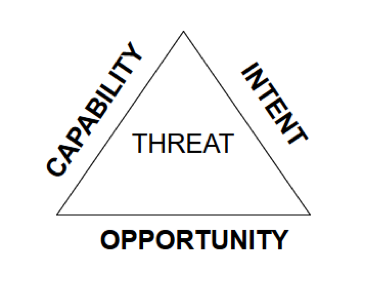
threat_triangleThere are many ways to evaluate threats, but I tend to revert to my Navy training when thinking about the cybersecurity of our customers. Our rules of engagement dictated evaluating threats from three avenues: the capability, intent and opportunity to cause harm.

Taken individually, each has seen an overall increase over the past few years. Taken together, the add up to what Europol recently characterized as the relentless growth of cybercrime.

Let’s briefly take a look at each pillar:

  • Capability of Threat Actors: As SurfWatch Labs noted in its recent report, officials have estimated that the bulk of the cybercrime-as-a-service economy may be powered by as few as 200 individuals, yet those services can put sophisticated cybercrime tools at the fingertips of a vast pool of actors. Europol agreed, writing in its report that “the boundaries between cybercriminals,  Advanced  Persistent  Threat  (APT)  style  actors  and other groups continue to blur.” Clearly the capability of threat actors continues to evolve, putting more organizations at higher risk.
  • Intent of Threat Actors: Cybercrime tends to be driven by either profit or the desire to cause harm to an organization. The growth of dark web marketplaces, the widespread adoption of successful tactics such as ransomware, and the increased focus on cybercrime by the media, government officials and regulators has widened actors’ abilities to monetize cybercrime and directly impact an organization’s brand and bottom line.
  • Opportunity for Threat Actors: A recent study found that 89 third-party vendors access a typical company’s IT system each week. In addition, the technology footprint of organizations continues to grow as more as-a-service solutions are implemented to increase productivity and more digital services are offered to customers. This provides threat actors with an expanding number of avenues that can be exploited — some of which are not directly under your control.

Despite this widely reported growth in the capability, intent and opportunity of threat actors, many individuals still feel as though they will never be targeted. A study released last month from the National Institute of Standards and Technology found that many people still hold the view that cybercrime will never happen to them and that data security is someone else’s responsibility. People feel overwhelmed by cyber threats, and as a result, they engage in risky behavior.

Simplifying Security, Control What You Can Control

The good news is that out of those three aspects used to evaluate cyber threats, organizations essentially have control over only one: opportunity. The capability and intent of threat actors are largely external to your organization; however, a real and measurable impact can be made when it comes to limiting the opportunities for cyber-attacks.

Unfortunately, many organizations have not done enough to close the opportunity window on cyber-attacks. That was a central theme of SurfWatch Labs mid-year report: despite claims of “sophisticated” attacks, the bulk of cybercrime observed has exploited well-known attack vectors. Europol’s September report also found that organizations were not helping themselves — in many cases providing ample opportunity for cybercriminals to exploit.

“A large part of the problem relates to poor digital security standards and practice by businesses and individuals,” Europol noted. “A significant proportion of cybercrime activity still involves the continuous recycling of relatively old techniques, security solutions for which are available but not widely adopted.”

This brings us back to the importance of evaluated cyber threat intelligence. Cyber threat intelligence should directly address that opportunity and provide solutions to close — or at least to severely limit — cybercriminal avenues of attack. What vulnerabilities are being actively exploited in your industry? What social engineering techniques are being leveraged in similar campaigns? How are threat actors monetizing the information and what is the potential impact if our organization faces a similar breach?

The answers to questions like these are a large part of the hard work that is the intelligence portion of cyber threat intelligence. Those answers can help to shine a light on paths that may significantly reduce your organization’s potential cyber risk.

Cyber threat intelligence, if done right, can help to limit the opportunity for threat actors to cause harm. This renders their capability less capable and their intent harder to pull off — at least against your organization.

Closing the C-Suite Knowledge Gap with Cyber Threat Intelligence

I spend my work days digging through SurfWatch Labs’ cybercrime data and writing blogs and reports on the latest cyber threat intelligence trends, so it should come as no surprise that among my friends and family, I’ve become the “cybersecurity guy.”

In fact, many of those same people in my personal life would be happy to shove everything “cyber” in a box and put it far out of sight to never deal with again. Because of this, I’m not shocked when I read the latest studies about those in the C-suite having that same attitude — such as 90 percent of corporate executives saying they cannot read a cybersecurity report.

I have a confession to make myself: I’m not much of a technical IT guy either.

I view myself as more of a business analyst, and through that lens, the separation of cyber risk and business risk doesn’t make much sense. My sister getting Craigslist messages trying to dupe her out of money is no different than the scammers on the street pitching their elaborate stories in person. Likewise, a competitor stealing employee credentials in order to access valuable intellectual property isn’t much different than the paper-driven corporate espionage that existed before the Internet.

It’s the same risk, just in a different medium. If anything, the main difference is in volume. Actors halfway across the globe can target your organization, and expanding digital supply chains means there is a growing number of attack vectors and an ever-changing list of exploits that can be used to steal that information.

You may not be an expert on a specific threat or a risk out of the box, but that’s where cyber threat intelligence can help. With the right intelligence you can make more informed decisions that can dramatically improve your cybersecurity and resiliency.

screenshot-1474406400130
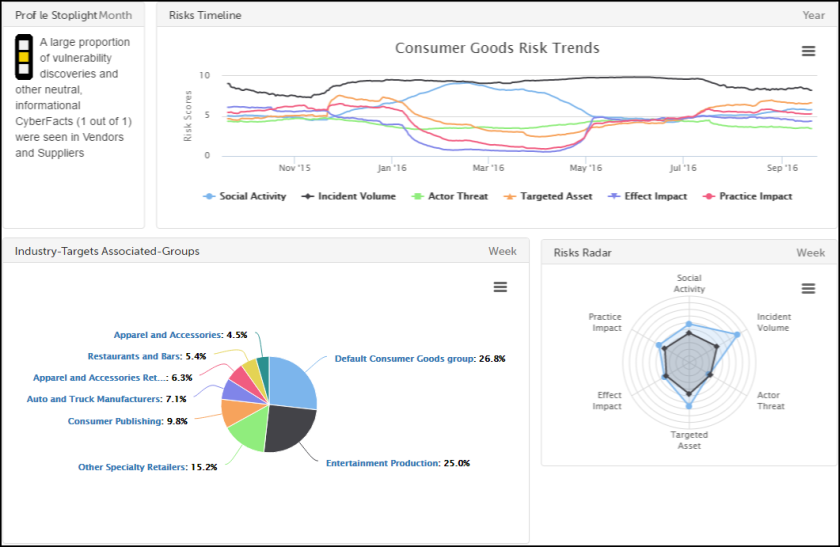
Dashboard of Consumer Goods risk from SurfWatch Threat Analyst

I’m reminded of a famous quote attributed to Socrates: “The only true wisdom is in knowing you know nothing.” Cyber threat intelligence is the wisdom that although individually we may know nothing, collectively we have great knowledge that can be leveraged.

Much has been written about cybercrime-as-a-service model and the way that malicious actors leverage past successes and individual expertise to create more effective tools and tactics. Cyber threat intelligence is about having that same effective and coordinated approach to risk management that the bad actors have when it comes to trying to exploit cyber risk.

The cybersecurity conversation has come a long way over the past few years, but what’s still missing from many organizations is that coordinated approach to cybersecurity — one that begins at the board of directors and goes down to the newest employee. As we previously noted, a proactive strategy backed by an engaged C-suite and board of directors has been shown to reduce the growth of cyber-attacks and data breaches.

It’s easy to berate the clueless executive, but I try to imagine them with the same level of knowledge that I once had — before I first picked up the phone, began interviewing cybersecurity experts, and had all of this cyber threat data at my fingertips.

We don’t all have to be experts. There are plenty of experts out there already. What those organizations need is a way to harness that collective knowledge, to compare that external data against their own internal intelligence, and to have that cyber threat information presented in an ongoing, easy-to-understand manner.

When customers ask our analysts about new threats or use our threat intelligence to improve their organization’s cybersecurity, we’re all working together to better defend against malicious actors by focusing resources on the threats that directly impact each organization. That collaboration and sharing of knowledge is what cyber threat intelligence is all about.

Does Your Cyber Threat Intelligence Tell a Story?

I began at SurfWatch Labs several years ago with one primary directive: be a story teller. Cybercrime impacts everyone, I was told, yet many business owners, executives and employees know next to nothing about cybersecurity. 

For the most part those people were either unaware, assumed their business would never be a targeted by hackers, or put the onus on the tech guys to handle those threats. Those who did take cybersecurity seriously and wanted to learn — well, without a technical background cyber-related writing has a tendency to induce a mini-coma within the first three paragraphs.

Essentially, there was large disconnect between the numerous cyber-attacks and data breaches and everyone who was being impacted by those incidents. That gap has closed quite a bit the last few years, but a gap still remains. Unlike regular crime, which tends to evoke much a more visceral reaction, cybercrime and the reporting on it often feels one step removed from our daily lives. Even as we currently find ourselves speculating how cyber-issues could help decide a presidential election, people are still surprised when they become the target of a cyber-attack.  

Take Patrick Feng, an adjunct assistant professor who studies technology and sustainability policy at the University of Calgary in Canada. As Scientific American reported, on May 28 a ransomware attack left many of the university’s researches locked out of their own data and email, leading the university to make a ransom payment of $15,500 to ensure nothing was lost.

“Even though I teach technology policy, and am aware of these kinds of issues, I still thought it was never going to happen to me,” Feng said.

Yes, presidential candidates are targeted, but little ol’ me? C’mon.

That disconnect is why I wrote back in 2014 that the story of celebrity nude photos being stolen may have been the most important cybercrime event of that year:

For most of us, we are not celebrities, and it does not affect us. But when I read that story, or stories like that of [Miss Teen USA] Cassidy Wolf, who described her reaction to being sextorted by a similar creep – “I literally threw my phone across the room and started screaming. It did not feel real, it was like a horror movie.” – it stays with me in a way that a hundred stories of credit cards being stolen from Home Depot will never do.

We need stories to help spur action across all aspects of our lives, including cybersecurity. In a sense, that is what effective cyber threat intelligence is all about. Our goal here at SurfWatch Labs is to tell those stories, to help connect those dots so that everyone from the newly hired employee to the board of directors can understand the risks posed to them both individually and to their organization as a whole.

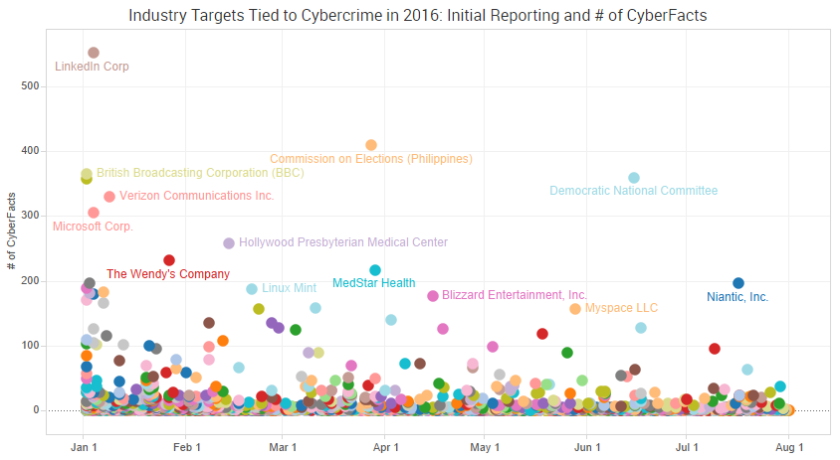
It’s also why charts like this are among my favorite ways to look at SurfWatch Labs’ cyber threat intelligence data — not because it’s a useful chart in any practical sense, but because of the way it highlights this year’s cybercrime events and shows the stories that collectively we are, and aren’t, paying attention to.

2016-08-05_firstseen.png
This chart shows the more than 1,000 industry targets SurfWatch Labs has collected data on this year (not including dark web data), as well as the date they first appeared in our data and how many CyberFacts we have collected pertaining to each organization.

In the cybersecurity space, we tend to define time by the major breaches — Target, Home Depot, Sony Pictures, Anthem, the U.S. Office of Personnel Management, Ashley Madison, LinkedIn, the Democratic National Committee — but doing so can negate the real story. As we noted in our recent cyber trends report, most attacks are not sophisticated. They are not high-profile incidents that garner national headlines. Rather, they are a steady wave of relatively simple and often automated attacks that continues to wash over those without proper awareness or understanding of their cyber risk.

Only a tiny fraction of cybercrime events cross over that gap and become part of the public consciousness. For the many more organizations that remain under the radar, cybercrime still has significant real-world consequences  — as well as for the employees, executives, shareholders and boards of directors that are tied to those various data breaches, denial-of-service attacks, extortion attempts, account takeovers, cyber-espionage, insider threats and other forms of cybercrime.

With cyber threat intelligence becoming one of the latest cybersecurity buzzwords, people are often trying to define what it is. What’s the proper balance between raw data and human analysis? Who is the target audience? How does that intelligence translate into specific action? In simpler terms, it is just telling the story of your organization’s cyber risk — with proper context and in a way that everyone can understand and take action on.

To continue to close that cybersecurity gap we need more training and more technological innovations and more smart leaders, but we also need to connect all of that together and drive progress forward somehow. That’s what cyber threat intelligence, and the stories it can tell, is all about.