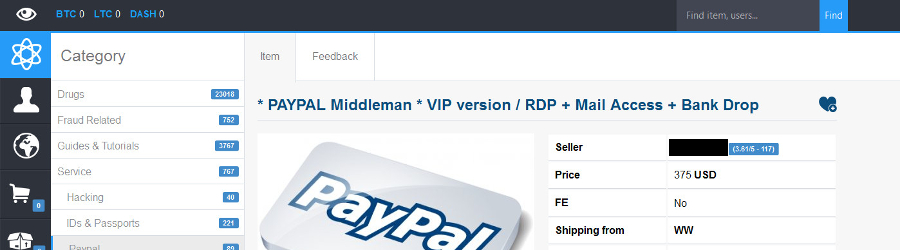
Nucleus Market Vanishes – Now What?

Over the past year, the number two Dark Web market in terms of activity was Nucleus. As of late 2015, this market had more than 25,000 vendor listings, but on April 13 of this year, Nucleus disappeared.

While it’s not the first time Nucleus has been down and it’s not uncommon for Dark Web markets to go offline, we are now one month into this “downtime.” As recently as May 8 there are still more than 5000 Bitcoins in the Nucleus wallet (a value of more than $2.25M USD). Here are some possible explanations:

  1. Exit Scam? There is a lot of talk from Nucleus Market buyers and sellers of an “exit scam.” Exit scams occur when the marketplace vendor wants out of the game and closes up shop, but doesn’t tell users and continues to accept payments in Bitcoin. If this is case, the owner of Nucleus Market may have pulled off quite the heist. However, there is a substantial quantity of bitcoins associated with the Nucleus Market and they continue to build each day. Since the market went offline there have been no withdrawals from the Nucleus wallet; however, there has been continuous deposits. Is the owner planning to grab that money and run? Or not?
  2. Hacked? Another possibility is that Nucleus was hacked and subsequently brought down. Legit business aren’t the only ones being victimized. There is some speculation that an actor who goes by the handle “theDmaster” exacted revenge on the market after he was kicked out. If this occurred, it’s possible that a) the access to the Bitcoins has been blocked as part of the attack or b) that the owners of Nucleus are in fact trying to get the market back up and running and thus have not run off with the Bitcoins.
  3. Busted? It’s also possible the Nucleus market was busted by law enforcement and/or the site’s owners are in hiding. The alleged administrators of Nucleus recently posted a comment about Interpol seizing their servers and that they were now working with Dream Market (another dark web marketplace) but this could just as easily be a plug from  competitor Dream Market in the hopes of winning Nucleus market customers.

Investigations will of course continue into Nucleus Market but how does what we know now impact dark web trade?

Before its disappearance from the Dark Web, Nucleus market was one of the top places to go for:

  • Drugs and paraphernalia
  • Fraud related activity (such as payment card information, stolen accounts)
  • Guides & tutorials (How to card; Get rich quick schemes; Black Hat SEO; Drug manufacturing)
  • Services (such as hacking for hire, fraud related services)
  • Counterfeits (i.e. money, apparel, tickets, etc.)
  • Digital goods, media piracy
  • Electronics
  • Erotica
  • Jewelry
  • Lab supplies
  • Weapons

Nucleus vendors now need to get their wares ready for sale on other markets. There has been significant buyer and vendor chatter about moving to AlphaBay, Dream Market, Hansa, Oasis, Valhala, Acropolis and new markets such as LEO. If they do, these vendors must re-establish street cred on the markets where they set up shop. It may also take time for buyers to find their preferred vendors.

What does this mean for you?

First, recognize there is no honor among thieves. Second, and more importantly, this highlights the “intelligence challenge” of dark web surveillance as markets and vendors disappear and sometimes reappear. By tracking the commodities being sold on the black markets, organizations can gauge the underground market economy and get an idea of what commodities are being actively sold, what prices they are being sold for, and how much volume they are moving. No different than a legitimate business, you can get a sense of what commodities are the top desired items and therefore gain an understanding of what the future targets may be. Most importantly, you will know if you look similar to those targets.

When markets such as Nucleus cease operations, the actors who were operating in that area will quickly scatter to new locations and start anew. From an intelligence perspective this creates an instance where past history measurements lose some steam and causes a moment of chaos until the market places begin to settle down.

While the Nucleus Market going offline is most impactful to the users who lost their money, it does illustrate the need for continuous monitoring of the black markets to understand the potential fraud footprint and how it shifts. For organizations that have to continuously battle a large fraud footprint, it is critical to maintain situational awareness of the ebb and flow of market change.


Podcast: More Bank Attacks, New Malware and Walmart Sues Visa

A new episode of the SurfWatch Cyber Risk Roundup has been posted, Episode 69: More Bank Attacks, New Malware and Walmart Sues Visa:

This week’s trending cybercrime events included data breaches at Google, Kiddicare, and InvestBank as well as a ransomware infection that led to YahooMail being temporarily banned from the House of Representatives and a series of Anonymous-led DDoS attacks against banks. Researchers discovered several new mobile threats including RuMMS and Viking Horde Botnet malware. Blogger, PerezHilton and CBS-affilitiated websites were hit with malvertising. A new credit card scam was uncovered in Kuala Lumpur. Legal news includes Walmart suing Visa over chip-and-signature practices, the FTC and FCC partnering to investigate mobile security updates, and updated information on several stories including the Wendy’s data breach and the signing of the Defend Against Trade Secrets Act of 2016. Lastly, a Lego robot can bypass screen pattern security.

Listen to the podcast via the player below, or learn more about SurfWatch Labs podcasts on our podcast page.

PII Data Breaches Trending In Critical Infrastructure

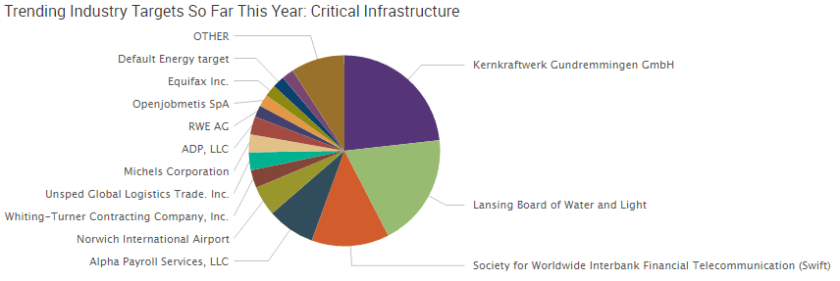
Over the last couple weeks, several critical infrastructure cyber-events made headlines in the Industrials, Energy, and Utilities industries. Some of these targets include the German Gundremmingen nuclear reactor, the Lansing Board of Water and Light (BWL), and the Canadian gold mining firm Goldcorp. While none of these cyber-attacks resulted in chaos, they did demonstrate weaknesses within these companies.

2016-05-09_itt
The chart above shows the top trending targets in Critical Infrastructure YTD in 2016. In this chart, “Critical Infrastructure” includes data from the Industrials, Utilities, and Energy Sectors.

W-2 and tax-related data breaches have been trending in 2016 – this trend is also occurring in critical infrastructure. In 2016, many top trending critical infrastructure targets have suffered such a breach, including:

  • Alpha Payroll Services
  • Whiting-Turner Contracting Company
  • ADP
  • Michels Corporation
  • Equifax

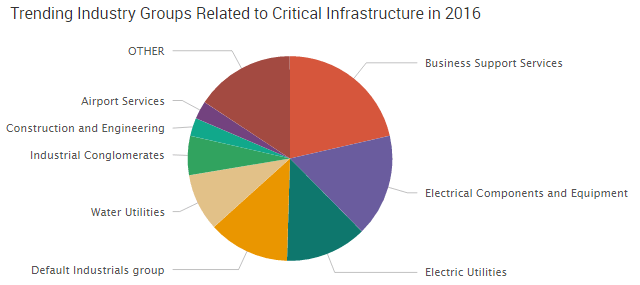
SWIFT was the software compromised in the Central Bank of Bangladesh cyber heist. As a result, business support services was the top trending industry group affected in critical infrastructure so far in 2016.

2016-05-09_groups
The industry group “Business Support Services” is the top trending tag so far in 2016.

The Critical Infrastructure Cyber Threat

Attacks against critical infrastructure have occurred in the U.S.; however, these attacks have never lead to the doomsday scenario many of us fear, such as disabling power to cities or truly compromising a nuclear reactor. Most critical infrastructure attacks in the U.S. involve the loss of user data, not a takeover of key operating capabilities.

A critical infrastructure takeover has occurred in another country. In 2015, a cyber group named Sandworm Team launched an attack against the Ukrainian Power Authority. Using the infamous BlackEnergy malware, the group was able to successfully shut down power for 700,000 people over a two hour period – the first known power outage caused by a cyber-attack. The Sandworm team has attacked U.S. critical infrastructure in the past, forcing ICS-Cert to issue an alert in 2014 addressing the threat.

Attacks against critical infrastructure have been taken especially seriously by the U.S. government. In February 2013, President Barack Obama signed Executive Order 13.636, “Improving Critical Infrastructure Cybersecurity,” and Presidential Policy Directive 21, “Critical Infrastructure Security and Resilience.” The executive order and policy directive attempt to address key issues with our nation’s critical infrastructure cybersecurity, including:

  • Promote information sharing with U.S. private sector
  • Clearly define roles of key officials involved with critical infrastructure security
  • Commit to providing assistance in the event of a data breach
  • Create a framework to reduce cyber risk to critical infrastructure
  • Promote innovation, research, and development of enhanced cybersecurity measures

As a result, the Department of Homeland Security (DHS) launched the Critical Infrastructure Cyber Community Voluntary Program. The goal of this program is to help enhance critical infrastructure cybersecurity and to promote the adoption of the National Institute of Standards and Technology’s Cybersecurity Framework.

Our country’s critical infrastructure suffers from the same vulnerabilities as other sectors. Valuable information is kept on databases and people are used as a bridge to that information. While the threat of a doomsday attack against our nation’s critical infrastructure remains a serious threat, traditional cybercrime is still driven by profit motive. Those in charge of critical infrastructure security not only have to be prepared for threats attempting to cause physical harm to our nation, they must also prepare for the theft of personal information, which seems to be the current trend.

Social Engineering – Security’s Big Problem and How to Fight Back

Pick any recent data breach. It could be a high-profile one or one of the many that never make national headlines. If we were to follow the string of events back to the beginning of that compromise, what would we find?

Chances are, it’s an employee getting duped by a cybercriminal.

In fact, one could make the case that social engineering is the single biggest issue facing organizations when it comes to cybersecurity. No matter how big of a fortress you build, all it takes is one employee to open the gate and let the bad guys walk into the heart of a business.

One of my favorite cartoons sums up the issue facing businesses:

Source: John Klossner

With all of the recent W-2 breaches in the news this year, I’ve been thinking once again about the issue of social engineering. What can businesses do? It seems every article I read only points out the problem and then makes vague references to “awareness.”

In 2015 SurfWatch Labs interviewed a variety of people to try to get to the heart of that question, and I think it’s a good idea to revisit that conversation eight months later. After all, it is a problem that will never go away.

Essentially, everyone agrees that a three-pronged approach is the key to limiting the success of cybercriminals using social engineering tactics:

  1. Use technology and tools to limit the exposure to social engineering
  2. Train employees so those social engineering attempts that do get through are less successful
  3. Realize that even the best trained organizations aren’t perfect, so have tools and a response plan in place to limit the potential damage

Let’s briefly expand on the first two points about prevention.

Limiting Exposure to Social Engineering

Technology is getting better at limiting users’ exposure. Take email as an example. In 2006 about 30 percent of an average Hotmail user’s inbox was spam — a huge problem. By 2012 that number was down to 3 percent. In July 2015, Google released its latest numbers, and less than 0.1 percent of the average Gmail inbox was spam.

The less malicious activity that gets through an organization, the less potential there is for an employee to make a mistake. There are several ways an organization can go about this goal, as have been outlined by many groups and organizations dedicated to fighting social engineering such as the Anti-Phishing Working Group.

Some best practices specific to phishing include:

  • Filtering and endpoint technologies – Filtering technologies are great at catching high-volume, low customization spam. Endpoint solutions can also combat things like malicious attachments.
  • Blocking images, links, and attachments – Disabling images and links in emails from untrusted senders can help users identify legitimate emails and prevent employees from clicking malicious links. Disabling Microsoft Office macros from Internet-obtained documents can help block a common attack vector that has led to many recent data breaches.
  • Web traffic filtering – There are many websites that are known to steal user credentials. These phishing websites are often collected into lists by both commercial vendors and free services like PhishTank. Blocking access to these sites can limit the opportunity for users to fall victim to social engineering.

Some other areas that can be useful in preventing social engineering include:

  • Authentication – Malicious actors will often impersonate others outside of email, so it is important to have strong ways to authenticate users.
  • Physical security – Physical security limits the ability for unauthorized individuals to access areas, eavesdrop on conversations, and use baiting (like dropping a malware-loaded USB stick). The organization should have effective physical security controls such as visitor logs, escort requirements, and background checks.

Training Employees and Raising Awareness

Even with security technology in place, employees will still make mistakes. Security company RSA learned this in 2011 when a phishing email targeting four low-level employees was caught by a filter and placed in their junk folders; however, one of the employees enticed by headline — “2011 Recruitment plan.xls” — retrieved it from the folder and opened the attachment, leading to a compromise that cost the company $66.3 million.

That is why training and awareness is often touted as the most important and cost effective step in combating social engineering. According to the 2016 Verizon Data Breach Investigations Report, 30% of phishing messages were opened and 12% went on to click the malicious attachment. And in 2016 phishing is on the rise, according to SurfWatch Labs data. Additionally, a recent Ponemon Institute study examining six proof of concept studies found that phishing training led to employee click rates being reduced between 26-99%.

This lead Ponemon to conclude, “Assuming a net improvement of 47.75%, we estimate a cost savings of $1.80 million or $188.40 per employee [for the average organization].”

Some of the do’s and don’ts of a good security training program include:

Social engineering is one of the biggest cyber threats facing organizations; however, many businesses devote relatively few resources to addressing this problem. Implementing  technology and tools to limit the exposure to social engineering and training employees may be the most cost effective way for many organizations to significantly improve their cyber risk.

Does Your Cyber Risk Strategy Pass the Penny Test?

As cyber incidents proliferate, security experts continue to stress the importance of cyber risk strategy starting at the top of organizations. However, a recent report surveying more than 1,500 non-executive directors, C-level executives, Chief Information Officers, and Chief Information Security Officers found that some organizations still have a big knowledge gap when it comes to cyber threats.

According to The Accountability Gap: Cybersecurity & Building a Culture of Responsibility:

  1.  Only 10% of high vulnerable respondents agree that they are regularly updated about pertinent cybersecurity threats
  2. More than 90% of high vulnerable board members say they can’t interpret a cybersecurity report
  3. Only 9% of high vulnerable board members said their systems were regularly updated in response to new cyberthreats

Many of these organizations are concerned about potential cybercrime. All of them are likely doing something to combat cyber risks. But they’re not getting updated on important threats, they cannot understand the updates that do come through, and as a result they do nothing.

That led me to wonder if we’ve all gotten stuck in the same methods of looking at the same things in the same way day after day without ever taking a breath and a step back and asking, “Wait, why am I doing this?”

The Penny Test

There was a fascinating story on the news awhile back about people getting wrongfully convicted based on faulty eyewitness testimony.

In fact, according to the Innocence Project, “Eyewitness misidentification is the single greatest cause of wrongful convictions nationwide, playing a role in 72% of convictions overturned through DNA testing.”

However, the point wasn’t that eyewitnesses are being careless or that they are just plain ignorant, it’s that without having the whole picture — the complete context of the situation — it’s natural to make a simple mistake that can cost a person decades of his or her life.

To illustrate, let’s do a variation of the Penny Test using a six person “lineup” to see if you can identify the “real” penny.

Which penny is correct?

If you’re like most people, you’ll eliminate a few possibilities, narrowing it down to a couple of choices. Then, over time — and along with other factors that may reinforce your decision — you grow more certain that, yes, that penny you’ve chosen is definitely the right one.

But here’s the problem with the story I’ve given you: it’s incomplete. I failed to mention the possibility that the correct version of the penny might not be there at all.

That’s one of the problems with the human mind, it wants to pick something, and it’s one of the many problems that can arise from eyewitness identification.

All of the pennies were wrong.

Cybersecurity Blind Spots

That lack of context can also be a real problem when it comes to managing cyber risk. Without having the whole picture, it’s natural to invest in the wrong areas or to make a mistake that leaves an organization vulnerable to cyber-attack.

This is what many of the recent studies and surveys have been reinforcing. The IT team is wasting their time elbows deep in low-level data and investigating red flags, never having a chance to think about or act on a high-level strategy. Executives don’t even know what aspects of their company are at risk, so they’re fumbling around in the dark and relying on vendors for the answers.

The problem with that? They’re biased.

Just as the cops in the world of traditional crime may lead a subject towards a certain perpetrator (“We thought it may have been number three too.”), a vendor may lead you towards their biases — regardless of the true risk profile and needs of your business.

When you’re assessing cyber risk, remember that one option is always “none of the above.” The answer might be something else entirely.

Understanding Complete Context

Many organizations have these cyber blind spots. For example, most organizations don’t assess the security of third-party partners or their supply chain, yet we’ve seen dozens of data breaches that begin from these very avenues.

If relevant cyber threat information is available, it often doesn’t make its way to those with the ability to actually make changes. And if it does get passed along, those executives may be unable to interpret the technical language of the threats. And if they do know and understand the threats, it may end up that those threats are no longer as relevant; there may be newer, more pressing cyber risks.

That’s why nearly every cybersecurity best practice guide or cyber risk management program beings with the same thing: context. Clear away as many of those blinds spots as possible.

Remember the Penny Test. Just because you are doing something doesn’t mean it’s the best use of resources. The real threat might still be out there, and without having complete context around your cyber risks, you may miss it.

Podcast: New Attacks, Massive Leaks and Setting Data Breach Records

A new episode of the SurfWatch Cyber Risk Roundup has been posted, Episode 68: New Attacks, Massive Leaks and Setting Data Breach Records:

Details on more than 7 million user accounts for Minecraft community Lifeboat were compromised. A German nuclear plant discovered malware on its systems. A ransomware attack hit the Lansing Board of Water and Light. Huge amounts of data were leaked from Canadian gold-mining firm Goldcorp and the Kenya Ministry of Defense. Trending advisories include vulnerabilities in Android, increased extortion and ransomware activity, and massive dumps of user credentials being leaked from several sources. On the legal side, the New York Attorney General announced the state is on pace for a record number of data breach notices this year, a new version of PCI DSS was released, and a hacker claims to have accessed Hillary Clinton’s email server. Finally, a 10-year-old boy won a $10,000 bug bounty.

Listen to the podcast via the player below, or learn more about SurfWatch Labs podcasts on our podcast page.

Trade Secret Legislation Awaits Obama’s Signature

Organizations will soon have another avenue to seek relief from trade secret theft, as President Obama is expected to sign into law the Defend Trade Secrets Act. The bill, which gives companies the ability to pursue trade secret cases in federal courts rather than at the state level, is the latest in a string of headlines related to stolen intellectual property.

The effort is meant to help combat the growing problem of espionage, which costs the U.S. $300 billion and 2.1 million jobs each year, according to a 2013 report from the Commission on the Theft of American Intellectual Property.

2016-05-03_espionage
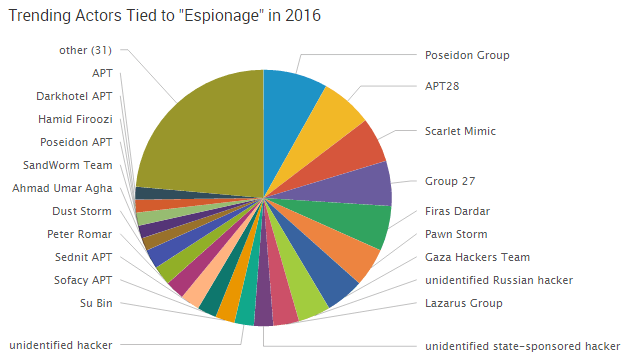
Many different individuals and groups have been associated with cyber-espionage so far this year, according to threat intelligence data from SurfWatch Labs.

House Judiciary Committee Chairman Bob Goodlatte (R-Va.) said the DTSA would “build on efforts over the past two years and take a significant and positive step toward improving our nation’s trade secret laws.”

The first version of DTSA was introduced in 2014, just weeks before the U.S. made waves when — for the first time ever — they filed charges against five Chinese military hackers for cyber-espionage against U.S. corporations. That 2014 indictment centered around alleged hacking and theft related to six organizations: Westinghouse, SolarWorld, U.S. Steel, Allegheny Technologies, the United Steelworkers Union, and Alcoa.

Those allegations continue to play out as U.S. Steel recently took steps to request the government prevent imports from China’s largest manufacturers due to, among other things, trade secret theft. A complaint filed on April 26 with the U.S. International Trade Commission under a section of the U.S. Tariff Act alleges those stolen trade secrets led to decades of research in creating the next generation of high-strength steel being taken and reproduced in China. 

The DTSA gives the many organizations affected by the theft of trade secrets another outlet to seek relief, and the version awaiting Obama’s signature has received widespread support (the house voted 410-2 in favor); however, the legislation is not without detractors. When the bill was first introduced two years ago, 31 law professors signed a letter opposing it, and in November 2015 they again called on Congress to reject the DTSA:

While we agree that effective legal protection for U.S. businesses’ legitimate trade secrets is important to American innovation, we believe that the DTSA — which would represent the most significant expansion of federal law in intellectual property since the Lanham Act in 1946 — will not solve the problems identified by its sponsors. Instead of addressing cyberespionage head-on, passage of the DTSA is likely to create new problems that could adversely impact domestic innovation, increase the duration and cost of trade secret litigation, and ultimately negatively affect economic growth.

The federal law does not replace current state laws, the group argued, so it will complicate rather than simplify trade secret litigation by adding a new layer of federal jurisprudence.

What this Means for Business

Most states have adopted a version of the Uniform Trade Secrets Act, which is how most trade secret disputes are currently handled. Once the DTSA is signed into law, organizations will be able to decide whether federal or state courts are more beneficial.

Although most legal experts agree that the DTSA provides a slightly broader interpretation of “trade secrets” as well as additional tools that can be used, the choice of avenue for litigation will likely need to be decided on a case by case basis.

“State courts may still to be a more preferable venue for many plaintiffs, as they typically provide more lenient rules for obtaining ex parte relief and a temporary restraining order,” the National Law Review noted. “Federal courts are often backlogged and may not hear a temporary restraining request immediately. By the time a temporary restraining order is issued, the critical information may be disclosed or forever gone. Thus, an expedited hearing in state court may outweigh the benefits of the federal court option provided by the DTSA.”

Trade secrets are often the most important assets for an organization, and the recent legal developments should serve as a reminder for businesses to assess the risks associated with those secrets, do their best to ensure those secrets are protected, and to have a plan in place so they can take legal recourse should those secrets get stolen.

Cyber-Attacks Against Banks Making Huge Impact in 2016

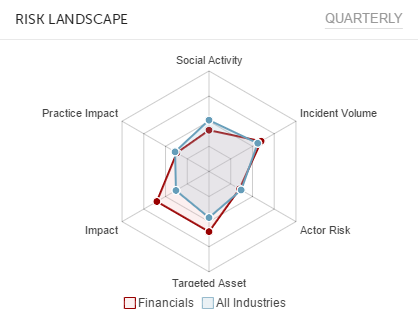
Although the financials sector hasn’t been as widely discussed as others this past quarter, cyber-attacks in the sector are having a greater impact, according to SurfWatch Labs’ data.

snapshot_1462215431132
The impact and targeted asset financials scores (red) are trending much higher than other sectors (blue), according to SurfWatch Labs.

Since March 2016, the financials industry has made big headlines for high-profile cyber events involving the Central Bank of Bangladesh and most recently, Qatar National Bank. These two banks have contributed enormously to the amount of cybercrime discussion surrounding banks.

2016-05-02_groups
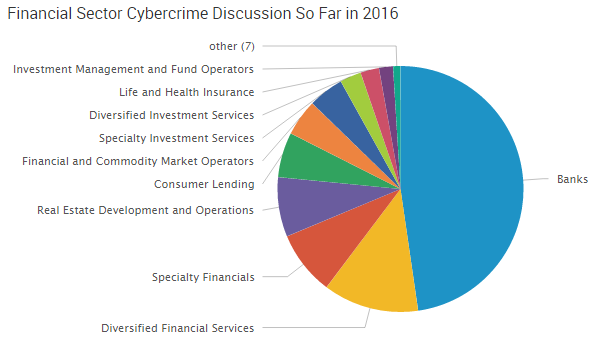
Banks are the most discussed group in the financials sector, accounting for nealy 40% of the negative CyberFacts collected by SurfWatch Labs, followed by Diversified Financial Services (14%) and Specialty Financials (13%)

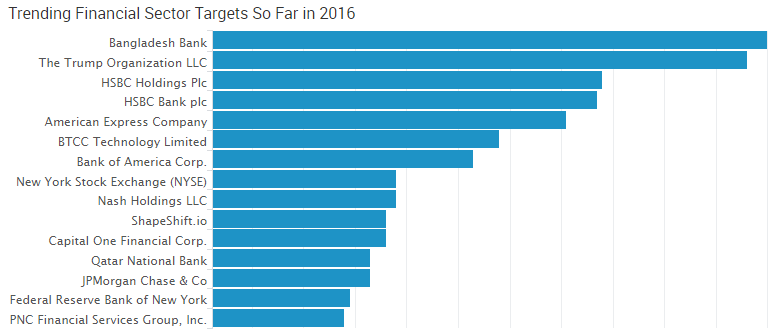
The Central Bank of Bangladesh is the top trending financials sector target so far in 2016. The multiple cyber-attacks against the Trump Organization – including an Anonymous campaign – and the January DDoS attack against HSBC Bank round out the top three targets.

2016-05-02_itt
The Central Bank of Bangladesh is the top trending financials target in 2016. 

Latest on Bangladesh Bank Heist

The $81 million bank heist of the Central Bank of Bangladesh is one of the most successful cyber bank thefts in history. The bank was attacked via SWIFT, a well-known and utilized international bank messaging system.

SWIFT stands for the Society for Worldwide Interbank Financial Telecommunication. The system authorizes payments between accounts and is recognized for its security. According to Michael Corkery of The New York Times, one financial analyst even called SWIFT “the Rolls-Royce of payments networks.”

Unfortunately for banks, SWIFT issued a warning to customers that cybercriminals have attempted similar bank thefts through its system.

“SWIFT is aware of a number of recent cyber incidents in which malicious insiders or external attackers have managed to submit SWIFT messages from financial institutions’ back-offices, PCs or workstations connected to their local interface to the SWIFT network,” the warning read.

One of the main problems with SWIFT is that not all banks put security features in place to protect against potential threats.

“SWIFT is a great organization,” said Chris Larsen, the founder of Ripple, to The New York Times. “But the system is fractured and antiquated. The way it is set up, you cannot totally isolate problems in a place like Bangladesh from the whole network.”

HSBC U.K. Banking System Taken Offline

In January 2016 Europe’s largest financial lender HSBC suffered a DDoS attack, keeping several banking customers unable to access their accounts. The attack took place on Friday, January 29, and services were restored on January 30.

This was the second website outage suffered by the bank in January.

The attack was particularly damaging due to its timing. HSBC was attacked on the last Friday in January, a particularly busy day for banks as the end of the fiscal year approaches. Millions of customers -– both online and mobile app users –- were affected by the attack.

HSBC never released any technical data about the incident. DDoS attacks can have an impact on brand reputation as well as loss of revenue. On average, a DDoS attack can cost about $40,000 per hour, according to a study conducted by Incapsula.

New Hybrid Malware Used In Bank Attacks

Cybercriminals are always looking for new, sophisticated ways to attack organizations. A new threat called GozNym malware has been identified targeting banks in the North America, Asia, and Europe. As SurfWatch Labs recently reported to customers, the malware has stolen over $4 million between 24 banks in North America alone.

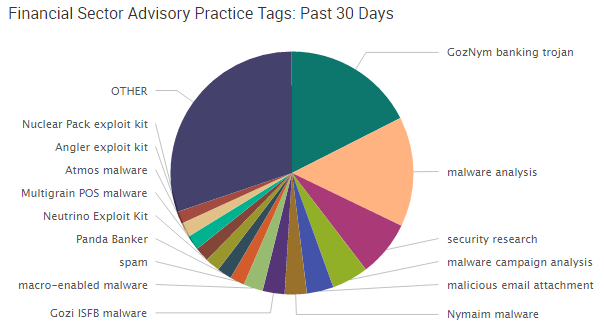
The GozNym banking Trojan has been discussed frequently over the past 30 days.

2016-05-02_advisories
The GozNym banking Trojan is the top trending advisory tag in the Financial sector over the last 30 days. 

GozNym is a hybrid malware, containing code from both the Nymaim and Gozi ISFB variants. The source code from the Nymaim malware is used to steal user data and login credentials. Once this data is obtained, the source code from the Gozi ISFB malware manipulates web sessions and conducts online banking fraud attacks. This nasty threat not only perpetrates bank fraud, it can also open the door for further malware attacks, including ransomware.

Like most malware, GozNym relies heavily on one factor to promote infection – human behavior. The malware is spread through exploit kits and Office macros, both of which require human interaction for its operation to take place.

Banks are an especially ripe target for cybercriminals due to the amount of transactions and data transferred between individuals and other organizations. Hacking tools such as malware and DDoS services can be purchased on the dark web for a surprisingly low price and used to create havoc and devastating financial loss for organizations. As demonstrated in the Central Bank of Bangladesh theft, it only takes one vulnerability to crack a company’s security, and the impact of those attacks is often more far reaching than other sectors.

Sharing is Caring – Threat Intel for You and Your Business Partners

As kids we’re taught to share our toys. It’s a hard lesson to “get.”

When it comes to cybersecurity and information sharing, many still don’t “get” it. Liability concerns, competitive disadvantages, and so on. But even if some of these concerns are legitimate, this lesson really shouldn’t be so hard.

According to the latest Verizon DBIR, while compromises are happening faster, the time to discover the compromise is taking longer than in previous years. We can combat this challenge through the use of sound threat intelligence and sharing among “friends.” Through intel you can be more prepared in advance of an attack, reducing the amount of incidents you need to respond to.

Many are trying to address this sharing problem — hence the creation of Information Sharing and Analysis Centers, aka ISACs. There are a boatload of ’em — 18 listed on Wikipedia’s page on ISACs. Each of these ISACs is specific to an industry, so in theory there is relevancy built in to the information that is shared. The intent of these ISACs is sound, and there are many good people working to make these ISACs really useful. But they have their limits as well. We all have businesses to run and support after all.

So how do we take the ISAC concept up a notch, where the intel being shared is more than relevant, but SPECIFIC to your business? Privatize the ISAC to fit your own business ecosystem. This means pulling in your partners and suppliers. You should already be sharing information with them anyway, just include cyber as part of it.

Whether you are a big, medium or small business, most likely you have partners and suppliers that are an extension of your cyber footprint. They typically have some level of access to to your network, applications and data. Having these intersecting points allows business to run more efficiently. But with these intersections comes risk. A company’s suppliers are often integral to their business — I need X and Y to fulfill Z, and X comes from a supplier. Suppliers that don’t pay enough attention to security ultimately can cause a very direct and painful impact on your business (Target is the obvious supply chain cyber example used often, but there are plenty more where that came from).

As opposed to sharing information with folks you don’t know (and let’s be honest, how much do you want to really expose to a wider audience not within your control?), your own supply chain is, for all intents and purposes, just an extension of your own enterprise. It only makes sense that your security “umbrella” should extend out a bit over them as well.

As such, sharing info, analysis and expertise within your “extended family” can be very valuable to establishing the kind of early warning system that is the promise of cyber information sharing to begin with — and without most of the risks.

Sharing threat intelligence, risk identification and other analysis with your partners helps you help yourself. Cybercriminals work together and share information all the time in Dark Web forums and even sometimes out in the open.

Sharing is caring. And the group of folks that you will get the most value out of sharing cyber threat intelligence with are the companies in your supply chain.