2017 Cyber Forecast: Blackmail Using Media and Sensitive Data Will Grow

The end of the year is drawing nearer, and with that comes a handful of traditions: family gatherings, eggnog by the fire, and everyone’s annual list of cybersecurity “predictions.” While it’s a bit semantic, I’m personally not a big fan of the term “predictions.” As someone who lives in the intel world, it’s more about looking at the data and making forecasts using probabilities. In all of the cyber threat intelligence that we provide our customers, we include a confidence level based on what we’re seeing and the probability of that threat impacting a specific customer.

I start out with the above just to level set the rest of this blog (and the next several blogs around 2017 cyber forecasts). When it comes to identifying trends and making a forecast on probability of what threats make waves in 2017, based on the success of ransomware attacks I have moderate confidence that we will see growth of more traditional extortion-related cybercrime.

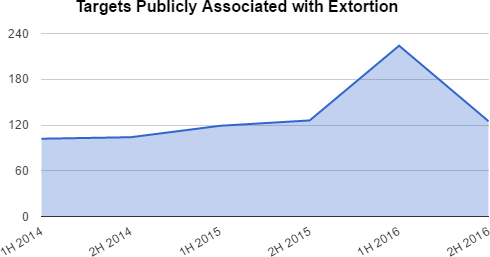
SurfWatch Labs has seen a steady growth in the number of targets publicly associated with extortion, blackmail and ransoms over the past few years, and we expect that number to rise even higher in the coming year.
2016-12-08_extortion
Extortion-related crimes are on the rise (note: 2H 2016 data includes intelligence collected through December 7).

One of the best and most recent examples of malicious actors using extortion is the hacking group known as TheDarkOverlord, which has breached, attempted to extort and then publicly shamed a variety of organizations over the second half of 2016.

The latest incident is the November breach of Gorilla Glue. TheDarkOverlord claimed to have stolen more than 500 GB of data, including research and development material, intellectual property, invoices and more. The group then offered Gorilla glue its signature “business proposition.” As we wrote in a SurfWatch Labs blog earlier this year, the proposition is simple: pay the blackmail or face further data leaks and public shaming. After what TheDarkOverlord described as “a moderate dispute” with Gorilla Glue over payment — we’re guessing Gorilla Glue refused to pay — TheDarkOverlord shared a 200 MB cache of files with the media to help spread the story.

The evolving use of the media is actually one of the more interesting tactics used by TheDarkOverlord and other successful extortion groups this past year. Extortionists have referenced news coverage in their demands, prompted users to research past victims, and impersonated cybercriminals with established media coverage — all in an effort to lend credibility to their threats.

For example, back in April CloudFlare reported that a group using the “Armada Collective” name was blackmailing businesses with an extortion email that read, in part:

We are Armada Collective.

http://lmgtfy.com/?q=Armada+Collective

Your network will be DDoS-ed starting [date] if you don’t pay protection fee – 10 Bitcoins @ [Bitcoin Address].

If you don’t pay by [date], attack will start, yours service going down permanently price to stop will increase to 20 BTC and will go up 10 BTC for every day of attack.

This is not a joke.

The link in the email led to a Google search of the group, allowing victims to quickly see that some security researchers had described Armada Collective as a “credible threat.” Except the attackers were not part the original Armada Collective. They were copycats simply exploiting the original group’s already established name. As CloudFlare later discovered, there was not “a single incident where the current incarnation of the Armada Collective has actually launched a DDoS attack.” Despite the lack of follow through, the group managed to extort hundreds of thousands of dollars from the victims.

Leveraging the media in that manner is something the SurfWatch analyst team has observed more frequently over the past year. However, news outlets and victims are starting to become more skeptical of claims. That’s one of the reasons threat actors such as TheDarkOverlord have evolved their tactics to establish a more direct and somewhat dysfunctional “relationship” with the media. Bloggers and news outlets get access to a direct source of stolen data that can help help generate headlines. Extortion groups receive the platform necessary to incite worry in the partners and consumers of the victim organization, adding pressure to pay extortion demands.

With cybercrime events seeing more mainstream coverage each year and extortion proven to be a successful, low-effort tactic, expect that dysfunctional relationship to continue to develop in the coming year. Extortion has proven particularly useful when it comes to the theft of sensitive customer data as it provides multiple additional ways for a threat actor to monetize information. If the victim organization doesn’t provide immediate compensation via an extortion payment, individual customers may then become targets of blackmail — sometimes years into the future.

Adultery site Ashley Madison announced its data breach in the summer of 2015, but individuals exposed in that breach were still being sent blackmail letters and emails nearly a year later. Some victims reported that when they didn’t pay, the blackmailers then followed through on their threats by sending letters about the individuals’ alleged infidelity to family, friends, and workplaces.

More recently, hackers stole customer information from Valartis Bank Liechtenstein and were reportedly threatening individual customers — including politicians, actors and high net worth individuals — that their personal information will be leaked if they do not pay 10 percent of their account balances in ransom.

These extortion and blackmail attempts are not nearly as prevalent as ransomware, but they follow the same principle of quick and easy monetization via the victims themselves. The past year has proven that the media can be successfully used as a tactic to better extort both organizations and individuals, particularly when it comes to sensitive information that may lead to brand damage or embarrassment. That trend will likely grow in 2017 as threat actors look to take advantage of every avenue when attempting to monetize future data breaches.

Weekly Cyber Risk Roundup: Another Botnet and the Gamification of Cybercrime

Botnets were once again front-and-center this past week as new developments were announced by security researchers, malicious actors and government officials.

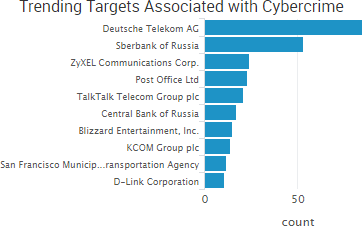
2016-12-09_ITT.pngTo start, CloudFlare observed a ten-day long series of distributed denial-of-service (DDoS) attacks that have generated as much as 400 Gbps in traffic, sparking fears of yet another massive botnet that can disrupt organizations. The attacks “are not coming from the much talked about Mirai botnet,” the researchers wrote. “They are using different attack software and are sending very large L3/L4 floods aimed at the TCP protocol.”

Following that announcement, the hacker known as BestBuy, who had previously begun advertising a Marai-based DDoS service, claimed to have taken control of 3.2 million routers. He told Motherboard that a server he set up automatically connects to vulnerable routers and pushes a malicious firmware update to them. “They are ours, even after reboot. They will not accept any new firmware from [Internet Service Provider] or anyone, and connect back to us every time :),” he said in an online chat. “Bots that cannot die until u throw device into the trash.”

If true, those developments are certainly worrisome for organizations like Deutsche Telecom, the UK Postal Office, TalkTalk, and Kcom ISP – all of which have seen customer outages due to attempted Marai infections – not to mention the businesses that may be targeted with DDoS attacks from all those compromised devices.

One piece of good news on the botnet front: the cybercriminal network known as Avalanche was dismantled in what authorities are describing as the largest-ever use of sinkholing to combat botnet infrastructures. Europol said that the four-year investigation with global partners resulted in over 800,000 domains being seized, sinkholed or blocked. Although exact calculations are difficult, monetary losses associated with attacks conducted over the Avalanche network are estimated to be in the hundreds of millions of dollars worldwide.

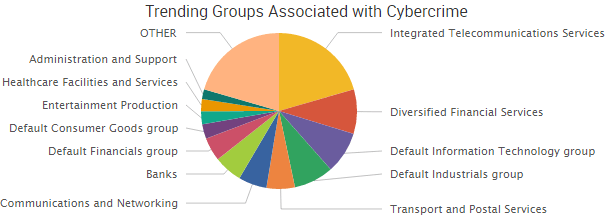
2016-12-09_groups

Other trending cybercrime events from the week include:

  • Massive thefts announced: Technical trade secrets were stolen from ThyssenKrupp, one of the world’s largest steel makers, in what the company described as a “massive cyber attack.” The theft occurred at the steel production and manufacturing plant design divisions, the company said. Two billion rubles ($31 million) was stolen from banking clients that hold accounts at Russia’s central bank, according to a bank spokesperson. The hackers attempted to steal approximately five billion rubles, but the bank managed to recover some of the money. Reuters reported that hackers broke into accounts at the bank by faking a client’s credentials, citing a report issued by the bank.
  • Ransomware updates: The ransomware attack that affected about 900 computers at the San Francisco Municipal Transportation Agency cost the agency an estimated $50,000 in lost fares due to passengers being unable to pay. Ransomware behind the infection that caused an NHS hospital trust to shut down systems and cancel 2,800 patient appointments in early November has been confirmed as Globe2. Allegheny County district attorney Stephen Zappala Jr. admitted that his office was hit in January 2015 and that the office paid nearly $1,400 in ransom. The announcement came after several victims of the Avalanche network were revealed via court documents.
  • Malicious insiders face consequences: A former computer support technician employed at Experian subsidiary Hotwire.com pleaded guilty to accessing the emails of executives and using that non-public information to illegally profit from trading Expedia stock. The man accessed documents and emails on the devices of the Chief Financial Officer and the Head of Investor Relations. A former employee of Internet service provider Pa Online was sentenced to 24 months in prison and ordered to pay $26,000 in restitution for hacking into Pa Online’s network after being fired and installing malware that caused files and directories to be erased and the network to crash.
  • Third-party breaches: More than 43,000 Indian patient pathology reports, including those of HIV patients, were left publicly exposed by Health Solutions. Security researcher Troy Hunt said the information is now removed from public view after a lengthy process to track down and motivate those behind the leak and that the incident appears to be the result of shockingly poor security. A breach of a contractor’s email account exposed the information of individuals who participated in the U.S. Olympic Committee’s 100-Days Out event in April 2016. Members of the Scotland Supporters Club were sent phishing emails from the Scottish Football Association’s official email account after a third-party email database was compromised.
  • Other data breaches: An Intranet server for South Korea’s cyber command was contaminated with malware, and the attack appears to have come from North Korea, the South Korean military said. An official said that some military documents had been hacked, including confidential information, but that they have yet to determine the full extent of the leak. Around 420,000 customers may have had their personal information leaked due to a data breach at an online store run by IPSA, a subsidiary of Japanese cosmetics maker Shiseido. A University of Wisconsin–Madison law school database was breached, resulting in 1,213 applicants having their names and Social Security numbers compromised.

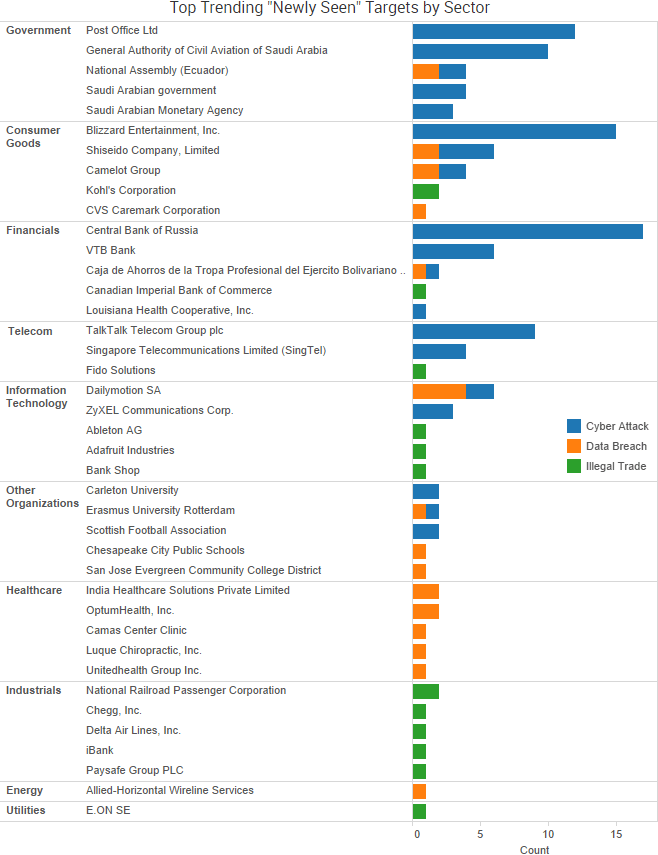
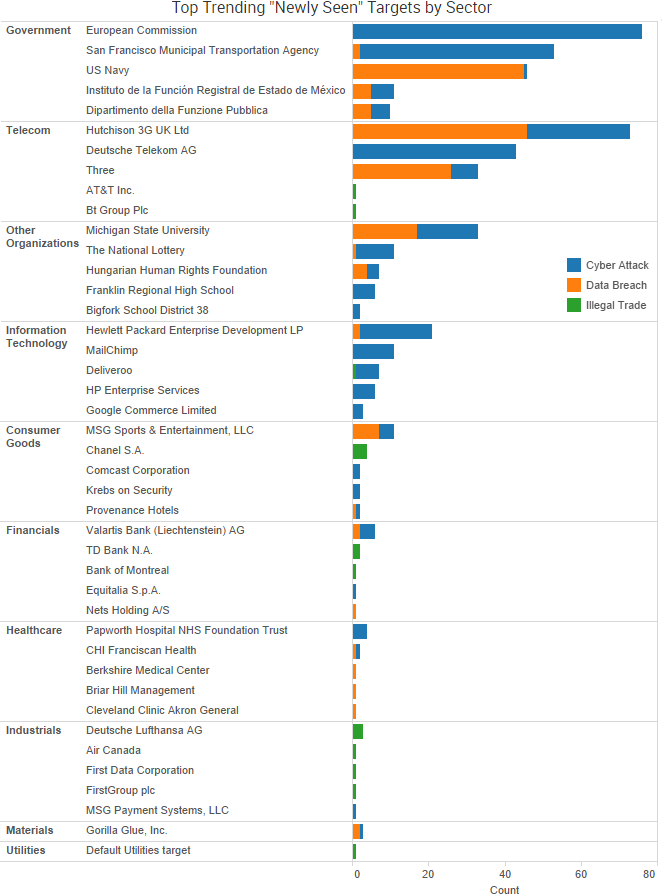
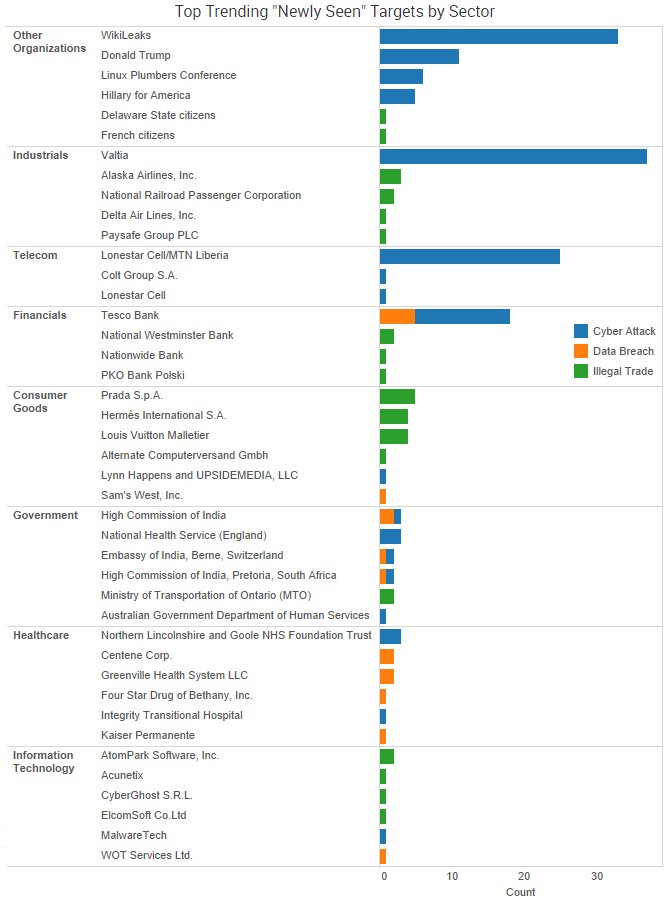
SurfWatch Labs collected data on many different companies tied to cybercrime over the past week. Some of those “newly seen” targets, meaning they either appeared in SurfWatch Labs’ data for the first time or else reappeared after being absent for several weeks, are shown in the chart below.

2016-12-09_ittnew

Cyber Risk Trends From the Past Week

2016-12-09_risk

One of the more interesting developments over the past week is the new tactics being used by malicious actors in order to spread malware and encourage cyber-attacks. For example, a new ransomware called “Popcorn Time” is encouraging victims to spread ransomware by offering them options when it comes to decrypting their files. They can go the usual route of paying the 1 bitcoin ransom, or they can go the “nasty way” and infect other users in order to avoid payment.

popcorn_ransomware_referral.png

“Send the link below to other people, if two or more people will install this file and pay, we will decrypt your files for free,” the malware authors wrote. This is the first time SurfWatch Labs has observed ransomware developers using the tactic of leveraging victims in order to intentionally spread the malware.

Another interesting cybercriminal tactic is being used by a DDoS collaboration service called “Surface Defense.” A set of Turkish hackers is using gamification to encourage others to attack political organizations are not in line with Turkey’s government. They provide a point system for attacks, rewards that can be earned, and a live scoreboard. Rewards include cybercriminal tools such as click-fraud bots and the Sledgehammer DDoS tool. Two dozen organizations are being targeted by the gamified-DDoS service, including the German Christian Democratic Party, The People’s Democratic Party of Turkey, the Armenian Genocide Archive, and the Kurdistan Workers Party. Users can also suggest new targets.

Malicious actors are continuing to experiment with new ways to expand their reach. It is difficult to judge how successful these types of tactics will be, but expect other actors to incorporate similar features in the future if they are proven to be successful.

Weekly Cyber Risk Roundup: Shamoon is Back and Marai Problems Continue

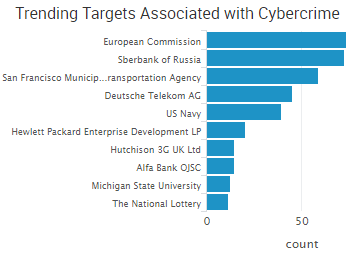
The European Commission is the top trending cybercrime target over the past two weeks after experiencing a distributed denial-of-service attack (DDoS) that brought down Internet access for several hours over two separate periods, making it difficult for employees to work, a staff member told Politico.

2016-12-02_ITT.pngHowever, the most impactful event from the period is the campaign that targeted organizations in Saudi Arabia with the Shamoon malware and wiped the hard drives of thousands of computers. The campaign targeted six organizations, resulting in extensive damage at four of them. People familiar with the investigation told Bloomberg that thousands of computers were destroyed at the headquarters of Saudi’s General Authority of Civil Aviation and that office operations came to a halt for several days after critical data was erased. Among the other targets were the Saudi Central Bank and several unnamed government agencies.
Saudi authorities said evidence suggests Iran is to blame. The attackers used the exact same Shamoon malware that hit Saudi Aramco in 2012 and destroyed 35,000 computers, according to people familiar with the investigation. Ars Technica noted that Shamoon attempts to spread across networks by turning on file sharing and attempting to connect to common network file shares. In addition, the attackers used stolen credentials hard-coded into the malware.

Shamoon is made up of three components. The dropper component determines whether to install a 32-bit or 64-bit version of the malware. The wiper component uses RawDisk, the same driver that was used against Sony Pictures in 2014. The communications component was not used in this attack as the malware was configured with the IP of 1.1.1.1.

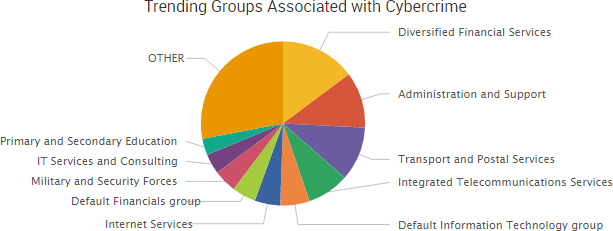
2016-12-02_groups

Other trending cybercrime events from the week include:

  • Another week of “oops” breaches: Security researcher Chris Vickery discovered a file repository for Allied-Horizontal exposed to the Internet and requiring no authentication that contained sensitive information related to explosives. Confidential police files on 54 terrorist cases were copied onto a staffer’s private storage device that was connected to the Internet without a password. The U.S. Department of Housing and Urban Development accidentally made the personal information of almost 600,000 individuals temporarily available to the public via its website.
  • Individuals and organizations face blackmail: Hackers have allegedly stolen data from Valartis Bank Liechtenstein and are threatening individual customers that they will leak their stolen information to financial authorities and the media if they do not pay ransom demands. The hacking group known as TheDarkOverlord said they gained access to Dropbox and email accounts for Gorilla Glue and stole 500 GB of information, including intellectual property and product designs. TheDarkOverlord said they offered the company “a handsome business proposition,” which is the group’s way of saying they demanded ransom.
  • Ransomware disrupts organizations: The computer systems of the San Francisco Municipal Transportation Agency were infected with ransomware, and the actor behind the attack demanded $73,000 in ransom. Passengers unable to pay fares due to locked machines were temporarily given free rides. Bigfork School District in Montana recently experienced a ransomware infection due to a malicious email attachment, but the district said it would not pay any ransom demands. Computers at Carleton University in Canada were infected with ransomware, bringing research to a halt. The attackers asked for around $39,000 to decrypt the data.
  • Business-to-business cybercrime: Gaming company Zynga is suing two former employees over the theft of “extremely sensitive” information, which was then allegedly taken to rival company Scopely. James Frazer-Mann, a 35-year-old former operator of Elite Loans, was sentenced by a UK court for hiring a hacker to DDoS his former company’s competitors and the website of the Consumer Action Group.
  • More data breaches announced: The Madison Square Garden Company announced a point-of-sale data breach affecting customers who used payment cards to purchase food and merchandise at Madison Square Garden, the Theater at Madison Square Garden, Radio City Music Hall, Beacon Theater and Chicago Theater. The Navy was notified by Hewlett Packard that the names and Social Security numbers of more than 130,000 sailors were compromised. An unauthorized party gained access to a Michigan State University server containing personal information on 400,000 individuals, but only 449 of those records are confirmed to have been accessed. The hacker behind the data breach at Casino Rama has uploaded a five gigabyte file containing more than 14,000 documents to a torrent website. UK Telecom company Three announced a data breach after cybercriminals were able to gain access to its upgrade system using authorized logins.The sensitive personal information of 17,000 students was compromised in a data breach at Erasmus University in the Netherlands.

SurfWatch Labs collected data on many different companies tied to cybercrime over the past two weeks. Some of those “newly seen” targets, meaning they either appeared in SurfWatch Labs’ data for the first time or else reappeared after being absent for several weeks, are shown in the chart below.

2016-12-02_ittnew

Cyber Risk Trends From the Past Week

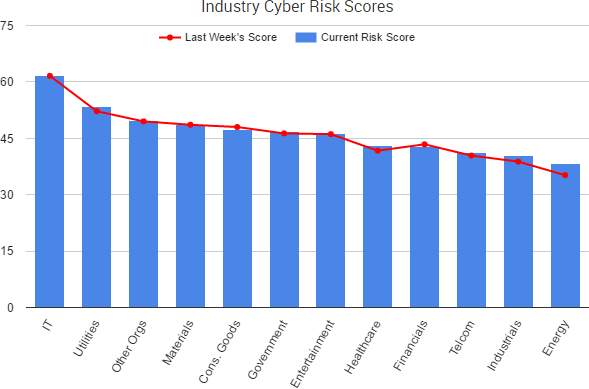
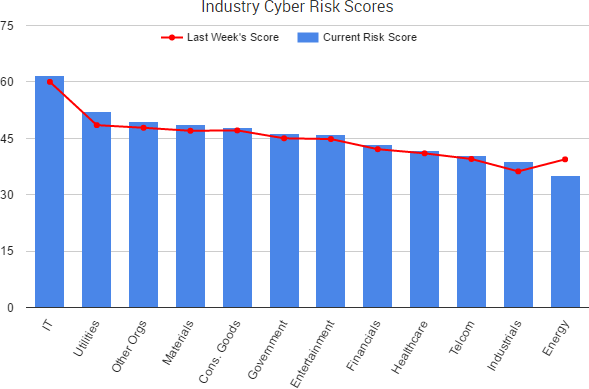
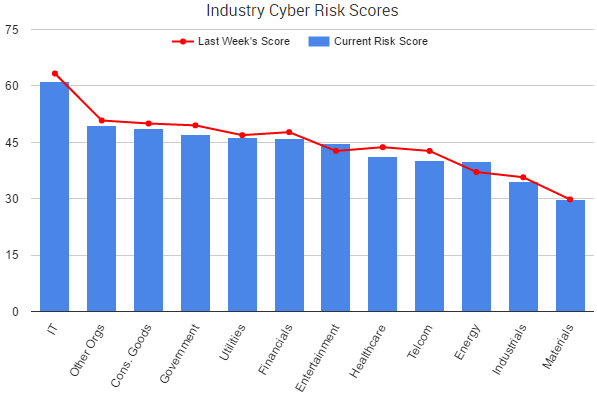
Over the past two weeks, most industry sectors have seen an increase in their SurfWatch Labs’ cyber risk scores. The IT sector, once again, has the highest overall score. That is due, in part, to ongoing worry over DDoS attacks tied to Marai and other botnets compromised of Internet-of-Things devices.

2016-12-02_riskscores

Around 900,000 customers of Deutsche Telekom had their service disrupted due to external actors trying and failing to infect routers with malware, the company said. The attack caused crashes or restrictions on approximately four to five percent of all routers. Thousands of KCOM customers also lost their Internet access due to routers being targeted in a cyber-attack. KCOM issued a statement about the incident:

“We have now identified that the root cause of the problem was a cyber attack that targets a vulnerability in certain broadband routers, causing them to crash and disconnect from the network. The only affected router we have supplied to customers is the ZyXel AMG1302-T10B. The vast majority of our customers are now able to connect to and use their broadband service as usual.”

Researchers have identified other companies that use routers made by ZyXel and may be vulnerable to similar attacks, including Irish telecom operator Eir and Vodafone Group Plc in Britain.

Two hackers have since claimed credit for the attack against Deutsche Telekom and apologized for the outage. They were trying to enlist those routers in a growing Marai botent, which they claim is now the most powerful Marai-based botnet. One of the hackers told Motherboard the botnet included over a million devices; however, other researchers have estimated that number to be around 400,000.

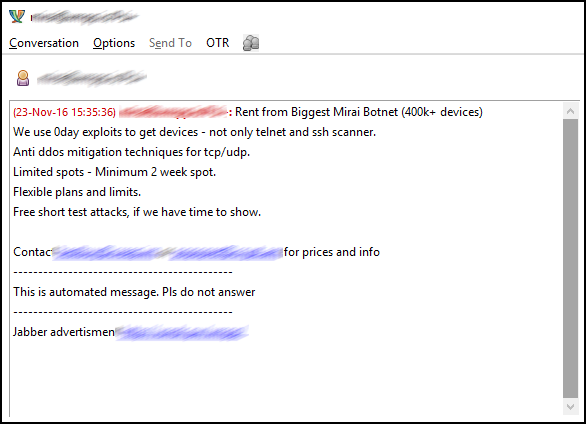
The hackers, going by the name BestBuy and Popopret, are advertising a DDoS service powered by their new botnet with attacks allegedly ranging up to 700 Gbps.

2016-12-03_botnetad
Source: BleepingComputer

Popopret told BleepingComputer that the price for a two-week long attack using 50,000 bots — and an attack duration of one hour along with a 5-10 minute cooldown time between attacks — is approximately $3000-$4,000. BestBuy reported similarly high fees, telling Motherboard that a similar attack using 600,000 bots would cost $15,000-$20,000.

It is unclear exactly how many devices the group controls at the moment, but it is clear that various groups are competing to infect and retain control over a growing number of Internet-connected devices.

San Francisco Muni Refuses Extortion Demands, But Many Others Choose to Pay

The San Francisco Municipal Transportation Agency (SFMTA) is continuing to deal with the fallout from a Friday ransomware attack that affected 900 office computers and led to passengers getting free rides as ticket machines were taken offline. The agency has since restored systems from a backup, and fares have been running as normal since Sunday; however, the actor behind the attack is still threatening to release 30GB of data if the 100 bitcoin ransom ($75,000) is not paid by tomorrow.

The actor, going by the name Andy Saolis, has refused to provide media outlets with a sample of the stolen data in order to verify the alleged theft, and SFMTA said that its ongoing investigation has not discovered that any data exfiltration took place.

“[N]o data was accessed from any of our servers,” the agency said in a statement. “The SFMTA has never considered paying the ransom. We have an information technology team in place that can restore our systems, and that is what they are doing.”

Many Organizations Choose to Pay

While SFMTA has decided not to pay the ransom, other organizations targeted by the same threat actor have been successfully extorted. A security researcher who gained access to an email account used by Andy Saolis said that the hacker had extorted at least $140,000 in bitcoins from victim organizations over the past few months, including 63 bitcoins (around $45,000) from a U.S.-based manufacturing firm. The emails also show that this past Sunday another company, China Construction of America Inc., paid 24 Bitcoins (around $17,500) to decrypt 60 servers infected with the same strain of ransomware, known as HDDCryptor or Mamba.

In addition to the attacks described above, SurfWatch Labs has collected, evaluated and analyzed data pertaining to dozens of other targets associated with extortion over the past month.

2016-12-01_extortion
Facebook is the top trending target tied to ransomware and extortion due to recent attacks known as ImageGate.

The top trending ransomware story over the past 30 days is the newly discovered attack vector known as ImageGate, which is infecting numerous users with Locky ransomware via Facebook and LinkedIn by exploiting a misconfiguration that forces victims to download a malicious image file. It’s unclear how many of those victims have paid the ransom, but a variety of other organizations have publicly confirmed making ransom payments recently:

  • The Lansing Board of Water & Light recently acknowledged it paid a $25,000 ransom after an employee opened an attachment that led to a ransomware.
  • A $28,000 ransom was paid after an infection locked up several government systems in Madison County, Indiana and the county’s insurance carrier advised payment.
  • The New Jersey Spine Center paid an undisclosed amount after CryptoWall encrypted all electronic medical records and the most recent system backup, as well as disabled the phone system.
  • Cloud service provider VESK said that it paid £18,600 after being infected with a strain of the Samas DR ransomware

Government Agencies Continue to Warn of Threat

Despite the many public incidents of late, the vast majority of ransomware attacks are believed to go unreported. That’s why in September the FBI urged victims to report infections regardless of the outcome. The FBI also warned of cybercriminals shifting tactics to target servers in order to receive larger ransoms.

“Actors engaging in this targeting strategy are also charging ransoms based on the number of host (or servers) infected,” the FBI warned. “This recent technique of targeting host servers and systems could translate into victims paying more to get their decryption keys, a prolonged recovery time, and the possibility that victims will not obtain full decryption of their files.”

2016-12-01_extortion2.png
Tags such as HDDCryptor, Locky and unauthorized server access are trending in SurfWatch Labs’ data due to recent ransomware attacks.

In November, the Federal Trade Commission also warned organizations that it may investigate certain ransomware incidents.

“[I]n some cases, a business’ inability to maintain its day-to-day operations during a ransomware attack could deny people critical access to services like health care in the event of an emergency,” wrote Ben Rossen, an attorney at the FTC. “Thus, a company’s failure to update its systems and patch vulnerabilities known to be exploited by ransomware could violate Section 5 of the FTC Act.”

The Department of Health and Human Services issued a similar statement over the summer, warning that in most cases a ransomware infection would qualify as a reportable “breach”:

The presence of ransomware (or any malware) on a covered entity’s or business associate’s computer systems is a security incident under the HIPAA Security Rule. …

When electronic protected health information (ePHI) is encrypted as the result of a ransomware attack, a breach has occurred because the ePHI encrypted by the ransomware was acquired (i.e., unauthorized individuals have taken possession or control of the information), and thus is a “disclosure” not permitted under the HIPAA Privacy Rule.

As the FBI noted, new ransomware variants are emerging regularly and global ransomware infections continue to grow. Organizations need to ensure they have a plan in place to deal with this threat.

SurfWatch Labs’ Recommend Courses of Action

A large percentage of ransomware is spread via social engineering techniques; therefore, SurfWatch Labs advises customers that user education around tactics such as spear phishing is the best method to prevent these kinds of attacks. In addition, having data that is backed up and can be restored is often the quickest and cheapest way to get operations back up and running. Organizations should make regular backups that are not stored on local machines or connected through network shares.

Other ransomware prevention tips include:

  • Antimalware software configured to scan all email attachments will help catch most malicious attachments. All settings that allow the documents to download and open directly should also be disabled.
  • General users should be restricted from administrator-level permissions on their local machines, unless specifically required. Limiting this privilege could lessen the impact of ransomware.
  • The ‘vssadmin’ utility should be removed unless it is justifiably required to be on the system. This will not stop the encryption from occurring, but could assist with recovering key files from a machine that has been affected if the system’s shadow copy files are left intact.
  • It’s recommended that Remote Desktop Protocol (RDP) be disabled as this can exploited by certain ransomware types.
  • Since HDDCryptor creates a suspicious set of files, using Host Intrusion Prevention (HIPS) software can help detect this activity.
  • All Macros in MS Office programs should be disabled to ensure no accidental activation of an infected document. Users should be made aware not to activate macros on documents that are unverified.
  • When possible, segmenting networks by role and criticality may prevent the spread of the malware itself or limit the extent of the network is impacted when a device is compromised.
  • Keep operating systems, software, and antivirus protections patched and up to date.

Weekly Cyber Risk Roundup: Adult Friend Finder’s Massive Breach and Securing IoT Devices

Distributed denial-of-service (DDoS) attacks were once again among the most discussed cybercrime events of the week as discussion around the Marai botnet continued and a handful of Russian banks were targeted with attacks powered by compromised Internet-of-Things (IoT) devices. The week also saw one of the largest data breaches ever as the Adult Friend Network was hacked and the details of 412 million accounts were compromised.

2016-11-17_ITT.pngThe information compromised in the Adult Friend Finder hack dates back 20 years, according to LeakedSource, and includes email addresses, passwords stored in either plain visible format or SHA1, dates of last visits, browser information, IP addresses and site membership status. Accounts for a variety of sites were infected: 339 million Adult Friend Finder accounts, 62 millions Cams.com accounts, 7 million Penthouse.com accounts, 1.4 million Stripshow.com accounts and 1.1 million iCams.com accounts.

This is the second time Adult Friend Network has been hacked in 18 months. In May 2015 almost four million users had their personal details leaked by hackers.

It’s not clear who was ultimately behind the recent hack. A researcher going by the name revolver posted screenshots of a Local File Inclusion vulnerability being exploited on Adult Friend Finder in October and threatened to “leak everything,” but he said he was not behind the breach. Friend Finder Networks vice president and senior counsel, Diana Ballou did say that the company identified and fixed “a vulnerability that was related to the ability to access source code through an injection vulnerability.” The breach is the second largest of the year in terms of the number of customer accounts compromised — behind only Yahoo, which affected more half a billion accounts.

2016-11-17_groups

Other trending cybercrime events from the week include:

  • More large data breaches: Casino Rama Resort in Ontario recently announced the theft of a variety of data including IT information, financial reports, security incident reports, Casino Rama Resort email, patron credit inquiries, collection and debt information, vendor information, and contracts and employee information such as performance reviews, payroll data, terminations, social insurance numbers and dates of birth. A man hacked into the website of the Indian state of Kerala’s government’s civil supplies department, stole information on all of 8,022,360 of Kerala’s Public Distribution System beneficiaries and their family members, and then uploaded that information to Facebook. Recruitment firm Michael Page may have had as much as 30GB of data exposed when it was published to a publicly exposed website, according to researcher Troy Hunt. Hunt said multinational consulting and outsourcing firm Capgemini was behind the exposed data.
  • Retail woes both criminal and accidental: A&M has announced a payment card breach affecting customers who shopped at Annie Sez, Afaze, Mandee, Sirens and Urban Planet locations between November 2015 and August 2016. Australian discount department store Big W is apologizing to customers after a technical issue led to a small number of customers having the first stage of the online checkout process pre-populated with the personal information of another customer.
  • More ransomware attacks and payments: The office of Robert J. Magnon at Seguin Dermatology is informing patients of a September ransomware attack that likely accessed protected health information. The Lansing Board of Water & Light acknowledged it paid a $25,000 ransom after an employee opened an infected attachment and the resulting ransomware infection shut down the board’s accounting systems, email systems and phone lines.
  • Hacktivist attacks and sentences: A hacking group known as “Amn3s1a Team” claims to have stolen internal documents, source code and other information from the file-sharing site Mega.nz. ZDNet examined an 800-megabyte archive of source code — which appears to be related to its instant messenger service Megachat, the site’s Chrome browser extension, and a private RSA key. A 22-year-old Tennessee man and member of the NullCrew hacking collective has been sentenced to 45 months in prison for his role in hacking Bell Canada. Canadian prosecutors said the hackers exfiltrated million of files from Bell Canada, and the man posted about 12,700 customer logins and passwords and Tweeted a link to the data. A hacker going by the Twitter handle @CyberZeist announced that he had hacked the Windham County Sheriff’s Office, posted the stolen database on Pastebin, and was even offering to give away backdoor access.
  • Cybercrime goes virtual: A group of hackers wrote software that tricked Electronic Arts’ servers into thinking that thousands of FIFA soccer matches had been completed in order to “mine” FIFA coins, and that virtual currency was then sold via black market sites for millions of dollars in profits, according to a recently unsealed FBI indictment.

SurfWatch Labs collected data on many different companies tied to cybercrime over the past week. Some of those “newly seen” targets, meaning they either appeared in SurfWatch Labs’ data for the first time or else reappeared after being absent for several weeks, are shown in the chart below.

2016-11-17_ittnew

Cyber Risk Trends From the Past Week

For the second week in a row, most sectors saw a decline in their overall SurfWatch Labs’ cyber risk scores. The financials sector saw the biggest drop and is now at its lowest score of all of 2016 after steadily declining throughout October.

2016-11-17_risk

Much of the discussion around cyber risk over the past month has been focused on issues related to DDoS attacks and Internet-connected devices. The most discussed new cybercrime event of the past week, by far, was the DDoS attacks against at least five of Russia’s largest banks. Reports indicate that the attacks were carried out over a two-day period and generally lasted for one hour each, although one attack lasted for almost 12 hours. The attacks were powered by around 24,000 compromised IoT devices across 30 countries, and Sberbank said the attacks were among the most powerful the bank had seen.

The concern around IoT devices has also led the Department of Homeland Security to release its Strategic Principles for Securing the Internet of Things (IoT), which is designed as “a first step to motivate and frame conversations about positive measures for IoT security among IoT developers, manufacturers, service providers, and the users who purchase and deploy the devices, services, and systems.” The document contains six principles that would “dramatically improve the the security posture of IoT,” and those principles are meant to be adapted and applied as needed.

In addition, the document outlines four key areas of effort going forward:

  1. Coordinate across federal departments and agencies to engage with IoT stakeholders and jointly explore ways to mitigate the risks posed by IoT.
  2. Build awareness of risks associated with IoT across stakeholders.
  3. Identify and advance incentives for incorporating IoT security.
  4. Contribute to international standards development processes for IoT.

“We recognize the efforts underway by our colleagues at other federal agencies, and the work of private sector entities to advance architectures and institute practices to address the security of the IoT,” DHS wrote “This document is a first step to strengthen those efforts by articulating overarching security principles. But next steps will surely be required.”

Recent Campaigns Highlight Evolving Social Engineering Tactics

Over the past month, researchers have observed several new phishing campaigns that demonstrate a more sophisticated and targeted approach to social engineering by threat actors.

For example, on Monday Trustwave wrote about the Carbanak gang targeting the hospitality and restaurant sectors. The actors began the attack by using public tools such as LinkedIn to find the names of company department heads or other key employees. Then they called the organization’s customer service line and claim that they were having difficulties with the online registration system and ask to send the information via email. They would spend a significant amount of time on the phone with the employee — often dropping those researched names in order to build trust — until the employee eventually opened the malicious Word document attached in the email.

Finally, the organization would be infected with malware capable of stealing system information, taking desktop screenshots, and downloading additional tools such as point-of-sale malware.

Targeted Social Engineering Becomes Less Direct

Other threat actors are shifting towards similarly indirect paths of compromise — beginning their attacks with a message, or several messages, designed to build trust before attempting to cause harm. This is the case with recent business email compromise (BEC) scams, which the FBI has repeatedly warned is a growing problem for organizations.

“In most cases, a BEC scam attempts to portray an email or request as being urgent, placing pressure on the recipient to act fast without asking questions,” SurfWatch Labs noted in a blog post about the FBI’s July alert. “The email is often sent from a legitimate looking source — such as a high-ranking company official or a bank that works with the company — which further eliminates questions from the recipient.”

However, Symantec recently warned that BEC scams had shifted to a less urgent approach. Instead, most BEC scams now begin with a simple introductory message before requesting a fraudulent wire transfer, as this email exchange demonstrates:

2016-11-16_becEmail.png
An actor using an informal introduction before going on to a more traditional wire transfer request, as shown by Symantec.

In June, shortly before the FBI’s last BEC warning, just 20 percent of BEC emails began by inquiring about the recipient’s availability — with the rest directly requesting a wire transfer, according to Symantec. By October, 60 percent of the emails began with the more indirect approach of inquiring about the recipient’s availability.

A Look at SurfWatch Labs’ Threat Intelligence Data

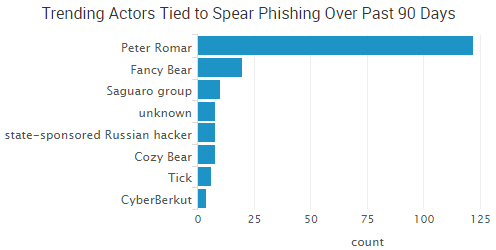
Warnings of targeted attacks like the ones described above have led to spear phishing being the most common practice tag related to social engineering over the past 90 days, according to SurfWatch Labs’ data.

2016-11-16_socialengineering.png

A wide variety of industry groups have been tied to spear phishing threats over the period. However, the most talked about cybercrime stories of the past month may have been the hacking and publication of emails from the Democratic National Committee and Hillary Clinton’s campaign chairman John Podesta, as well as what role those breaches had in shaping the recent US presidential election.

2016-11-16_socialengineering2.png

In those cases, the leaks have been tied to spear phishing emails from Russian hacking group Fancy Bear, one of the most prominent hacking groups related to spear phishing over the past 90 days, behind only Peter Romar, a 37-year-old Syrian national who recently pled guilty to his role in the Syrian Electronic Army.

2016-11-16_socialengineering3

Those Fancy Bear attacks used a particular tactic: the use of shortened URLs. As Esquire’s Thoma Rid wrote explained, those shortened URLs both tricked users into clicking malicious links at an alarming rate and, ultimately, helped researchers uncover the actors behind those targeted attacks:

To manage so many short URLs, Fancy Bear had created an automated system that used a popular link-shortening service called Bitly. The spear-phishing emails worked well—one in seven victims revealed their passwords—but the hackers forgot to set two of their Bitly accounts to “private.” … Between October 2015 and May 2016, the hacking group used nine thousand links to attack about four thousand Gmail accounts, including targets in Ukraine, the Baltics, the United States, China, and Iran. … Among the group’s recent breaches were the German parliament, the Italian military, the Saudi foreign ministry, the email accounts of Philip Breedlove, Colin Powell, and John Podesta—Hillary Clinton’s campaign chairman—and, of course, the DNC.

These breaches highlight some of the ways in which social engineering has continued to affect organizations across all sectors and how new techniques are incorporated in order to make it harder for individuals to detect suspicious activity.

That’s why training and awareness is often touted as the most important and cost effective step in combating social engineering, as we noted in a prior social engineering blog. Having the proper tools and training, along with up-to-date threat intelligence to inform them of the latest threats, can help organizations and their employees provide a better front line of defense against the evolving techniques used by threat actors.

Weekly Cyber Risk Roundup: Services Get Disrupted and Hacking Elections

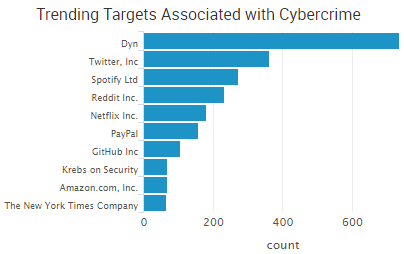
Distributed denial-of-service (DDoS) attacks and other incidents leading to service interruption have been widely discussed in the cybersecurity community ever since the October attack against DNS provider Dyn. This past week saw Marai-driven attacks that reportedly knocked out Internet access for the entire county of Liberia; however, security researchers such as Brian Krebs noted that those news articles may have exaggerated the facts as there is little evidence “anything close to a country-wide outage” occurred as a result of the attack.

2016-11-11_ITT.png

“While it is likely that a local operator might have experienced a brief outage, we have no knowledge of a national Internet outage and there are no data to [substantiate] that,” Daniel Brewer, general manager for the Cable Consortium of Liberia, told Krebs.

Nevertheless, concerns around DDoS attacks remain high, and some have speculated that the attacks against Liberia and others may be test runs for a larger attack in the future.

In other service interruption news, two apartment buildings located in Lappeenranta, Finland, and managed by facilities services company Valtia had the systems that controlled central heating and warm water circulation disabled by a DDoS attack. The systems tried rebooting the main control circuit in response to the attack, the CEO of Valtia said, and this was repeated in an endless loop resulting in the heat not working for the properties. Also, a unspecified malware infection caused three UK hospitals to cancel operations, outpatient appointments and diagnostic procedures for three days while staff access to patient records was restored. According to The Sun, approximately 3,300 patients at hospitals in Grimsby, Scunthorpe and Goole were affected. The attacks led to a high-severity alert being issued to National Health Service providers reminding “all users of the need for proactive measures to reduce the likelihood of infection and minimise the impacts of any compromise.”

2016-11-11_groups

Other trending cybercrime events from the week include:

  • Fraud and financial loss continue: Tesco Bank said the widespread criminal activity that led to the halting of online transactions has been narrowed down to £2.5 million in losses across 9,000 accounts – a drop from the 20,000 accounts previously reported. Sentinel Hotel is notifying customers of a breach after reports of unauthorized charges on guests payment cards led to the discovery of malware on a point-of-sale terminal. City of El Paso officials revealed the city was scammed out of more than $3 million via a phishing attack. The city has recovered about half of the money. A ransomware infection recently locked up several government systems in Madison County, Indiana, and county commissioners voted to pay the extortion demands in order to regain control of those systems.
  • Poor security leads to potential breaches: Researchers discovered that 128 car dealership systems were being backed up to a central location without any encryption or security, potentially exposing the personal information of both customers and employees. Cisco is warning job applicants that information on the Cisco Professional Careers mobile website may have been exposed as a result of an incorrect security setting following system maintenance. Newfoundland and Labrador’s privacy commissioner is ordering Eastern Health to examine controls around employees logging out of accounts after an incident in which a doctor failed to log out of Meditech patient information software and patient information was accessed and printed by an unknown person.
  • More breaches and data dumps: Two hackers claim to have used SQL injection to steal personal information from seven Indian High Commission websites and published the stolen databases in a Pastebin post. Anonymous Italia has defaced several police websites and leaked 70 megabytes of data presumably stolen from the databases of the Sindacato Autonomo Polizia Penitenziaria’s blog and its official monthly magazine. Integrity Transitional Hospital, based in Texas, recently reported a health data hacking incident that potentially affects the information of more than 29,000 patients.
  • Cybercrime leads to arrests: A man has been arrested for compromising more than a thousand university email accounts and then using that access to further compromise other social media and online accounts. The man allegedly accessed one university’s password reset utility approximately 18,640 different times between October 2015 and September 2016 and successfully changed the passwords for 1,035 unique accounts. An employee of Lex Autolease Limited pleaded guilty to selling the personal information of hundreds of customers to a third party. A 19-year old hacker plead guilty to creating and running the Titanium Stresser booter service, which has been used in more than 1.7 million DDoS attacks worldwide.

SurfWatch Labs collected data on many different companies tied to cybercrime over the past week. Some of those “newly seen” targets, meaning they either appeared in SurfWatch Labs’ data for the first time or else reappeared after being absent for several weeks, are shown in the chart below.

2016-11-11_ittnew

Cyber Risk Trends From the Past Week

2016-11-11_risk

Most industry sectors saw a slight decline in their SurfWatch Labs’ cyber risk scores this week. The biggest story of late, naturally, was the U.S. presidential election, and now that it is over, pundits from both sides are reflecting on how their candidates managed to win or lose the race. That examination includes the role that cybersecurity, hacking and data leaks may have played in the outcome.

In fact, back in August we posed that very question: would 2016 be the first presidential campaign ultimately swung by information obtained in a data breach? The answer remains uncertain. What is certain is that cyber-issues were put front-and-center in a way we have never seen in any other presidential election.

For example, in the days leading up to the election, WikiLeaks published 8,000 more leaked emails from the Democratic National Committee, dubbed #DNCLeak2. That dump came after a previous release of 20,000 emails from the DNC as well as 50,000 emails from Hillary Clinton aide John Podesta. The effect of those stolen emails being steadily leaked — and other cyber-issues such as Clinton’s personal email server — may be impossible to quantify, but they likely contributed in some way to nearly 60 percent of voters who perceived Clinton as a dishonest and untrustworthy candidate.

WikiLeaks founder Julian Assange wrote an election day post defending his actions and stating that publishing the stolen emails was not an attempt to influence the outcome of the election.

“We publish material given to us if it is of political, diplomatic, historical or ethical importance and which has not been published elsewhere,” Assange wrote. “At the same time, we cannot publish what we do not have. To date, we have not received information on Donald Trump’s campaign, or Jill Stein’s campaign, or Gary Johnson’s campaign or any of the other candidates that fulfills our stated editorial criteria.”

Clearly, Assange is saying if WikiLeaks did have information on other political candidates then that information would be made public as well — as it has in the past with the release hundreds of thousands of emails related to the government of Turkey. WikiLeaks claims to be non-partisan, but other threat actors do have a biased agenda and those actors are likely to be emboldened by the success of this year’s election-related hacks.

As Wired wrote: “For Russia, [Trump’s win] will also be taken as a win for the chaos-injecting tactics of political hacks and leaks that the country’s operatives used to meddle in America’s election — and an incentive to try them elsewhere. … That Russia perceives those operations as successful, experts say, will only encourage similar hacks aimed at shifting elections and sowing distrust of political processes in Western democracies, particularly those in Europe.”

Those efforts are already underway, researchers have noted, with at least a dozen European organizations being targeted by groups linked to the Russian state since that hacks against the DNC. Whether this election was ultimately swayed by breaches and other cyber-issues may be up for debate, but what is clear is that political and advocacy organizations are actively being targeted and that threat actors will likely try to influence future elections across the globe to align with their goals.

Controlling What You Can Control: Using the Threat Triangle to Gain Focus

With cyber-attacks on the rise and organizations looking for more effective ways to fend off malicious actors, cyber threat intelligence has emerged as a buzzword in cybersecurity. Unfortunately, some of the information being marketed as cyber threat intelligence isn’t backed up by much actual intelligence; rather, it’s just another threat feed to be added to the already large pile of data that needs to be evaluated.

Part of the problem with good threat intelligence, I recently wrote, is that it’s time consuming. Effective cyber threat intelligence shouldn’t just add to the ever-growing list of concerns facing your organization, it should provide actionable insight into how to best focus security resources to achieve solutions. Evaluating those specific threats, determining their relevance and coming up with practical solutions unique to your organization is hard work.

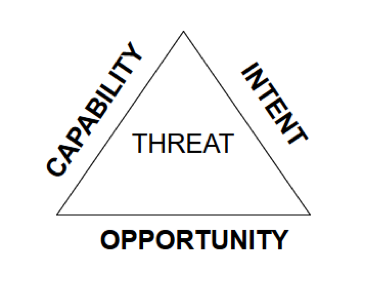
threat_triangleThere are many ways to evaluate threats, but I tend to revert to my Navy training when thinking about the cybersecurity of our customers. Our rules of engagement dictated evaluating threats from three avenues: the capability, intent and opportunity to cause harm.


Taken individually, each has seen an overall increase over the past few years. Taken together, the add up to what Europol recently characterized as the relentless growth of cybercrime.

Let’s briefly take a look at each pillar:

  • Capability of Threat Actors: As SurfWatch Labs noted in its recent report, officials have estimated that the bulk of the cybercrime-as-a-service economy may be powered by as few as 200 individuals, yet those services can put sophisticated cybercrime tools at the fingertips of a vast pool of actors. Europol agreed, writing in its report that “the boundaries between cybercriminals,  Advanced  Persistent  Threat  (APT)  style  actors  and other groups continue to blur.” Clearly the capability of threat actors continues to evolve, putting more organizations at higher risk.
  • Intent of Threat Actors: Cybercrime tends to be driven by either profit or the desire to cause harm to an organization. The growth of dark web marketplaces, the widespread adoption of successful tactics such as ransomware, and the increased focus on cybercrime by the media, government officials and regulators has widened actors’ abilities to monetize cybercrime and directly impact an organization’s brand and bottom line.
  • Opportunity for Threat Actors: A recent study found that 89 third-party vendors access a typical company’s IT system each week. In addition, the technology footprint of organizations continues to grow as more as-a-service solutions are implemented to increase productivity and more digital services are offered to customers. This provides threat actors with an expanding number of avenues that can be exploited — some of which are not directly under your control.

Despite this widely reported growth in the capability, intent and opportunity of threat actors, many individuals still feel as though they will never be targeted. A study released last month from the National Institute of Standards and Technology found that many people still hold the view that cybercrime will never happen to them and that data security is someone else’s responsibility. People feel overwhelmed by cyber threats, and as a result, they engage in risky behavior.

Simplifying Security, Control What You Can Control

The good news is that out of those three aspects used to evaluate cyber threats, organizations essentially have control over only one: opportunity. The capability and intent of threat actors are largely external to your organization; however, a real and measurable impact can be made when it comes to limiting the opportunities for cyber-attacks.

Unfortunately, many organizations have not done enough to close the opportunity window on cyber-attacks. That was a central theme of SurfWatch Labs mid-year report: despite claims of “sophisticated” attacks, the bulk of cybercrime observed has exploited well-known attack vectors. Europol’s September report also found that organizations were not helping themselves — in many cases providing ample opportunity for cybercriminals to exploit.

“A large part of the problem relates to poor digital security standards and practice by businesses and individuals,” Europol noted. “A significant proportion of cybercrime activity still involves the continuous recycling of relatively old techniques, security solutions for which are available but not widely adopted.”

This brings us back to the importance of evaluated cyber threat intelligence. Cyber threat intelligence should directly address that opportunity and provide solutions to close — or at least to severely limit — cybercriminal avenues of attack. What vulnerabilities are being actively exploited in your industry? What social engineering techniques are being leveraged in similar campaigns? How are threat actors monetizing the information and what is the potential impact if our organization faces a similar breach?

The answers to questions like these are a large part of the hard work that is the intelligence portion of cyber threat intelligence. Those answers can help to shine a light on paths that may significantly reduce your organization’s potential cyber risk.

Cyber threat intelligence, if done right, can help to limit the opportunity for threat actors to cause harm. This renders their capability less capable and their intent harder to pull off — at least against your organization.

Yahoo and Others Face Cybercrime-Related Brand Damage

A month after announcing one of the largest data breaches ever, Yahoo is continuing to deal with the subsequent fallout and reputation damage related to that massive cyber theft.

On September 22, Yahoo confirmed that information associated with at least 500 million user accounts was stolen. The day after that breach announcement, Yahoo saw a 474 percent rise in online mentions, according to social media monitoring company BrandWatch — 70 percent of which were negative. Since then there’s been an ongoing swirl of negativity surrounding Yahoo’s breach — from lawsuits to concerned regulators to potential lost users — and that has led to reports that Verizon may either push for as much as a $1 billion reduction in its pending $4.8 billion agreement to buy Yahoo or back out of the deal altogether.

The negativity around the Yahoo brand due to its breach poses a difficult-to-answer question: just how much damage does a cyber-attack actually have on the bottom line of a company?

Difficulty of Tracking Brand Damage

Tracking brand damage directly tied to a cyber incident is a difficult prospect; however, there does appear to be at least one correlation. A survey conducted by SANS for a December 2015 paper, Cleaning Up After a Breach Post-Breach Impact: A Cost Compendium, found that “the breaches receiving the most media attention also suffered the greatest loss in brand/reputation.”

Which comes first in that chicken-or-egg scenario is up for debate, but SurfWatch Labs’ data suggests that, for the most part, it’s the scope and potential damage of breaches that drive the media coverage, not the other way around.

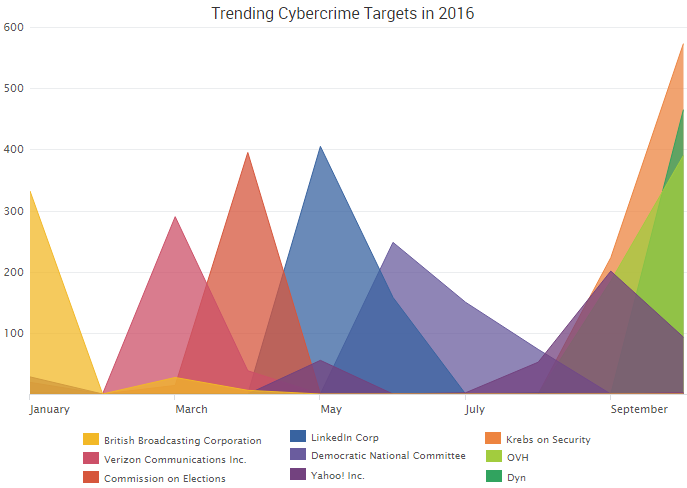
2016-10-26_targets
The Yahoo breach is one of the most talked about cybercrime events of the year.

A quick glance at the list of the year’s top trending cybercrime events, based on the number of CyberFacts collected by SurfWatch Labs, shows that the most-discussed targets generally line up with the most widespread and impactful breaches: the Philippines Commission on Elections, LinkedIn, the Democratic National Committee, Yahoo and, more recently, targets of major DDoS attacks.

Other High-Profile Incidents Damage Brands

Like Yahoo, Wells Fargo is dealing with similar ongoing brand issues after reports of employees fraudulently opening more than two million customer accounts dominated several news cycles last month. A survey of 1,500 bank customers by management consultancy firm cg42 found that negative perceptions of Wells Fargo had spiked from 15 percent before the scandal to 52 percent afterwards. Likewise, the number of prospects that were very or extremely likely to consider doing business with Wells Fargo has plummeted from 21 percent to just three percent.

“The short and medium term outlook for Wells Fargo is gloomy, and the fallout from the scandal will impact the bank’s bottom line for years to come,” the report stated.

Wells Fargo is attempting to stem the tide with a new advertising campaign that promises, among other things, to begin proactively notifying customers of new accounts that are opened in their names. That campaign follows the firing of thousands of employees and the resignation of CEO John Stumpf.

Similar resignations have followed other high-profile breaches this year, most notably the breach at the Democratic National Committee, which lead to the resignations of chairwoman Debbie Wasserman Schultz, chief executive Amy Dacey, chief financial officer Brad Marshall and communications director Luis Miranda.

The brand damage from a cyber-attack can also move down to the supply chain, as we noted last week with XiongMai Technologies, a Chinese electronic company that makes products used in many of the Internet-connected DVRs and cameras tied to the massive DDoS attacks against Krebs On Security, OVH and Dyn. XiongMai said on Monday that it would issue a recall of some of its U.S. products. That recall notice also threatened legal action against individuals and organizations who “defame” the company with “false statements,” but the threat of legal action has been described by some as simply a face-saving PR effort by a company that’s used to operating behind the scenes and selling its white-labeled products to other brands.

Extent of Yahoo Fallout Uncertain

If the Yahoo breach will have a direct impact on its acquisition by Verizon is yet to be seen. Verizon’s general counsel Craig Silliman told Reuters and other reporters two weeks ago that the incident could trigger a clause in the deal that says Verizon can withdraw if a new event “reasonably can be expected to have a material adverse effect on the business, assets, properties, results of operation or financial condition of the business.”

“I think we have a reasonable basis to believe right now that the impact is material and we’re looking to Yahoo to demonstrate to us the full impact,” Silliman said, adding that Verizon needed to obtain “significant information” before making a final decision.

Like cg42 noted about Wells Fargo, the effects of a major cyber incident can take years to fully play out, and even then, it can be difficult to attribute some of the years-long business trends directly back to one cybercrime event.

One takeaway worth noting is that many of the major cybercrime stories that remain in the spotlight each year contain a similar thread: the lack of proactively addressing cyber risk. That seemingly cavalier attitude around cybersecurity is frequently cited by both data breach litigation and government and private regulators — and it will often prolong the a negative story with hearings, lawsuits and a string of news stories that continue to cause brand damage long after the initial incident occurred.

Weekly Cyber Risk Roundup: Latest Breaches and Enhanced Security Standards

The massive distributed denial-of-service (DDoS) attack that disrupted websites and services on October 21 was the focal point of a large portion of cybercrime discussion last week. As we noted in a previous post, the attack against DNS provider Dyn has led to widespread concern about insecure Internet-connected devices and calls for government agencies to get involved in order to ensure those devices are secured against future attacks.

2016-10-28_ITT.pngAccording to some reports, the DDoS attack may have surpassed one terabyte per second of traffic; however, the latest analysis from Dyn indicates that the botnet behind the attack may have been much smaller than the initial reports of “millions.”
“It appears the malicious attacks were sourced from at least one botnet, with the retry storm providing a false indicator of a significantly larger set of endpoints than we now know it to be,” wrote Scott Hilton, EVP of products at Dyn. “We are still working on analyzing the data but the estimate at the time of this report is up to 100,000 malicious endpoints. We are able to confirm that a significant volume of attack traffic originated from Mirai-based botnets.”

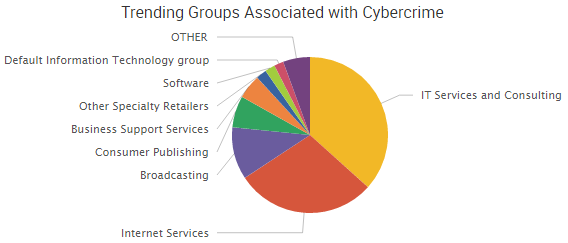
Other trending DDoS news includes the Syrian Cyber Army claiming responsibility for attacks against Belgian news organizations. The DDoS attacks made several news websites inaccessible or extremely slow, including De Standaard, Het Nieuwsblad, Gazet van Antwerpen, Het Belang van Limburg and RTFB. In another case of ideological hacktivism, Martin Gottesfeld, 32, was indicted for his role in DDoS attacks against Boston Children’s Hospital (BCH) and the Wayside Youth and Family Support Network. Gottesfeld admitted to his involvement in #OpJustina in a written editorial, saying that the attack against BCH was designed to interfere with a fundraiser in order to cause maximum financial damage. Finally, The Guardian is reporting that financial institutions in London are stockpiling bitcoins in the event extortionists target them with powerful DDoS attacks.

2016-10-28_groups

Other trending cybercrime events from the week include:

  • Payment card breaches announced: Danish payment processor Nets is warning of a payment card breach that appears to be tied to a foreign-based Internet retailer and is advising banks to block up to 100,000 cards in order to prevent fraudulent transactions. A data breach at Hitachi Payment Services, which manages ATM network processing for Yes Bank, is suspected to be the cause of recent fraud that has led to banks in India either replacing or asking customers to change security codes on 3.25 million debit cards. A pro-Donald Trump super PAC known as Great America PAC has mistakenly published the credit card numbers and expiration dates of 49 donors. Last month the same super PAC exposed 336 donors’ email addresses and phone numbers.
  • Data breaches continue, both large and small: A Red Cross Blood Service database of 1.28 million donor records going back to 2010 was accidentally published to a webserver by a third-party contractor. A hacker known as Peace told Motherboard he hacked Adult FriendFinder and obtained a database of 73 million users, and another hacker known as Revolver or 1×0123 posted screenshots appearing to show he had access to the website’s infrastructure. A Ukrainian hacker group known as CyberJunta has released more than a gigabyte of emails stolen from the office of Russian politician Vladislav Surkov. Baystate Health is notifying about 13,000 patients that their personal information may have been compromised due to a phishing attack that was designed to look like an internal memo. Virgin Media potentially exposed the personal information of up to 50,000 people applying for jobs. Rocky Mountain Credit Union in Montana notified 135 of its members that their personal information may have been accidentally exposed due to an undisclosed security issue discovered on the website customers use to upload documents related to mortgage applications. The University of Santa Clara’s Office of Marketing and Communications had internal documents stolen and leaked to the student newspaper due to an employee leaving his or her username and password in plain site at a workstation.
  • Update on cybercrime charges and arrests: The Booz Allen Hamilton contractor who was arrested for the possession of classified NSA materials allegedly had documents dating back to 1996 that were marked either “secret” or “top secret,” according to recent court filings. In total, investigators have seized more than 50 terabytes of information and thousands of pages of documents. Celebgate hacker Ryan Collins, 36, of Lancaster, Pennsylvania, was sentenced to 18 months in prison for using phishing emails designed to steal Apple and Google credentials and then using those stolen credentials to hack into more than 100 accounts. Authorities said there is no evidence that Collins was responsible for the leak of nude celebrity photographs tied to the hack. Yevgeniy Nikulin, the Russian man who was arrested in connection with the 2012 LinkedIn breach, has also been indicted for his alleged role in the breaches at Dropbox and Formspring, according to documents unsealed on Friday.

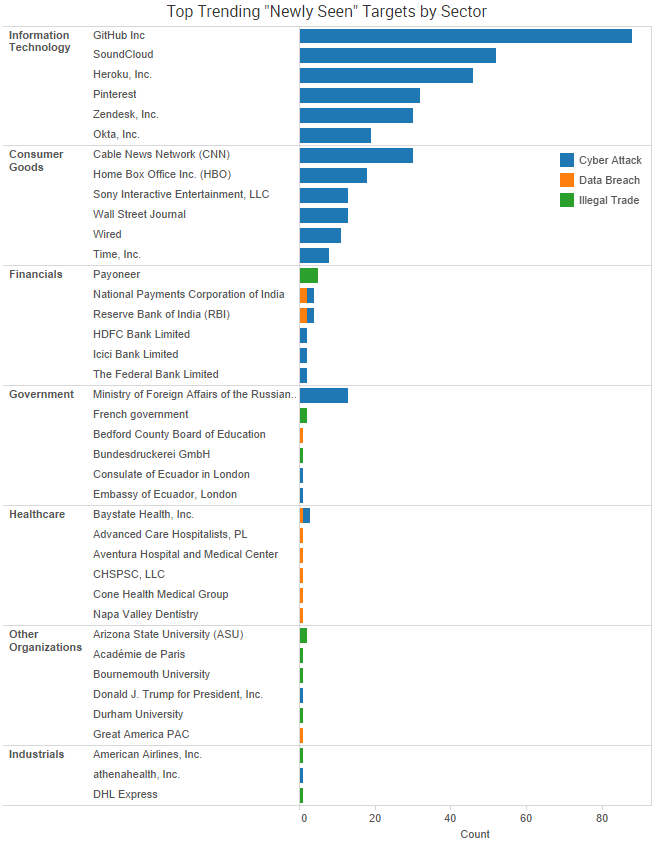
SurfWatch Labs collected data on many different companies tied to cybercrime over the past week. Some of those “newly seen” targets, meaning they either appeared in SurfWatch Labs’ data for the first time or else reappeared after being absent for several weeks, are shown in the chart below.

Note: Dyn, by far the top trending new target, is not shown in the chart below in order to make the other targets more readable.

2016-10-28_ittnew

Cyber Risk Trends From the Past Week

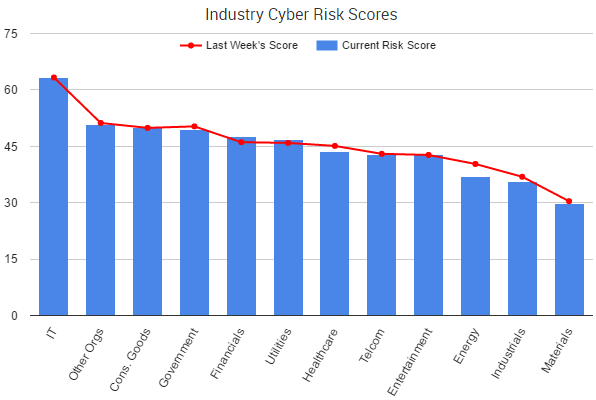
The Financials sector’s cyber risk score peaked in early October, reaching its highest level since February 2016. Since then, it has steadily declined for most of the month — until the past week. This week’s rise in cyber risk score (+2.2%) was the biggest increase of any sector over the period.

2016-10-28_risk

Part of that may be tied to the recent payment card breaches highlighted above, which began at online retailers and other providers before moving to directly impact banks. For example, the chief executive of National Payments Corp of India said that the spike in reported fraud that led to advising banks to replace cards was tied to a possible compromise of one of the payment switch provider’s systems. Sources told Reuters that the issue stemmed from a breach in systems of Hitachi Payment Services, which is currently investigating the matter.

That interconnectivity of the Financials sector has led to concerns from government agencies, and the the Board of Governors of the Federal Reserve System, the Office of the Comptroller of the Currency and the Federal Deposit Insurance Corporation recently issued a joint proposal on enhanced cyber risk management standards to address those concerns.

“Due to the interconnectedness of the U.S. financial system, a cyber incident or failure at one interconnected entity may not only impact the safety and soundness of the entity, but also other financial entities with potentially systemic consequences,” the proposal stated. “The enhanced standards would be designed to increase covered entities’ operational resilience and reduce the potential impact on the financial system in the event of a failure, cyber-attack, or the failure to implement appropriate cyber risk management.”

The proposal addresses five categories of cyber standards: cyber risk governance; cyber risk management; internal dependency management; external dependency management; and incident response, cyber resilience, and situational awareness.

According to the proposal, “The agencies are considering establishing a two-tiered approach, with the proposed enhanced standards applying to all systems of covered entities and an additional, higher set of expectations, or ‘sector-critical standards,’ applying to those systems of covered entities that are critical to the financial sector.”

The enhanced standards would apply to certain entities with total consolidated assets of $50 billion or more on an enterprise-wide basis, they added. Comments on the proposal are open until January 17, 2017.