Intentional or Not, Insider Threats Remain a Huge Risk to Businesses

Insiders are one of the most dangerous threats all organizations face, as the players involved in these attacks usually have easy access to an organization’s resources. Taking a look at the recent $81 million bank heist from the Central Bank of Bangladesh, the FBI suspects that this attack was an inside job, with several people who work for the bank playing a key role in the theft. If this attack was perpetrated by insiders — such as employees at the bank or with SWIFT — it would be one of the biggest insider attacks ever conducted and would further validate the dangers of an insider threat to an organization.  

However, not all insider threats have malicious intent.

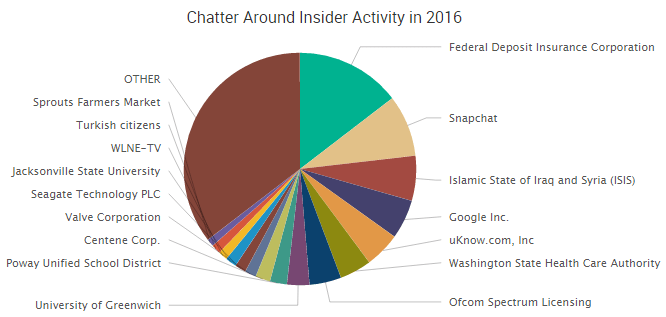
Some of the easiest and most harmful ways an organization is compromised through insider activity is simple human error. In April the Federal Deposit Insurance Corporation (FDIC) was the victim of a potential data breach after a former employee left the agency with a file containing personal information from 44,000 customers.

This wasn’t the first time FDIC employees have mishandled customer information. In May the FDIC’s chief information and privacy officer Lawrence Gross was called to testify before the House Science, Space and Technology Committee to discuss seven instances of employees accidentally downloading customer details as they were leaving the company.

SurfWatch Labs’ Insider Threat Data

Insider Activity 2016
The FDIC has the most CyberFacts tied to insider activity in 2016.

The motivation for insider data breaches varies, but company data tends to be the most affected, according to SurfWatch Labs’ data.

Insider Activity Tags
Data is the most sought after target from insider threats, with employees naturally being the most common insider threat actor. 

Legal Ramifications of Insider Theft

On May 27, 2016, the U.K.’s Information Commissioner’s Office (ICO) issued a warning to employees about taking client records to a new company. In the warning, the ICO referenced an incident involving a former waste disposal employee who took client information with him to a new job that was a rival company.

The information contained data on clients such as contact details and purchase history. Mark Lloyd, the former employee of Acorn Waste Management, emailed the contacts list from his previous business account to his personal account. Lloyd’s actions violated the U.K.’s Data Protection Act, leading to a guilty plea from Lloyd and costing him over 700 Euros in fines.

Steve Eckersley, the head of enforcement at ICO, provided the following warning to employees about mishandling client records:

“Employees need to be aware that documents containing personal data they have produced or worked on belong to their employer and are not their to take with them when they leave. Don’t risk a day in court by being ignorant of the law.”

Lloyd’s actions were clearly to bring new clients to a rival business, but his actions had bigger implications than simply stealing business from his previous employer. By sending these contacts to his personal email server, Lloyd compromised the information of these customers.

Organizations face many problems protecting data, and a malicious insider could be the biggest of those threats due to employees knowing proprietary information and often having legitimate access to sensitive data such as customer lists. Most employees are loyal, and though the most egregious data breaches involving malicious insiders have a tremendous impact to the victimized organization, it is the every day errors committed by these loyal employees that leave a company the most vulnerable.

Anonymous Ops Trending, Where are the Other Hacktivists?

Not long ago, several hacktivist groups like the Syrian Electronic Army and Lizard Squad were making headlines on a weekly basis with new hacktivism campaigns and random attacks. While Anonymous has always been the primary source of hacktivism throughout the world, it is interesting to see how these other prominent hacktivist groups’ activity has essentially fallen off the map. Where have all the hacktivists gone?

Taking a look at SurfWatch Labs’ data, Anonymous has been (and will remain) the top trending hacktivist group in 2016, with other factions of Anonymous such as New World Hacking and Ghost Squad Hackers providing additional support to the many Anonymous campaigns currently in existence.

2016-05-23_hacktivistactors
Anonymous is by far the top trending hacktivist group in 2016. Several other Anonymous-affiliated groups also made the list. 

The members of the Anonymous collective have been busy in 2016. New campaigns are underway, but several operations that were created in previous years have seen the most activity to date.

2016-05-23_hacktivistops
Throughout each month so far in 2016 an Anonymous campaign has made headlines. 

Government Sector Targeted, Financials Sector Trending

The government sector has been targeted the most by hacktivism in 2016 by a large margin. The data breach of the Philippines Commission on Elections is by far the top trending hacktivism target.

2016-05-23_hacktivism
The Government sector has been targeted the most by hacktivism in 2016. The Philippines Commission on Elections is the top trending industry target. 

Two Anonymous-affiliated groups were behind the data breach of the Commission on Elections: Anonymous Philippines and Lulzsec Pilipinas. The breach affected 55 million Filipino voters and is considered one of the biggest government data breaches on record.

The Financials sector has also seen a lot of activity over the last month. This is largely due to #OpIcarus, a campaign created by members of Anonymous that is specifically targeting banks.

As the chart illustrates above, several banks are trending, with new banks targeted by #OpIcarus making headlines seemingly on a weekly basis. Between May 13 and 19, a total of 18 banks suffered DDoS attacks at the hands of Anonymous.

Where are the Other Hacktivist Groups?

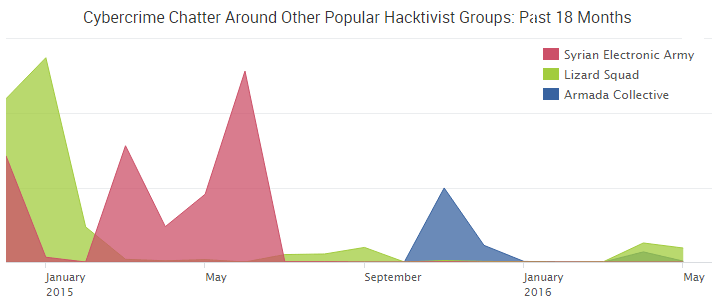
Anonymous continues to make headlines while other prominent hacktivist groups remain stagnant. Groups like Lizard Squad, the Armada Collective, and the Syrian Electronic Army (SEA) appear to have almost completely ceased all operations. The CyberFacts collected by SurfWatch Labs backs this up, with 2015 being the last time any significant conversation took place among the three groups.

2016-05-23_hacktivistgroups
The chart above shows negative CyberFacts for SEA, Lizard Squad, and the Armada Collective over the past 18 months. 

Syrian Electronic Army
Once one of the most recognized hacktivist groups, the SEA has seemingly disappeared since the summer of 2015. Most current news surrounding the SEA involves legal and law enforcement content as members of the group are being hunted down for past hacking activities. The SEA has been involved with many cyber-attacks, including the the hijacking of the Associated Press Twitter account and the takeover of Forbes. The group was founded in 2011, with most of their activity occurring during 2013 and 2014.

Lizard Squad
Perhaps one of the most notorious groups linked with DDoS attacks, Lizard Squad made a name for themselves after launching multiple DDoS attacks against the Sony Playstation Network and Xbox Live. The group has engaged in a war with Sony Online Entertainment president John Smedley, leading to bizarre events such as calling in a fake bomb threat to an airline which Smedley was a passenger of and effectively grounding the flight. Lizard Squad has recently made headlines without any effort, as a group of unknown hackers were posing as the hacktivist group in an effort to extort money from U.K. businesses through the threat of a DDoS attack. As for actual current activity from Lizard Squad, Blizzard reported a DDoS attack from the group back in April 2016.  

Armada Collective
The Armada collective is the newest hacktivist group out of the three, and it is well-known for its DDoS extortion attacks against online retailers, a method of attack that was first made popular by another hacker group, DD4BC. The group was very active towards the end of 2015, attempting to extort several companies. Much like ransom demands, experts have overwhelmingly warned companies not to give into these attacks. The group went silent in late 2015, although other groups continue to use the group’s name for fake DDoS threats, which unfortunately lead to the group earning over $100,000 for their efforts.

While many people find the threats of hacktivism to be just a nuisance, the damage created from a single attack can have lasting consequences. DDoS attacks — the primary hacktivist weapon of choice — can impact a company through financial losses and damaged brand reputation due to the amount of time the company’s servers are down. In other attacks, sensitive data can be obtained and leaked on the Internet for other criminals to exploit. Hacktivism hasn’t been as prominent in 2016 compared to years past, but the threat posed from these groups remains the same, and companies need to remain diligent in protecting from these threats.

Top Dark Web Markets: AlphaBay and Stolen Credentials

Dark web markets are constantly changing. The last major shakeup to occur was the disappearance of the Nucleus Market, which has been offline for nearly a month and a half. Since then, the site’s users have flocked to other markets in search of an alternative.

Many of those users have transitioned to AlphaBay, the current king of dark web markets. AlphaBay was the most popular marketplace before Nucleus Market disappeared. Since then it has only grown more popular.

AlphaBay_May2016_2
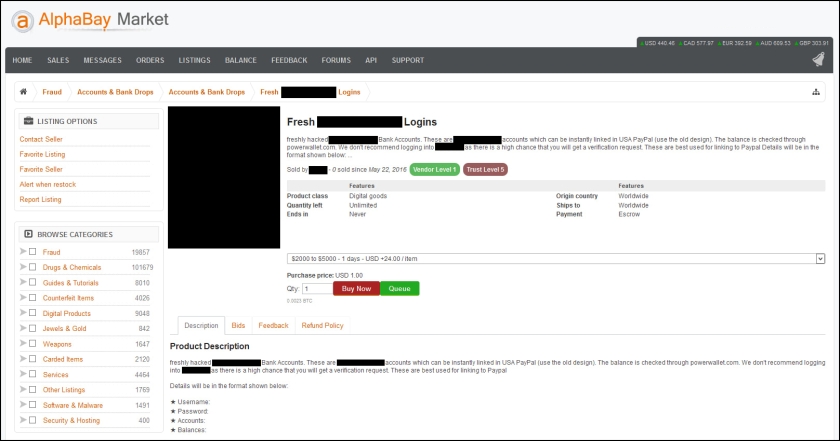
A vendor selling hacked bank account logins on AlphaBay.

A similar surge happened in March 2015 after the administrators of the dark web marketplace Evolution shut down and stole users’ bitcoins in an “exit scam.” In the three days following Evolution’s disappearance, AlphaBay received 18,000 new registrations, said alpha02, a well-known carder and founder of the AlphaBay market. A few months later another major dark web market, Agora, announced it was shutting down due to security issues. Once again, AlphaBay membership surged. By October 2015 AlphaBay announced it had hit 200,000 users and become one of the most popular markets on the dark web.

That growth has continued. In early January there were approximately 12,500 fraud-related listings. Today there are close to 20,000.

How Does AlphaBay Work?

As we noted last month, there are a lot of misconceptions about the dark web, and it is not hard for the average person to find these websites and purchase illicit goods and services. However, the markets are also full of law enforcement, researchers conducting threat intelligence (like SurfWatch Labs), and scammers. As a result, those buying and selling items tend to be concerned about two things: anonymity and security.

  1. Anonymity when purchasing: The combination of tools such as Tor, which helps users anonymously access the markets, and the growth of virtual currencies, which helps users anonymously purchase illegal items, has helped dark web markets such as AlphaBay flourish.
  2. Security among thieves: AlphaBay offers multi-signature escrow to help protect buyers from getting scammed. Money is deposited into a wallet with three people having keys: the buyer, the seller and the market. Two of those keys are needed to approve payment. If the buyer is happy, he or she releases the key and the seller is paid. If there is a dispute, the moderator can approve payment and give the second key to the seller — or deny payment and give the key to the buyer.

In addition, in just the past few months AlphaBay has rolled out mandatory two-factor authentication for vendors as well as a detailed privacy policy — the first dark web market ever to do such a thing, it claims.

Many markets try to emulate the customer-friendly features seen on popular e-commerce sites such as Amazon or eBay. In the case of AlphaBay, there is both a “Vendor Level,” which is based on number of sales and amount sold, and a “Trust Level,” which is based on the level of activity within the community as well as feedback from users. In addition, buyers can view feedback in the forms of reviews and star ratings.

AlphaBayFeedback_edited
Seller ratings on AlphaBay.

The key takeaway for those unfamiliar with these cybercriminal markets is that it is not that different an experience from buying things via the normal web.

What’s for Sale on AlphaBay?

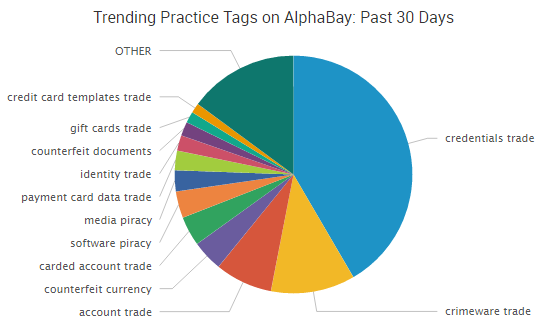
Being the most popular dark web market, AlphaBay offers nearly every type of item or service for sale. Drugs are the most common type of item — as is true of most markets. SurfWatch Labs doesn’t collect data on every listing, instead focusing mainly on cybercrime-related items. Of those, credentials trade is the top trending practice tag over the past 30 days.

2016-05-24_alphabay_practices
Although all types of items are for sale on AlphaBay, credentials trade is the top trending practice tag over the past month, according to SurfWatch Labs.

Credentials trade includes logins for various services and financial institutions. Those credentials can then be used for fraud, as a stepping stone for further attacks, or simply to use legitimate services such as Netflix or Uber for free. 

Specific items related to credential theft for sale the past few weeks include …

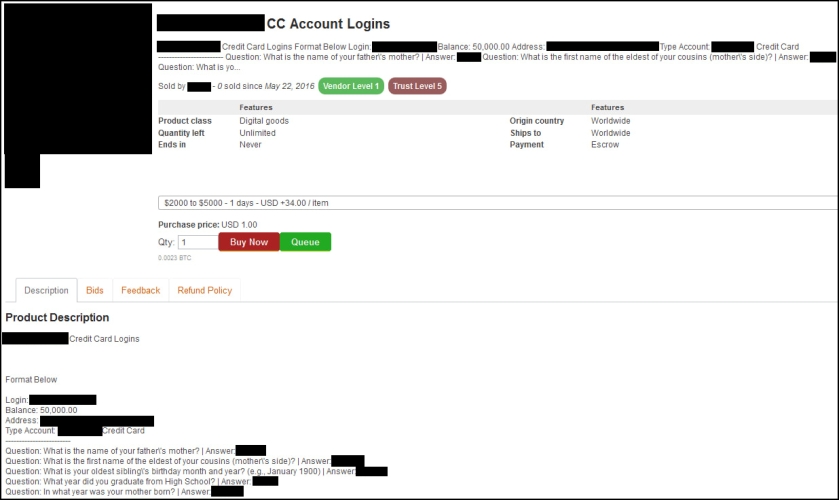
Credentials to access various credit card accounts or the information to answer associated security questions:

creditcardlogins.jpg

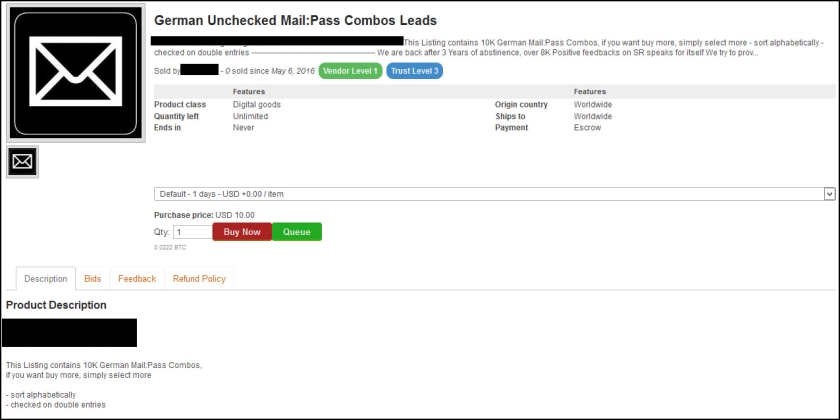
Credentials that can be bought in bulk such as this list of 10,000 German email addresses and passwords:

germanemail.jpg

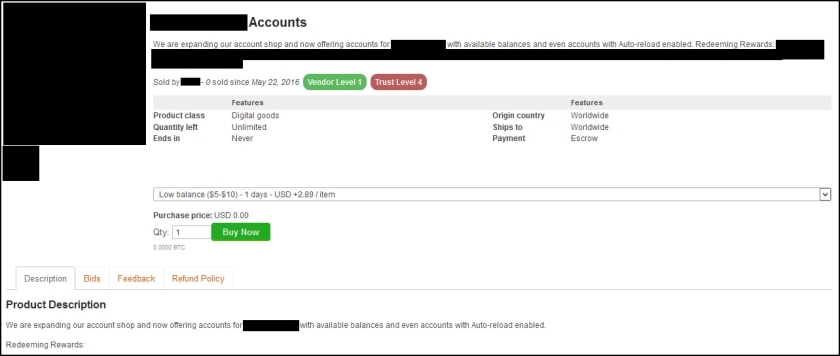
Credentials for customer accounts at various restaurants and coffee shops, including some that have payment information connected to “auto-reload” the account whenever the balance gets low enough:

restaurants.jpg

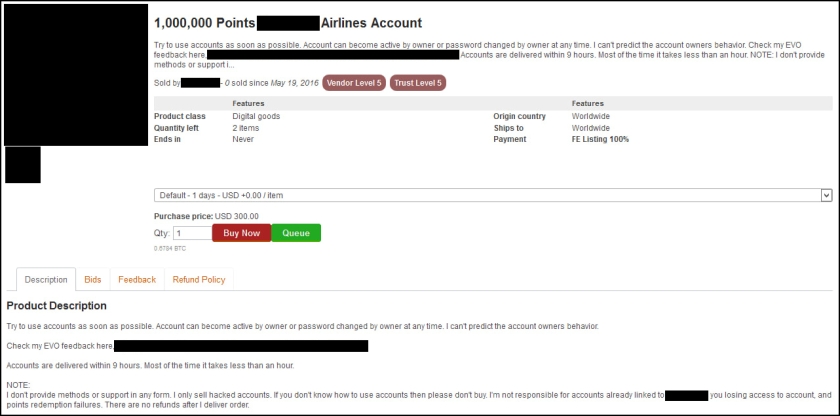
Credentials for reward accounts from airlines and other retailers that can be redeemed for various goods and services:

rewardspoints.jpg

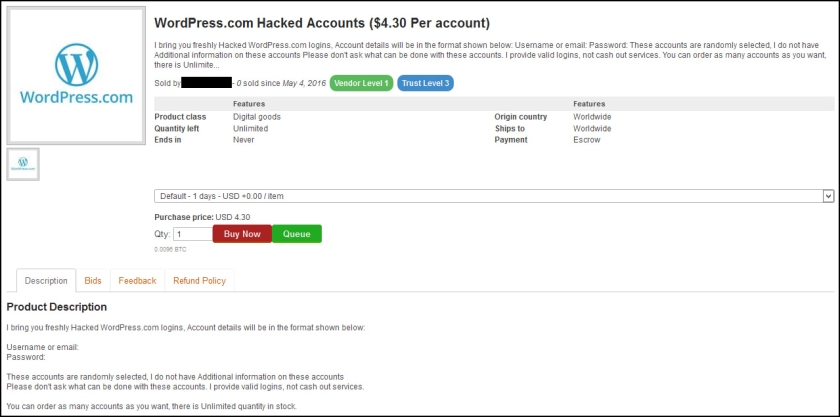
Credentials for hacked websites such as WordPress blogs:

wordpress.jpg

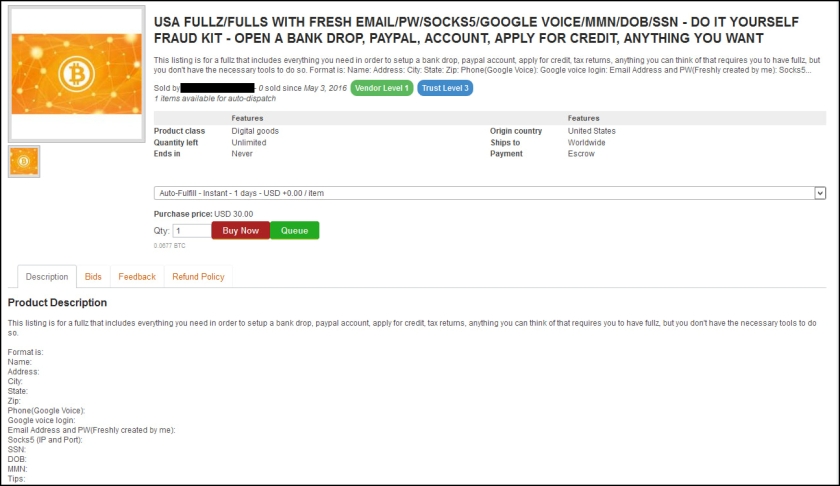
Full profiles — which include names, email, passwords, phone numbers, Social Security numbers, dates of birth and more — basically, everything needed to set up an account, apply for credit or perform other fraudulent actions:

fullz.jpg

And credentials for many, many more accounts.

Where do all of these stolen credentials come from? They come from data breaches, malware that captures keystrokes, phishing and, as we noted earlier this week, the problem of people continuing to reuse passwords across multiple sites, which allows automated tools to use those giant lists of previously stolen credentials to gain access to other sites.

Of course, AlphaBay offers a plethora of other items for sale unrelated to stolen credentials, and we’ll touch on some of those in the coming week’s as we examine the other dark web markets. Those top markets tend to change due to exit scams, security concerns or law enforcement actions, but for now AlphaBay remains the king of the underground.

Credential Theft and the Problem of Non-Breach ‘Breaches’

Earlier this month, news outlets across the country reported on the latest mammoth list of stolen credentials — 272 million in total.

“It is one of the biggest stashes of stolen credentials to be uncovered since cyber attacks hit major U.S. banks and retailers two years ago,” Reuters reported.

Turns out, the total number of actual accounts affected is much, much less — a representative for Google put the total number of bogus Google accounts at 98% — however, the story does bring a crucial cybersecurity point back to the forefront: stolen credentials and the collateral damage they cause. Companies are continually finding themselves in the news for data breaches that aren’t really breaches at all.

For example, this year we’ve seen:

  • Spotify had a list of user credentials posted to Pastebin, leading to a spate of articles about the company “denying” a data breach. “Spotify has not been hacked and our user records are secure,” the company repeatedly told reporters and bloggers.
  • China’s online shopping site Tabao had hackers use a database of previously stolen usernames and passwords to try to access over 20 million active accounts. “Alibaba’s system was never breached,” a spokesperson noted.
  • Reddit recently had more than 100 subreddits defaced when a hacker went on a spree of taking over moderator accounts. The Register speculated that it was “possible the hacker is testing breached passwords against the accounts to pop weak or reused credentials.”

In nearly every case, along with the negative — and some may argue unfair — breach-related headlines, a spokesperson steps up to say the same thing: we weren’t breached and the theft is likely due to customers reusing credentials that were stolen elsewhere.

Verizon’s recent Data Breach Investigations Report highlighted the issue as well: 63% of confirmed data breaches involved weak, default or stolen passwords. The report authors noted, “The use of stolen, weak or default credentials in breaches is not new, is not bleeding edge, is not glamorous, but boy howdy it works.”

As we repeatedly see, the reuse of stolen credentials puts many companies in the unfavorable position of having to deny a data breach happened — even as customer accounts are getting taken over.

Easy-to-Use Tools

Automated tools have made it easy for cybercriminals to take these massive lists of stolen credentials — such as the list of over 100 million LinkedIn credentials — and test those credentials against popular websites until they find cases of password reuse.

How often does that work? It varies depending on who you ask, but Shape Security recently wrote about its experience examining one of the popular tools used in these “credential stuffing” attacks.

“We have found that most combo lists have a 1% to 2% success rate, meaning that if an attacker purchases a list from a breach on site A (or a combination of site breaches) and then uses Sentry MBA (or another credential stuffing tool) with that list to attack site B, 1% to 2% of the usernames and passwords from site A will work on site B,” wrote Shape Security chief security scientist Xinran Wang.

One percent may not seem like much, but as Wang points out, if an attacker has a list of one million credentials, they may be able to hijack 10,000 accounts on any popular website using these readily available tools.

In some cases, this amounts to a massive number of fraudulent logins. According to Shape Security researchers, over a one week period last December, attackers made five million log-in attempts at the website of a Fortune 100 company using the Sentry MBA tool.

That’s why some of these recent legitimate breaches have been so widely criticized. The companies in question often are not taking into account the potential collateral damage.

Big Breaches and Collateral Damage

Last month security researcher Troy Hunt reported that over seven million user accounts for the Minecraft community “Lifeboat” were compromised. According to Motherboard, Lifeboat didn’t bother telling its users about the potential issue — and how it may affect other accounts with similar credentials.

“When this happened [in] early January we figured the best thing for our players was to quietly force a password reset without letting the hackers know they had limited time to act,” said a Lifeboat representative, not clarifying to Motherboard when pressed why the company never informed its users. “We have not received any reports of anyone being damaged by this.”

But would they know if someone used those stolen credentials to log into someone’s email or social media or bank account?

Likewise, Brian Krebs recently criticized LinkedIn’s handling of its massive breach of user credentials. In 2012, LinkedIn discovered a data breach that it thought affected 6.5 million users. The company contacted those users to force a password reset. However, last week they discovered the breach actually impacted more than 117 accounts.

“Inexplicably, LinkedIn’s response to the most recent breach is to repeat the mistake it made with original breach, by once again forcing a password reset for only a subset of its users,” Krebs wrote.

“We did at the time what we thought was in the best interest of our member base as a whole, trying to balance security for those with passwords that were compromised while not disrupting the LinkedIn experience for those who didn’t appear impacted,” LinkedIn spokesman Hani Durzy said in an email to Krebs about the 2012 incident.

But what about the more than 100 million potentially compromised credentials that may have been used for years without users even being aware they may have been stolen?

Looking Forward

There will always be a subset of users that reuse credentials, and those users will always be at increased risk of their accounts being hijacked. Unfortunately for companies, their names are often associated with a data breach or a hack even if it is an event driven largely by a combination of other organizations’ breaches and bad password habits.

Implementing additional layers of security such as two-factor authentication can help protect those customers. Or organizations can follow the lead of proactive companies like Amazon, which recently reset some users passwords after finding a list of leaked credentials online.

“While the list was not Amazon-related, we know that many customers reuse their passwords on multiple websites,” Amazon wrote to impacted users. “Since we believe your email addresses and passwords were on the list, we have assigned a temporary password to your Amazon.com account out of an abundance of caution.”

Until organizations get more proactive or force users to implement more layers of security, with so many stolen credentials available to cybercriminals, expect organizations to continue to make negative headlines due to these “non-breach breaches.”

Ransomware Is Not the Top Cybersecurity Threat Facing the Healthcare Sector

Ransomware is making all the headlines so far in 2016. This threat has become so mainstream it has caused both the FBI and US-CERT to issue ransomware alerts, with the healthcare sector being mentioned in both.

On March 31, 2016, the United States Computer Emergency Readiness Team (US-CERT) issued a ransomware warning concerning the Locky and Samas ransomware variants – both of which have been used to target hospitals and other healthcare targets.

On April 29, 2016, the FBI wrote a post warning of the rise in ransomware threats, saying that ransomware attacks were prevalent in 2015 and will continue to grow in 2016.

“Ransomware attacks are not only proliferating, they’re becoming more sophisticated,” the FBI post read. “Several years ago, ransomware was normally delivered through spam emails, but because email systems got better at filtering out spam, cyber criminals turned to spear phishing emails targeting specific individuals.”

However, when you look at the biggest data breaches in healthcare, are ransomware attacks really deserving of all the headlines?

Despite Ransomware Trend, Healthcare Most Impacted By Data Loss

SurfWatch Labs has collected data on 141 healthcare cybercrime targets so far in 2016, and the ransomware attacks against Hollywood Presbyterian Medical Center and Medstar Health have been the top two most discussed industry targets to date.

2016-05-16_healthcareitt
Ransomware attacks such as the ones against Hollywood Presbyterian Medical Center and MedStar Health have dominated the discussion around healthcare sector cybercrime in 2016.

Both Hollywood Presbyterian Medical Center and MedStar health made huge headlines this year after being victimized with ransomware. Hollywood Presbyterian paid the ransom demand to get their data back. Medstar Health was able to get their systems operational without paying a ransom.

While infected assets leads the way in terms of chatter around healthcare sector cybercrime effects this year – largely due the high level of ransomware discussion – stolen or leaked personal information and data are leading the way when looking at the total number of distinct healthcare targets being impacted by cybercrime so far this year.

upload
Although not receiving the most discussion (CyberFacts), the stolen personal information and stolen data tags are associated with the highest number of healthcare targets impacted by cybercrime in 2016.

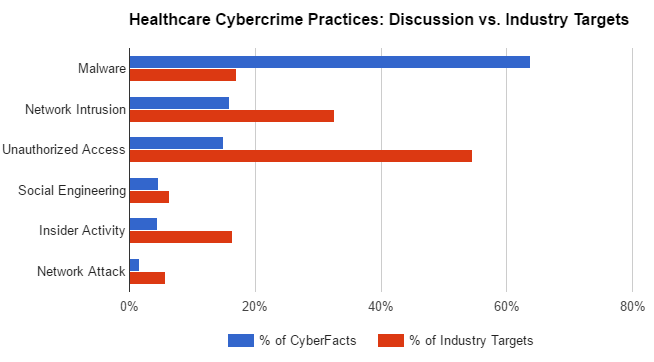
Similarly, while malware dominates the chatter around healthcare sector cybercrime practices, unauthorized access is the top trending practice category in terms of the actual number of affected targets.

upload1
Malware is leading the way in terms of discussion for the Healthcare sector in 2016; however, unauthorized access was the leading practice used in attacks against healthcare by total number of industry targets.

While everyone is talking about malware – more specifically, ransomware – affecting healthcare targets, if we dig deeper into that top practice category it’s clear that the old-fashioned, tried-and-true methods used by cybercriminals are causing the most damage in the healthcare sector in 2016.

2016-05-16_unauthorizedaccess
Physical theft was the top trending unauthorized access practice tag to date in the healthcare sector. 

Criminals Are Still Seeking Healthcare Data

While it is still important for hospitals and healthcare companies to worry about the threat of ransomware, as SurfWatch Labs’ data shows, ransomware attacks are just the tip of the iceberg when it comes to cyber threats facing the healthcare industry.

Several attack vectors are present in the healthcare industry. Phishing and social engineering attempts are still the primary cybersecurity threat concerning healthcare facilities, with stolen laptops and flash drives also creating a severe issue protecting data.

W-2 data breaches have made several headlines this year, affecting organizations throughout all sectors – including healthcare. Healthcare companies Main Line Health, York Hospital, E Clinical Works, Endologix, Care.com, CareCentrix, and Magnolia Health Corporation all suffered W-2 data breaches in 2016 that stemmed from a simple phishing email.

The verdict is in; ransomware isn’t going anywhere and will continue to trend throughout 2016. However, we can’t forget about the old-fashioned methods used by hackers since the dawn of the Internet when it comes to protecting organizations from cybercrime. Ransomware has become popular due to its ease of execution and potential to make a quick buck, but the valuable data stored throughout the healthcare sector is still the holy grail for cybercriminals looking for a bigger score.

Nucleus Market Vanishes – Now What?

Over the past year, the number two Dark Web market in terms of activity was Nucleus. As of late 2015, this market had more than 25,000 vendor listings, but on April 13 of this year, Nucleus disappeared.

While it’s not the first time Nucleus has been down and it’s not uncommon for Dark Web markets to go offline, we are now one month into this “downtime.” As recently as May 8 there are still more than 5000 Bitcoins in the Nucleus wallet (a value of more than $2.25M USD). Here are some possible explanations:

  1. Exit Scam? There is a lot of talk from Nucleus Market buyers and sellers of an “exit scam.” Exit scams occur when the marketplace vendor wants out of the game and closes up shop, but doesn’t tell users and continues to accept payments in Bitcoin. If this is case, the owner of Nucleus Market may have pulled off quite the heist. However, there is a substantial quantity of bitcoins associated with the Nucleus Market and they continue to build each day. Since the market went offline there have been no withdrawals from the Nucleus wallet; however, there has been continuous deposits. Is the owner planning to grab that money and run? Or not?
  2. Hacked? Another possibility is that Nucleus was hacked and subsequently brought down. Legit business aren’t the only ones being victimized. There is some speculation that an actor who goes by the handle “theDmaster” exacted revenge on the market after he was kicked out. If this occurred, it’s possible that a) the access to the Bitcoins has been blocked as part of the attack or b) that the owners of Nucleus are in fact trying to get the market back up and running and thus have not run off with the Bitcoins.
  3. Busted? It’s also possible the Nucleus market was busted by law enforcement and/or the site’s owners are in hiding. The alleged administrators of Nucleus recently posted a comment about Interpol seizing their servers and that they were now working with Dream Market (another dark web marketplace) but this could just as easily be a plug from  competitor Dream Market in the hopes of winning Nucleus market customers.

Investigations will of course continue into Nucleus Market but how does what we know now impact dark web trade?

Before its disappearance from the Dark Web, Nucleus market was one of the top places to go for:

  • Drugs and paraphernalia
  • Fraud related activity (such as payment card information, stolen accounts)
  • Guides & tutorials (How to card; Get rich quick schemes; Black Hat SEO; Drug manufacturing)
  • Services (such as hacking for hire, fraud related services)
  • Counterfeits (i.e. money, apparel, tickets, etc.)
  • Digital goods, media piracy
  • Electronics
  • Erotica
  • Jewelry
  • Lab supplies
  • Weapons

Nucleus vendors now need to get their wares ready for sale on other markets. There has been significant buyer and vendor chatter about moving to AlphaBay, Dream Market, Hansa, Oasis, Valhala, Acropolis and new markets such as LEO. If they do, these vendors must re-establish street cred on the markets where they set up shop. It may also take time for buyers to find their preferred vendors.

What does this mean for you?

First, recognize there is no honor among thieves. Second, and more importantly, this highlights the “intelligence challenge” of dark web surveillance as markets and vendors disappear and sometimes reappear. By tracking the commodities being sold on the black markets, organizations can gauge the underground market economy and get an idea of what commodities are being actively sold, what prices they are being sold for, and how much volume they are moving. No different than a legitimate business, you can get a sense of what commodities are the top desired items and therefore gain an understanding of what the future targets may be. Most importantly, you will know if you look similar to those targets.

When markets such as Nucleus cease operations, the actors who were operating in that area will quickly scatter to new locations and start anew. From an intelligence perspective this creates an instance where past history measurements lose some steam and causes a moment of chaos until the market places begin to settle down.

While the Nucleus Market going offline is most impactful to the users who lost their money, it does illustrate the need for continuous monitoring of the black markets to understand the potential fraud footprint and how it shifts. For organizations that have to continuously battle a large fraud footprint, it is critical to maintain situational awareness of the ebb and flow of market change.

PII Data Breaches Trending In Critical Infrastructure

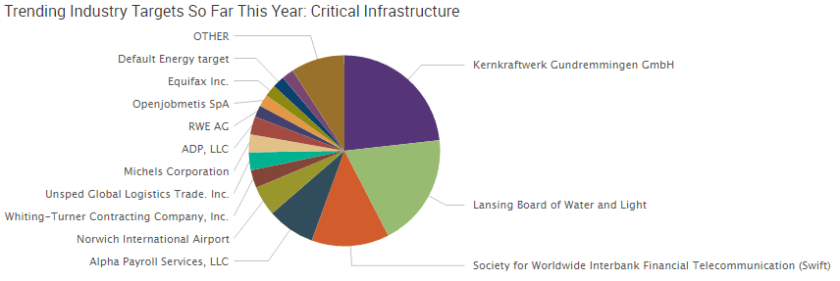
Over the last couple weeks, several critical infrastructure cyber-events made headlines in the Industrials, Energy, and Utilities industries. Some of these targets include the German Gundremmingen nuclear reactor, the Lansing Board of Water and Light (BWL), and the Canadian gold mining firm Goldcorp. While none of these cyber-attacks resulted in chaos, they did demonstrate weaknesses within these companies.

2016-05-09_itt
The chart above shows the top trending targets in Critical Infrastructure YTD in 2016. In this chart, “Critical Infrastructure” includes data from the Industrials, Utilities, and Energy Sectors.

W-2 and tax-related data breaches have been trending in 2016 – this trend is also occurring in critical infrastructure. In 2016, many top trending critical infrastructure targets have suffered such a breach, including:

  • Alpha Payroll Services
  • Whiting-Turner Contracting Company
  • ADP
  • Michels Corporation
  • Equifax

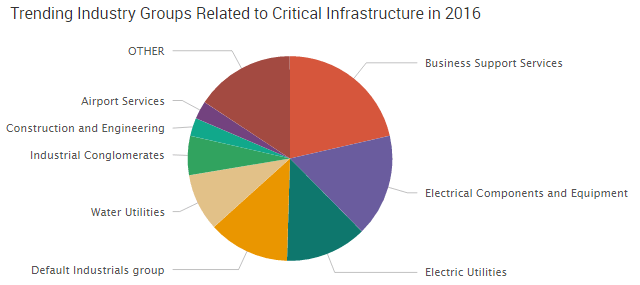
SWIFT was the software compromised in the Central Bank of Bangladesh cyber heist. As a result, business support services was the top trending industry group affected in critical infrastructure so far in 2016.

2016-05-09_groups
The industry group “Business Support Services” is the top trending tag so far in 2016.

The Critical Infrastructure Cyber Threat

Attacks against critical infrastructure have occurred in the U.S.; however, these attacks have never lead to the doomsday scenario many of us fear, such as disabling power to cities or truly compromising a nuclear reactor. Most critical infrastructure attacks in the U.S. involve the loss of user data, not a takeover of key operating capabilities.

A critical infrastructure takeover has occurred in another country. In 2015, a cyber group named Sandworm Team launched an attack against the Ukrainian Power Authority. Using the infamous BlackEnergy malware, the group was able to successfully shut down power for 700,000 people over a two hour period – the first known power outage caused by a cyber-attack. The Sandworm team has attacked U.S. critical infrastructure in the past, forcing ICS-Cert to issue an alert in 2014 addressing the threat.

Attacks against critical infrastructure have been taken especially seriously by the U.S. government. In February 2013, President Barack Obama signed Executive Order 13.636, “Improving Critical Infrastructure Cybersecurity,” and Presidential Policy Directive 21, “Critical Infrastructure Security and Resilience.” The executive order and policy directive attempt to address key issues with our nation’s critical infrastructure cybersecurity, including:

  • Promote information sharing with U.S. private sector
  • Clearly define roles of key officials involved with critical infrastructure security
  • Commit to providing assistance in the event of a data breach
  • Create a framework to reduce cyber risk to critical infrastructure
  • Promote innovation, research, and development of enhanced cybersecurity measures

As a result, the Department of Homeland Security (DHS) launched the Critical Infrastructure Cyber Community Voluntary Program. The goal of this program is to help enhance critical infrastructure cybersecurity and to promote the adoption of the National Institute of Standards and Technology’s Cybersecurity Framework.

Our country’s critical infrastructure suffers from the same vulnerabilities as other sectors. Valuable information is kept on databases and people are used as a bridge to that information. While the threat of a doomsday attack against our nation’s critical infrastructure remains a serious threat, traditional cybercrime is still driven by profit motive. Those in charge of critical infrastructure security not only have to be prepared for threats attempting to cause physical harm to our nation, they must also prepare for the theft of personal information, which seems to be the current trend.

Trade Secret Legislation Awaits Obama’s Signature

Organizations will soon have another avenue to seek relief from trade secret theft, as President Obama is expected to sign into law the Defend Trade Secrets Act. The bill, which gives companies the ability to pursue trade secret cases in federal courts rather than at the state level, is the latest in a string of headlines related to stolen intellectual property.

The effort is meant to help combat the growing problem of espionage, which costs the U.S. $300 billion and 2.1 million jobs each year, according to a 2013 report from the Commission on the Theft of American Intellectual Property.

2016-05-03_espionage
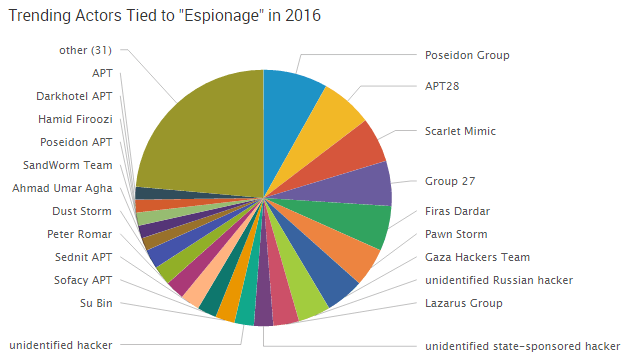
Many different individuals and groups have been associated with cyber-espionage so far this year, according to threat intelligence data from SurfWatch Labs.

House Judiciary Committee Chairman Bob Goodlatte (R-Va.) said the DTSA would “build on efforts over the past two years and take a significant and positive step toward improving our nation’s trade secret laws.”

The first version of DTSA was introduced in 2014, just weeks before the U.S. made waves when — for the first time ever — they filed charges against five Chinese military hackers for cyber-espionage against U.S. corporations. That 2014 indictment centered around alleged hacking and theft related to six organizations: Westinghouse, SolarWorld, U.S. Steel, Allegheny Technologies, the United Steelworkers Union, and Alcoa.

Those allegations continue to play out as U.S. Steel recently took steps to request the government prevent imports from China’s largest manufacturers due to, among other things, trade secret theft. A complaint filed on April 26 with the U.S. International Trade Commission under a section of the U.S. Tariff Act alleges those stolen trade secrets led to decades of research in creating the next generation of high-strength steel being taken and reproduced in China. 

The DTSA gives the many organizations affected by the theft of trade secrets another outlet to seek relief, and the version awaiting Obama’s signature has received widespread support (the house voted 410-2 in favor); however, the legislation is not without detractors. When the bill was first introduced two years ago, 31 law professors signed a letter opposing it, and in November 2015 they again called on Congress to reject the DTSA:

While we agree that effective legal protection for U.S. businesses’ legitimate trade secrets is important to American innovation, we believe that the DTSA — which would represent the most significant expansion of federal law in intellectual property since the Lanham Act in 1946 — will not solve the problems identified by its sponsors. Instead of addressing cyberespionage head-on, passage of the DTSA is likely to create new problems that could adversely impact domestic innovation, increase the duration and cost of trade secret litigation, and ultimately negatively affect economic growth.

The federal law does not replace current state laws, the group argued, so it will complicate rather than simplify trade secret litigation by adding a new layer of federal jurisprudence.

What this Means for Business

Most states have adopted a version of the Uniform Trade Secrets Act, which is how most trade secret disputes are currently handled. Once the DTSA is signed into law, organizations will be able to decide whether federal or state courts are more beneficial.

Although most legal experts agree that the DTSA provides a slightly broader interpretation of “trade secrets” as well as additional tools that can be used, the choice of avenue for litigation will likely need to be decided on a case by case basis.

“State courts may still to be a more preferable venue for many plaintiffs, as they typically provide more lenient rules for obtaining ex parte relief and a temporary restraining order,” the National Law Review noted. “Federal courts are often backlogged and may not hear a temporary restraining request immediately. By the time a temporary restraining order is issued, the critical information may be disclosed or forever gone. Thus, an expedited hearing in state court may outweigh the benefits of the federal court option provided by the DTSA.”

Trade secrets are often the most important assets for an organization, and the recent legal developments should serve as a reminder for businesses to assess the risks associated with those secrets, do their best to ensure those secrets are protected, and to have a plan in place so they can take legal recourse should those secrets get stolen.

Cyber-Attacks Against Banks Making Huge Impact in 2016

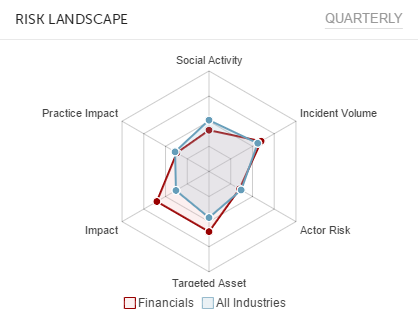
Although the financials sector hasn’t been as widely discussed as others this past quarter, cyber-attacks in the sector are having a greater impact, according to SurfWatch Labs’ data.

snapshot_1462215431132
The impact and targeted asset financials scores (red) are trending much higher than other sectors (blue), according to SurfWatch Labs.

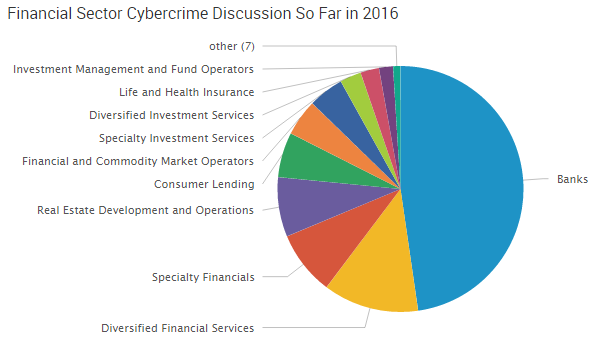
Since March 2016, the financials industry has made big headlines for high-profile cyber events involving the Central Bank of Bangladesh and most recently, Qatar National Bank. These two banks have contributed enormously to the amount of cybercrime discussion surrounding banks.

2016-05-02_groups
Banks are the most discussed group in the financials sector, accounting for nealy 40% of the negative CyberFacts collected by SurfWatch Labs, followed by Diversified Financial Services (14%) and Specialty Financials (13%)

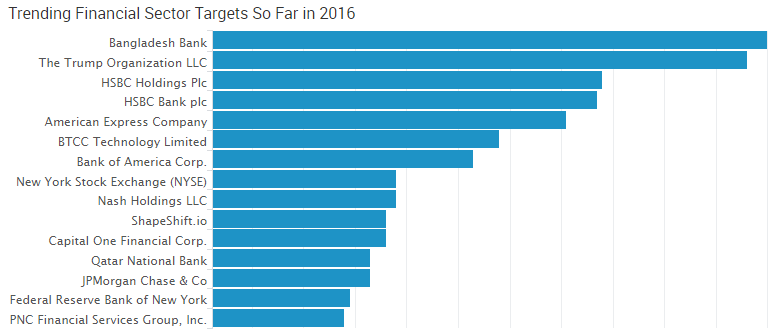
The Central Bank of Bangladesh is the top trending financials sector target so far in 2016. The multiple cyber-attacks against the Trump Organization – including an Anonymous campaign – and the January DDoS attack against HSBC Bank round out the top three targets.

2016-05-02_itt
The Central Bank of Bangladesh is the top trending financials target in 2016. 

Latest on Bangladesh Bank Heist

The $81 million bank heist of the Central Bank of Bangladesh is one of the most successful cyber bank thefts in history. The bank was attacked via SWIFT, a well-known and utilized international bank messaging system.

SWIFT stands for the Society for Worldwide Interbank Financial Telecommunication. The system authorizes payments between accounts and is recognized for its security. According to Michael Corkery of The New York Times, one financial analyst even called SWIFT “the Rolls-Royce of payments networks.”

Unfortunately for banks, SWIFT issued a warning to customers that cybercriminals have attempted similar bank thefts through its system.

“SWIFT is aware of a number of recent cyber incidents in which malicious insiders or external attackers have managed to submit SWIFT messages from financial institutions’ back-offices, PCs or workstations connected to their local interface to the SWIFT network,” the warning read.

One of the main problems with SWIFT is that not all banks put security features in place to protect against potential threats.

“SWIFT is a great organization,” said Chris Larsen, the founder of Ripple, to The New York Times. “But the system is fractured and antiquated. The way it is set up, you cannot totally isolate problems in a place like Bangladesh from the whole network.”

HSBC U.K. Banking System Taken Offline

In January 2016 Europe’s largest financial lender HSBC suffered a DDoS attack, keeping several banking customers unable to access their accounts. The attack took place on Friday, January 29, and services were restored on January 30.

This was the second website outage suffered by the bank in January.

The attack was particularly damaging due to its timing. HSBC was attacked on the last Friday in January, a particularly busy day for banks as the end of the fiscal year approaches. Millions of customers -– both online and mobile app users –- were affected by the attack.

HSBC never released any technical data about the incident. DDoS attacks can have an impact on brand reputation as well as loss of revenue. On average, a DDoS attack can cost about $40,000 per hour, according to a study conducted by Incapsula.

New Hybrid Malware Used In Bank Attacks

Cybercriminals are always looking for new, sophisticated ways to attack organizations. A new threat called GozNym malware has been identified targeting banks in the North America, Asia, and Europe. As SurfWatch Labs recently reported to customers, the malware has stolen over $4 million between 24 banks in North America alone.

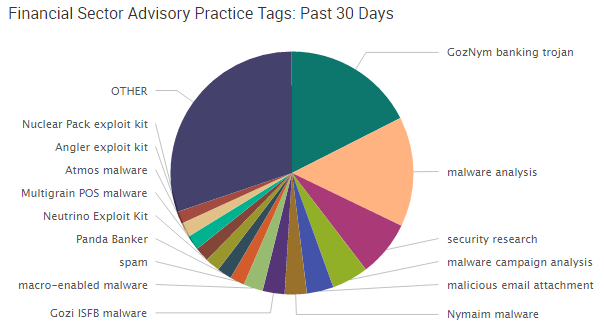
The GozNym banking Trojan has been discussed frequently over the past 30 days.

2016-05-02_advisories
The GozNym banking Trojan is the top trending advisory tag in the Financial sector over the last 30 days. 

GozNym is a hybrid malware, containing code from both the Nymaim and Gozi ISFB variants. The source code from the Nymaim malware is used to steal user data and login credentials. Once this data is obtained, the source code from the Gozi ISFB malware manipulates web sessions and conducts online banking fraud attacks. This nasty threat not only perpetrates bank fraud, it can also open the door for further malware attacks, including ransomware.

Like most malware, GozNym relies heavily on one factor to promote infection – human behavior. The malware is spread through exploit kits and Office macros, both of which require human interaction for its operation to take place.

Banks are an especially ripe target for cybercriminals due to the amount of transactions and data transferred between individuals and other organizations. Hacking tools such as malware and DDoS services can be purchased on the dark web for a surprisingly low price and used to create havoc and devastating financial loss for organizations. As demonstrated in the Central Bank of Bangladesh theft, it only takes one vulnerability to crack a company’s security, and the impact of those attacks is often more far reaching than other sectors.

W-2 Data Breaches Were Abundant During 2015 Tax Season

The 2015 tax season has ended, signaling a potential break in the number of tax-related data breaches we read about in the news. The list of companies suffering from these cyber-attacks seemed to grow weekly and nearly 100 companies have been publicly tied to W-2-related breaches in 2016. SurfWatch Labs collected a multitude of CyberFacts pertaining to W-2 and tax data breaches during the 2015 tax season.

2016-04-25_Tax_groups
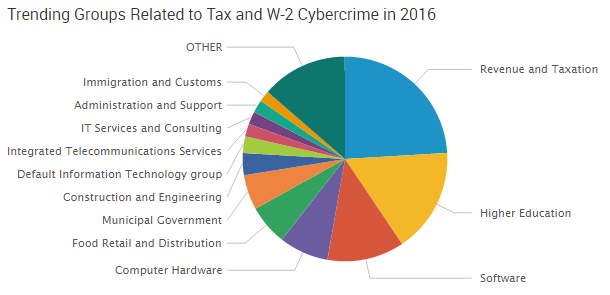
Tax-related cybercrime impacted companies across a wide variety of industry groups in 2016.

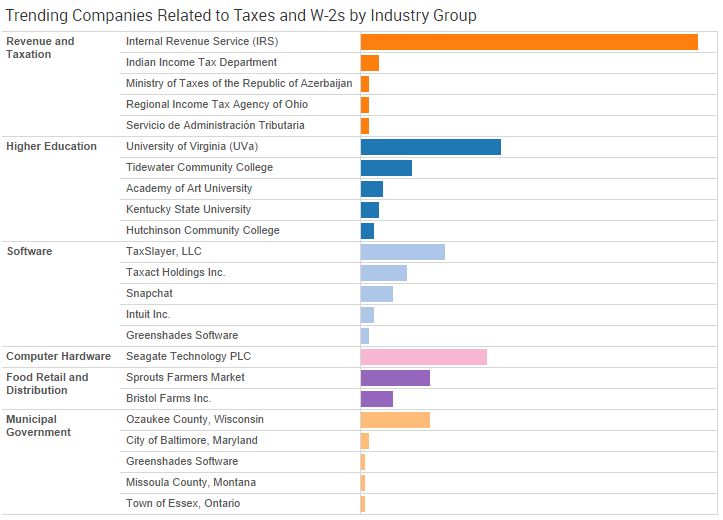
The IRS, predictably, has the most CyberFacts related to tax and W-2 cybercrime in 2016. The IRS has suffered massive data breaches within the last year. In 2015, the IRS exposed 700,000 taxpayer accounts through its “Get Transcript” service. Last February, the IRS was breached again, with more than 100,000 stolen Social Security Numbers used to successfully access an E-file PIN. Events like these have lead to predictions that the IRS will lose $21 billion to cyber fraud and fake tax returns in 2016.

Surprisingly, the group Higher Education also received a lot of discussion, with the high profile W-2 data breach at the University of Virginia leading the way in terms is discussion.

2016-04-25_tax_itt
The chart above lists the top trending organizations pertaining to tax and W-2 cybercrime for the most talked about industry groups. The IRS garnered the most discussion of any organization. 

IRS and FBI Release Warnings About Tax Fraud

In March, the IRS released an alert about tax fraud which described various methods used by criminals to obtain W-2 and tax information. The alert provided information on several areas individuals and organizations leave themselves vulnerable to compromise:

Abusive Return Preparer
Taxpayers should be very careful when choosing a tax preparer. While most preparers provide excellent service to their clients, a few unscrupulous return preparers file false and fraudulent tax returns and ultimately defraud their clients. It is important to know that even if someone else prepares your return, you are ultimately responsible for all the information on the tax return.”

Abusive Tax Schemes
“Abusive tax scheme originally took the structure of fraudulent domestic and foreign trust arrangements. However, these schemes have evolved into sophisticated arrangements to give the appearance that taxpayers are not in control of their money. However, the taxpayers receive their funds through debit/credit cards or fictitious loans. These schemes often involve offshore banking and sometimes establish scam corporations or entities.”
Nonfiler Enforcement
“There have always been individuals who, for a variety of reasons, argue taxes are voluntary or illegal.  The courts have repeatedly rejected their arguments as frivolous and routinely impose financial penalties for raising such frivolous arguments.  Take the time to learn the truth about frivolous tax arguments.”
The FBI also released a warning in March related to the rise of Business Email Compromise (BEC) scams targeting businesses and individuals within organizations. BEC scams have gained notoriety for defrauding organizations out of money. However, BEC scams can also be used to obtain information from organizations — including W-2 and tax information.

“Based on complaint data submitted to IC3, B.E.C. victims recently reported receiving fraudulent emails requesting either all Wage or Tax Statement (W-2) forms or a company list of Personally Identifiable Information prior to a traditional BEC incident,” the warning read.

A “traditional” BEC attack starts with a fraudulent request that is sent utilizing a high-ranking executives spoofed email. In this case, the email is sent to a member of an organization who handles employee W-2 and tax information. The email will appear to be an urgent message requesting all employee W-2 information.

This is what happened at Sprouts Farmers Market, which is facing a class action lawsuit after an employee fell for a BEC scam and forwarded W-2 information on all 21,000 of the company’s employees to a malicious actor.

Protecting Yourself From Tax Fraud

One of the biggest vulnerabilities we face concerning our data is that it is handled by other human beings. Humans make mistakes, and cybercriminals capitalize on this. Since corporations cannot guarantee your data will be safe in their hands, you must remain vigilant and prepare yourself for the possibility that your tax information could be stolen.

Here are a few tips on protecting yourself from tax fraud in 2016:

File Your Taxes Early: The early bird gets the worm; this also rings true when filing tax returns. If you file your tax return before a criminal does you’re in a much better position, as the tax return will already be marked as filed, preventing anyone else from filing a tax return with your credentials.

Avoid Password Reuse: Poor password management is one of the leading problems in cybersecurity. Remembering passwords can be cumbersome, so we do what is in our nature — we take shortcuts. Unfortunately, taking shortcuts on password management can lead to many problems. Employees have historically been shown to use the same password across several accounts, which could leave an organization vulnerable to compromise. In this scenario, a cybercriminal could obtain an employee’s login credentials from another site (Facebook is a good example) and use it to log into several accounts — even the employee’s account within an organization. Make sure employees are aware of the problems with password reuse. Also, make sure passwords are utilizing capitalization, numbers, symbols and are at least 8 characters long. Organizations can take this one step further and enable two-factor authentication, which would require an additional login step before employees, or malicious actors, could access accounts.

Educate Employees About BEC Scams: Employees are one of the primary targets in tax fraud. It is vital that employees understand the dangers of opening attachments from unknown sources. It is equally important that employees question unusual requests — like what you would see in a BEC scam email. Make sure employees understand that it is okay to ask questions before performing job functions, especially if that job function was requested via email. Before sensitive information is accessed, put in place checkpoints to make sure this information is only being shared with authorized and legitimate personnel.

Deploy Security: While there are plenty of examples that show security tools are not a 100% guarantee of protection, features such as firewalls and antivirus software are paramount when it comes to securing your data. It is also important to make sure these tools and other software — such as your operating system — are current on updates. The latest updates could provide patches to vulnerabilities in older versions of the software.