Weekly Cyber Risk Roundup: WannaCrypt Spreads and Trump Signs Executive Order

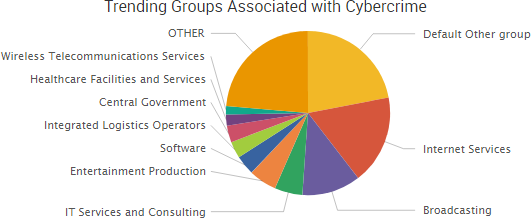
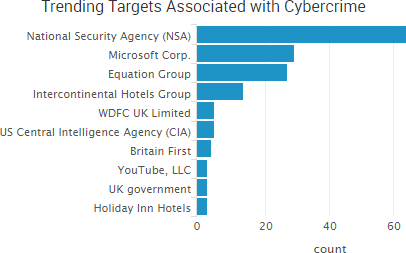
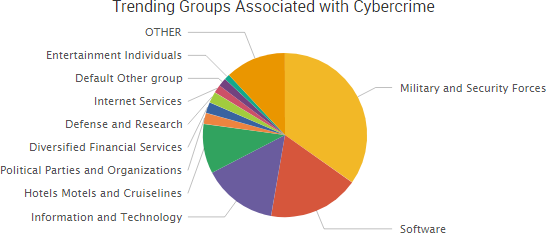
The week’s top cybercrime event was the spread of WannaCrypt ransomware, which managed to infect tens of thousands of computers on Friday. The attack affected NHS hospitals and facilities in England and Scotland, Telefonica and Gas Natural in Spain, FedEx in the U.S., and numerous other organizations — largely across Asia and Europe.

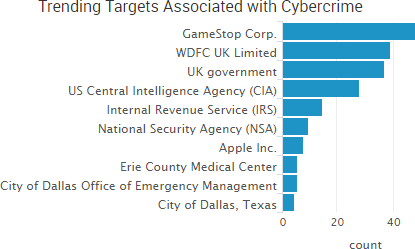
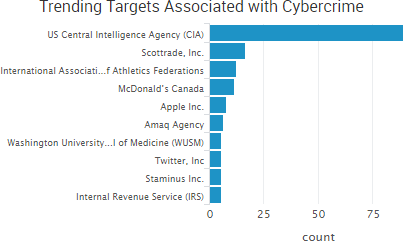
2017-05-12_ITT.PNGBy Saturday researchers reported more than 126,000 detections of the ransomware across 104 countries. The number of infections may have been worse, but the security researcher MalwareTech managed to halt the spread of the malware by purchasing a domain name, which essentially triggered a “kill switch.” MalwareTech explained why the ransomware had this design:

“I believe [the attackers] were trying to query an intentionally unregistered domain which would appear registered in certain sandbox environments, then once they see the domain responding, they know they’re in a sandbox [and] the malware exits to prevent further analysis. This technique isn’t unprecedented and is actually used by the Necurs trojan … however, because WannaCrypt used a single hardcoded domain, my [registration] of it caused all infections globally to believe they were inside a sandbox and exit.”

WannaCrypt leverages an allegedly NSA-derived exploit called “EternalBlue” that was made public by TheShadowBrokers last month. Microsoft has patched the flaw (MS17-010), but Friday’s events made it clear that many organizations have yet to apply that patch. Microsoft also announced that it is taking “the highly unusual step” of providing a security update for Windows XP, Windows 8, and Windows Server 2003 to help protect its customers from the threat. Organizations should patch immediately. As MalwareTech noted on Sunday, the last version of WannaCrypt was stoppable, but the next version will likely remove that flaw.

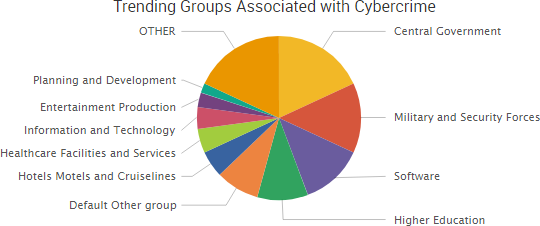
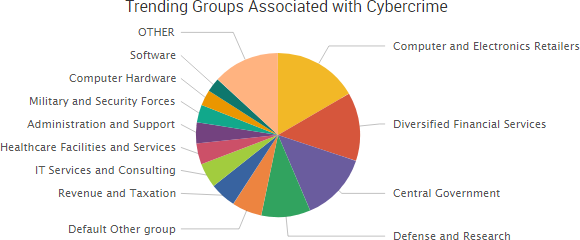
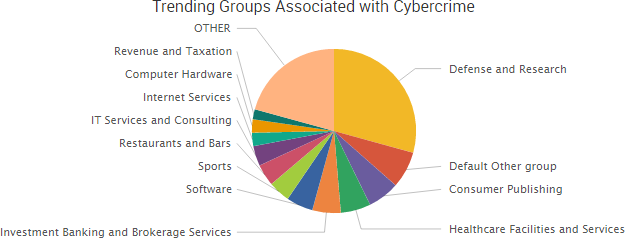
2017-05-12_ITTGroups

Other trending cybercrime events from the week include:

  • Third-party providers lead to breaches: Hackers managed to gain access to the stem files of Lady Gaga last December by sending spear phishing messages to executives at September Management, a music management business, and Cherrytree Music Company, a management and record company. Debenhams Flowers said that 26,000 website customers had their data compromised due to malware stealing their payment details from Ecomnova, a third-party e-commerce company. The email addresses and usernames of individuals who used the dating website Guardian Soulmates were exposed by a third-party service provider, resulting in members of the site receiving explicit spam emails.
  • Malicious actors sell and leak stolen data: A dark web vendor using the handle “nclay” claims to have 77 million records stolen from social learning platform Edmodo and is attempting to sell them on the dark web for just over $1000. The data allegedly includes usernames, email addresses, and passwords that are hashed with bcrypt and salted. Malicious actors leaked 9GB of internal documents from the campaign staff of France’s President-elect Emmanuel Macron in the days prior to the country’s election. A group known as “TuftsLeaks” published financial information belonging to Tufts University, including department budgets, the salaries of thousands of staff and faculty, and the ID numbers of student employees.
  • Healthcare organizations expose data: Patients of Bronx-Lebanon Hospital Center had their sensitive health and personal information exposed to the internet due to a misconfigured rsync backup managed by IHealth Innovations. The records and files from a number of departments were publicly accessible and viewable, including cardiology, surgery, pulmonology, psychiatry, and neurosurgery. A flaw in the website of True Health Diagnostics allowed users to view the medical records of other patients by modifying a single digit in the PDF link to their own records. Diamond Institute for Infertility and Menopause in New Jersey said that 14,633 patients had their data exposed due to an unknown individual gaining access to the third-party server in February 2017.
  • Other notable cybercrime news: An internet-connected backup drive used by New York University’s Institute for Mathematics and Advanced Supercomputing contained hundreds of pages of documents detailing an advanced code-breaking machine that had never before been described in public. The project was a joint supercomputing initiative administered by NYU, the Department of Defense, and IBM. A California court has found a former private security officer guilty of hacking into the servers of Security Specialists, his former employer, to steal data on customers; delete information such as archived emails, server files, and databases; deface the company website; steal proprietary software; and set up a rival business that used the stolen software. The incident occurred after the employee was fired in 2014 for logging into the payroll database with administrative credentials in order to pad his hours. Confluence Charter Schools is warning parents and staff that a hack of network servers has impacted email, phones, SISFIN, its financial system, and its student information system Infinite Campus and that the “breach has caused some files to be unrecoverable.”

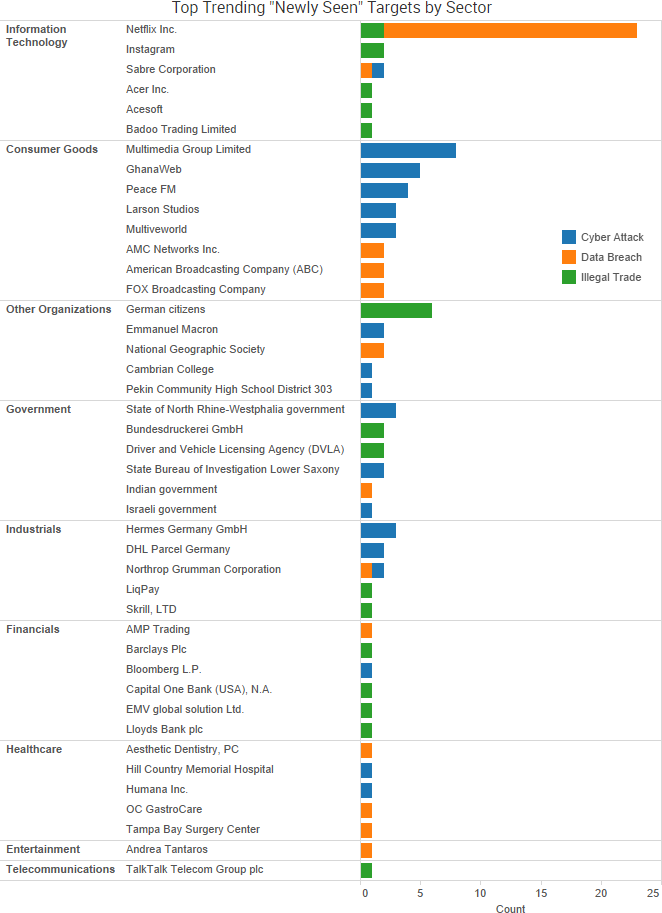
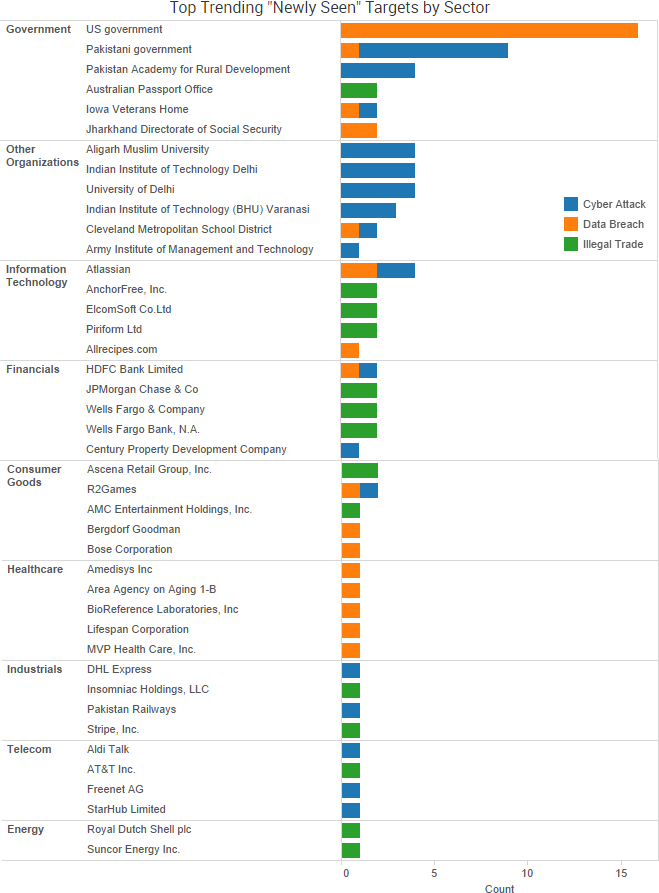
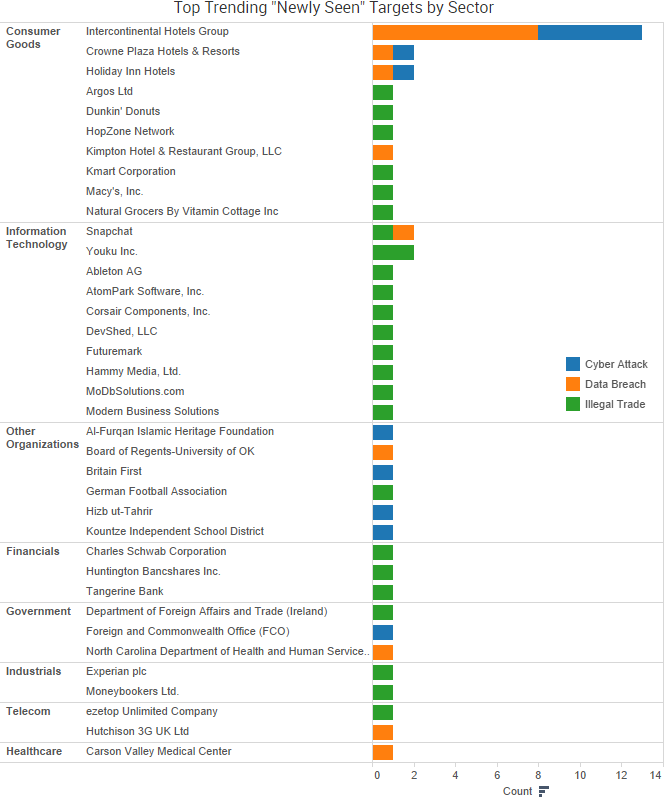
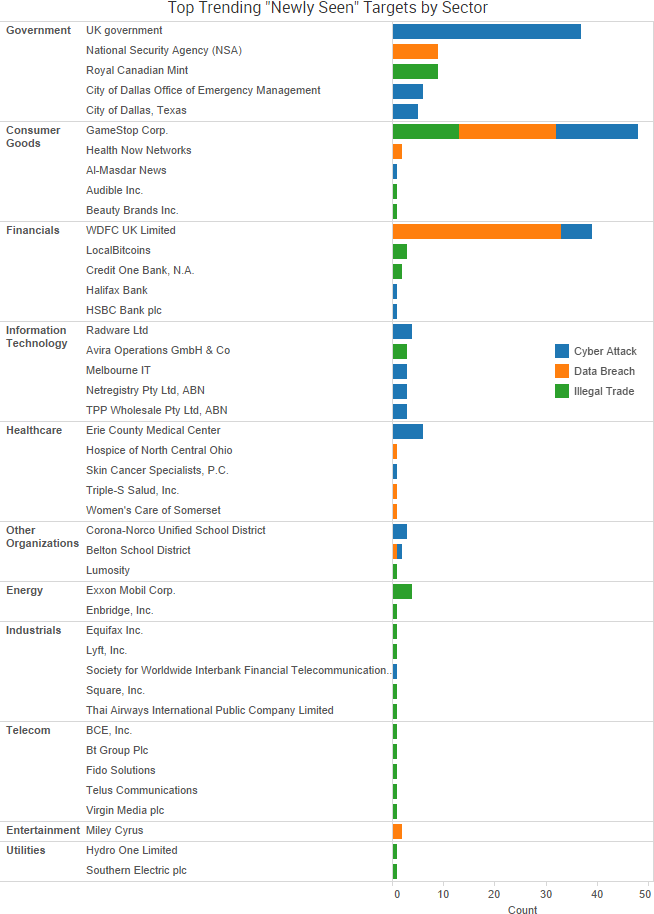
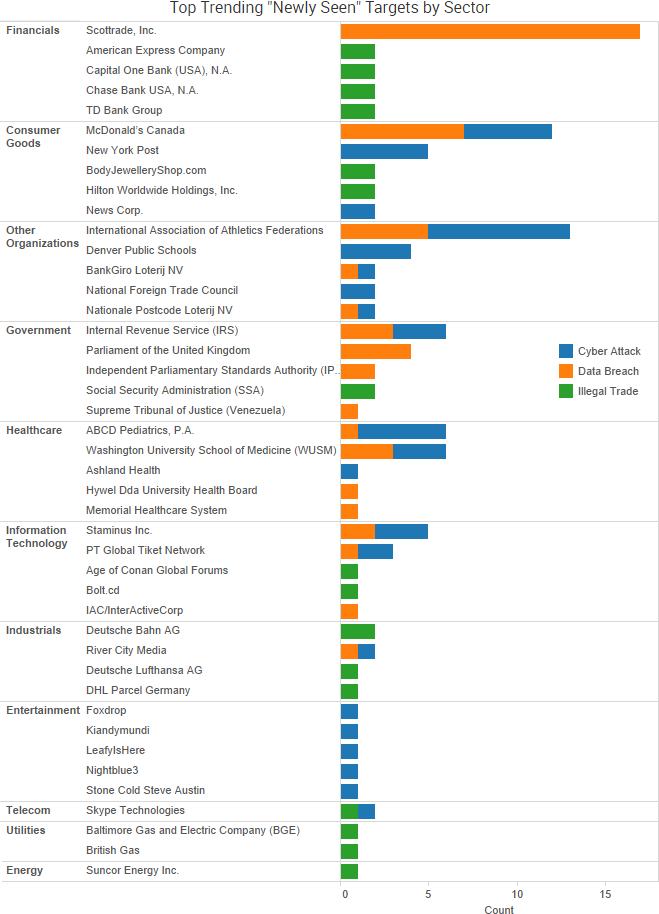
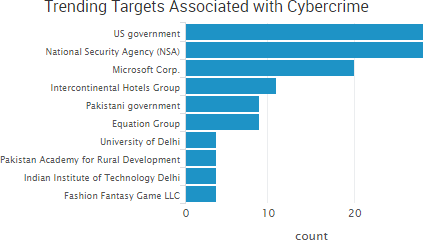
SurfWatch Labs collected data on many different companies tied to cybercrime over the past week. Some of those “newly seen” targets, meaning they either appeared in SurfWatch Labs’ data for the first time or else reappeared after being absent for several weeks, are shown in the chart below.

2017-05-12_ITTNew

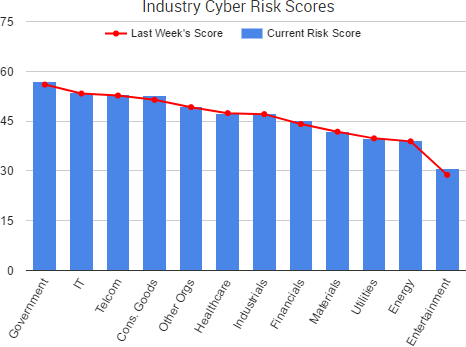
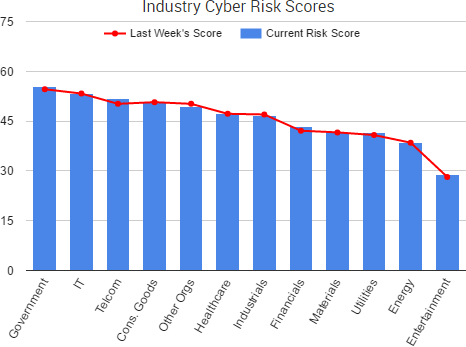
Cyber Risk Trends From the Past Week

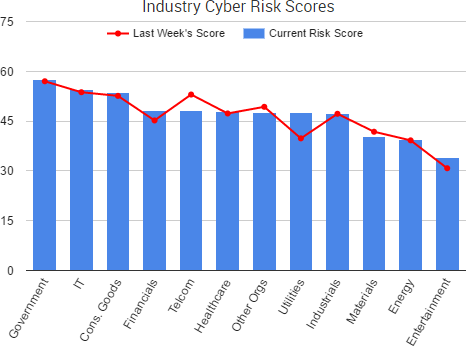
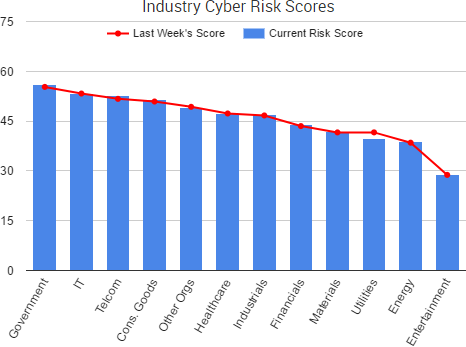
2017-05-12_RiskScoresOn Thursday, President Donald Trump issued an executive order on strengthening the cybersecurity of federal networks and critical infrastructure. The order includes a variety of mostly reporting requirements designed to protect federal networks, update outdated systems, and direct agency heads to work together “so that we view our federal I.T. as one enterprise network,” said Trump’s homeland security advisor Tom Bossert.

The order also requires  the heads of federal agencies to use The Framework for Improving Critical Infrastructure Cybersecurity developed by the National Institute of Standards and Technology (NIST) to assess and manage their agency’s cyber risk. Each agency must submit a risk management report to the Secretary of Homeland Security and the Director of the Office of Management and Budget (OMB) within 90 days that outlines their plan to implement the framework. The director of OMB and other supporting officials will then have 60 days to review the reports and pass along information to the president regarding a plan to align budgetary needs, policies, guidelines, and standards with the NIST framework. The Obama administration had previously encouraged the private sector to adopt the NIST framework, but government agencies were never required to follow it — until now.

“It is something that we have asked the private sector to implement, and not forced upon ourselves,” Bossert said at the daily White House press briefing on Thursday. “From this point forward, departments and agencies shall practice what we preach and implement that same NIST framework for risk management and risk reduction.”

The order also includes reporting regarding critical infrastructure, which builds upon the order issued by Obama in 2013, and reporting on “strategic options for deterring adversaries and better protecting the American people from cyber threats.”

As many media outlets have reported, the executive order has received a mostly positive response from the cybersecurity community; however, it is largely a continuation of the cybersecurity policy under previous administrations and has received some criticism for being more focused on reporting than actions.

Weekly Cyber Risk Roundup: TheDarkOverlord Returns and Multiple Attacks Circumvent 2FA

TheDarkOverlord was back in the news this week due to leaking data from multiple companies after failed extortion attempts. The most prominent leak involved Netflix, which had the first 10 episodes of the fifth season of its show Orange is the New Black leaked after it refused to cave to the actor’s ransom demands. The group also claims to have unreleased shows from ABC, Fox, National Geographic, and IFC. Media outlets reported that the shows appear to have been stolen from post-production studio Larson Studios in late 2016.

2017-05-05_ITT.PNG

It’s unclear exactly how much TheDarkOverlord demanded from Netflix to not release the episodes, but the actor once again framed its response to the failed extortion attempt by trying to appeal to future victims, essentially arguing that paying up will cost them a lot less money than having their data released.

“It didn’t have to be this way, Netflix,” the actor wrote in a post on April 29. “We figured a pragmatic business such as yourselves would see and understand the benefits of cooperating with a reasonable and merciful entity like ourselves. … And to the [other networks]: there’s still time to save yourselves. Our offer(s) are still on the table — for now.”

TheDarkOverlord has not yet released episodes allegedly stolen from other networks. However, three healthcare providers had data dumped by the actor on May 4. Aesthetic Dentistry in New York City and OC Gastrocare in California were both hacked last year by TheDarkOverlord, databreaches.net reported, and their dumps from last week contained 3,496 patient records and 34,100 patient records, respectively. The third dump was the biggest, containing more than 142,000 patient records allegedly stolen from Tampa Bay Surgery Center.

That large dump appears to be tied to a previously undisclosed breach, and TheDarkOverlord tweeted that the “clinic didn’t do anything wrong except annoy us.” That annoyance likely stemmed from the fact that the center did not cave to the group’s ransom demands, just like numerous other organizations targeted over the past year.

2017-05-05_ITTGroup

Other trending cybercrime events from the week include:

  • Payment card breaches continue: Sabre announced that it is investigating a data breach after discovering “unauthorized access to payment information contained in a subset of hotel reservations processed through our Hospitality Solutions SynXis Central Reservations system.” More than 32,000 properties use Sabre’s SynXis reservations system, which is described as an inventory management Software-as-a-Service application. Sabre told customers that the unauthorized access has been “shut off” and that there are not any additional details to share at this time.
  • Numerous ransomware infections reported: An April 22 ransomware infection at electronic health records vendor Greenway Health disrupted services to 400 client organizations using the vendor’s Intergy cloud-hosted platform, and half of those customers were still waiting to have a full EHR services restored on Monday, May 1. Pekin Community High School’s computer systems were infected with ransomware, and the actor demanded $37,000 in order to restore the encrypted files. Ransomware infected the computer systems of Cambrian College in Ontario and demanded a $54,000 payment. The school’s web portals, grade report, and student learning management systems were disrupted, and final grades and spring semester registration had to be postponed for several days. The law firm Moses Afonso Ryan Ltd was infected with ransomware last year that demanded a $25,000 ransom payment, and after paying a negotiated ransom payment the firm then had to renegotiate an additional payment when the first key purchased to decrypt the documents did not work.
  • Large amounts of data exposed: Around 135 million Aadhaar ID numbers and around 100 million bank account numbers have been leaked from four Indian government portals, according to a report released by The Centre for Internet and Society. The four government portals examined in the report include: National Social Assistance Programme, National Rural Employment Guarantee Act, Daily Online Payment Reports under NREGA, and Chandranna Bima Scheme. Data belonging to Alliance Direct Lending Corporation was found publicly available online and as a result at least 550,000 customers have had their personal information exposed. According to MacKeeper, the leaked data contained 124 files (with five to ten thousands records each) that contained financing records broken down by dealerships as well as 20 audio recordings of customers agreeing to auto loans or refinancing of auto loans.
  • Other notable cybercrime news: Retina-X Studios announced that in February 2017 a malicious actor was able to break into a server that held database tables for its Net Orbit, PhoneSheriff, and TeenShield products, and the actor then wiped “any data that he was able to force access to.” According to the company, the actor was able to find a vulnerability in a decompiled and decrypted version of a now-discontinued product in order to achieve the unauthorized access. Grey Eagle Resort & Casino in Calgary has had an additional 1.7 GB of data dumped, and the hackers behind the dump indicated that the data would be uploaded to torrent sites “soon” and that more data dumps would follow in the coming weeks. The casino initially had data released by hackers in January, and the new dump appears to include more data that was stolen prior to the first leak.

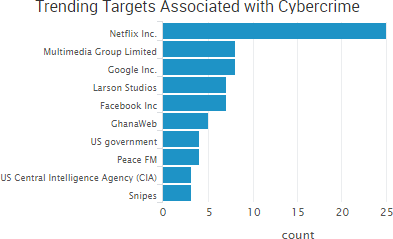
SurfWatch Labs collected data on many different companies tied to cybercrime over the past week. Some of those “newly seen” targets, meaning they either appeared in SurfWatch Labs’ data for the first time or else reappeared after being absent for several weeks, are shown in the chart below.

2017-05-05_ITTNew

Cyber Risk Trends From the Past Week

2017-05-05_RiskScoresSeveral recent cybercrime events have proven that although two-factor authentication is an effective way to prevent fraudulent transactions, malicious actors are focusing their efforts on ways to defeat that increasingly popular layer of security.


German newspaper Süddeutsche Zeitung reported that customers of O2-Telefonica had funds removed from their bank accounts due to malicious actors exploiting a flaw in  Signalling System No. 7 (SS7) — which is used by telecom companies around the world use to ensure their networks interoperate — in order to intercept the text message authentication codes sent to customers and then use those codes to successfully steal funds from customers’ bank accounts. The attack was carried out from the network of an unnamed “foreign provider,” and one expert told the German paper that  insider access could be bought for as little as €1000 in order to carry out similar attacks.

The flaw in SS7 has been known since 2014, and in 2015 60 Minutes aired a segment in which researchers demonstrated how U.S. Representative Ted Lieu’s phone messages and conversations could be intercepted. Lieu said the recent theft is yet another example of the insecurity of text-based, two factor authentication:

“Everyone’s accounts protected by text-based two-factor authentication, such as bank accounts, are potentially at risk until the FCC and telecom industry fix the devastating SS7 security flaw. Both the FCC and telecom industry have been aware that hackers can acquire our text messages and phone conversations just knowing our cell phone number. It is unacceptable the FCC and telecom industry have not acted sooner to protect our privacy and financial security. I urge the Republican-controlled Congress to hold immediate hearings on this issue.”

In addition, the UK’s National Fraud & Cyber Crime Reporting Centre is warning that malicious actors are continuing to use “SIM splitting” attacks to take control of victims’ phone numbers, authenticate transactions, and steal money from bank accounts. Like the SS7-based attacks, malicious actors first gain access to the victim’s bank accounts via phishing, malware, or cybercriminal markets — but in this case the actors then successfully report their phone lost or stolen in order to active the SIM card on a new phone and intercept communications. The fraudsters then transfer money from the victim’s account to a parallel business account they opened, and when the bank calls or texts to verify the transactions, they are in control of the victim’s phone number and can confirm the fraudulent transactions. In both cases, malicious actors have proven that they can successfully circumvent two-factor authentication with a little extra legwork.

Talking Strategic, Operational and Tactical Threat Intelligence

Cyber threat intelligence has become increasingly popular over the past few years. With that rise comes a variety of questions around the different types of intelligence that is available and how that intelligence can be best implemented by organizations looking to mitigate their cyber risk.

According to SurfWatch Labs chief security strategist Adam Meyer, there are three main types of threat intelligence — tactical, operational, and strategic — however, a focus has recently emerged on strategic threat intelligence.

“Strategic is where a lot of the business alignment can happen,” Meyer said this week on the Cyber Chat podcast. “You’re translating the capabilities out there, intentions out there, of adversaries — how they’re targeting things — and comparing it against you as an organization.”

That type of intelligence has proven to be a good starting point to answering a key question that organizational leaders may have: “Are we well-positioned for cyber risk or are we not? And if not, why not?”

On the Cyber Chat podcast, Meyer discusses a variety of topics related to cyber threat intelligence, including:

  • the difference between tactical, operational, and strategic threat intelligence,
  • how that intelligence can help manage an organization’s cyber risk,
  • what organizations should look for when evaluating threat intelligence,
  • and how threat intelligence will likely evolve in the coming years.

“The intent is to deliver finished and evaluated intelligence and put it on the desk of the decision maker. That helps them make better decisions,” Meyer said. “If you’re not doing that, you’re not technically in my book doing intelligence.”

Listen to the full Cyber Chat podcast below:

Weekly Cyber Risk Roundup: Ashley Madison Blackmail Returns, Facebook and Google Victims of Fraud

An old data breach came back to life this week as Ashley Madison users who had their data compromised back in July 2015 are once again being blackmailed — this time by an extortion group threatening to launch a public website and contact people in victims’ social media networks. The website will allegedly be launched on Monday, at which point it will be clear if the threat is just a ploy to extort victims who are low-hanging fruit or if the group will actually carry out their attempt at public shaming.

2017-04-28_ITT

“On May 1 2017 we are launching our new site — Cheaters Gallery – exposing those who cheat and destroy families,” a group using a Ukrainian top level domain recently wrote in an email to some Ashley Madison users. “We will launch the site with a big email to all the friends and family of cheaters taken from Facebook, LinkedIn and other social sites. This will include you if do not pay to opting out.”

Robin Harris wrote on ZDNet that the email he received quoted his personal Ashley Madison profile and that the blackmail price for “opting out” of the Cheaters Gallery website was around $500. Of course, paying that blackmail won’t accomplish much unless the victims are willing to keep paying ransoms in an endless game of extortion whack-a-mole. The breached Ashley Madison data has been circulating for 20 months now — ever since the account details of around 32 million users were published on the dark web — and numerous other actors have attempted to extort the victims in the past via extortion emails and letters sent to victims and their spouses. The repeated blackmail campaigns indicate that either victims are paying up and the campaigns are profitable or that the actors behind them at least believed they would be worth the investment.

Seeing another round of Ashley Madison blackmail threats nearly two years after the breach is a reminder that once data is exposed, it remains exposed forever. As SurfWatch Labs noted in a report last year, the pool of compromised data never empties; it only grows. That means that malicious actors can use, reuse, build upon, and find new ways to monetize that expanding pool of data now and in the future.

2017-04-28_ITTGroup

Other trending cybercrime events from the week include:

  • More payment card breaches: Chain restaurant Chipotle said that it is investigating a possible point-of-sale breach after detecting “unauthorized activity on the network that supports payment processing for purchases made in our restaurants.” The investigation is focusing transactions that occurred at locations from March 24, 2017 through April 18, 2017. Trading card dealer Blowout Cards announced a data breach due to “an exploit in the form of a modified payment .php file” that allowed the intruders to skim payment card information as customers checked out via its website. As a result, those who used credit and debit cards to check out via the site’s shopping cart between January 2017 and April 20, 2017, had their information compromised.
  • Espionage groups behind South Korea, Israel attacks: Iran’s OilRig hacking group is behind a series of targeted attacks against 250 individuals in government agencies, high-tech companies, medical organizations, and educational institutions such as the renowned Ben-Gurion University. The attacks took place between April 19 and 24 and employed the just-patched Microsoft CVE-2017-0199 remote code execution vulnerability in the Windows Object Linking and Embedding (OLE) application programming interface. Two cyber-espionage groups linked to China have been observed launching a variety of attacks against South Korea’s government, military, defense companies, and a big conglomerate involved in deploying Terminal High-Altitude Area Defense, or Thaad, a U.S. missile-defense system designed to protect South Korea from a North Korean missile threat.
  • FIN7 campaign uses social engineering: The FIN7 group (also known as Carbanak) is targeting large restaurant chains, hospitality, and financial service organizations with spear phishing messages centered around complaints, catering orders, or resumes. The group has also been observed calling stores at targeted organizations to ensure they received the email and attempting to walk them through the infection process, as it has done in previous campaigns.  
  • Phishing leads to fraud, data breaches: Fraudsters were able to convince more than 500 University of California students to hand over their health information, and that information was used to steal almost $12 million from the university by writing fake medical prescriptions in the students’ names. The Iowa Veterans Home is notifying 2,969 people that their medical and financial information may have been compromised after three IVH employees fell for phishing emails that compromised their email account credentials.
  • Other notable cybercrime events: A vulnerability in a popular third-party library used by HipChat.com led to a data breach. The email addresses and unique IMEI numbers from Ciphr phone users have been dumped online, and Ciphr claims that the leak was carried out by a rival secure phone company. A hacker claims to have compromised the forums of R2 games. Concordia University said that approximately 9,000 students may have been affected by unauthorized access to its online course systems. The information of 8,000 Home Depot customers who had lodged complaints with its MyInstall program was found exposed online. Ransomware infected some City of Newark computers. WikiLeaks has published the user guide for the “Weeping Angel” tool allegedly developed by the CIA.

SurfWatch Labs collected data on many different companies tied to cybercrime over the past week. Some of those “newly seen” targets, meaning they either appeared in SurfWatch Labs’ data for the first time or else reappeared after being absent for several weeks, are shown in the chart below.

2017-04-28_ITTNew

Cyber Risk Trends From the Past Week

2017-04-28_RiskScoresFacebook and Google confirmed this week that they were the victims of the $100 million phishing scheme announced by the Department of Justice of last month.

The scheme was carried out by Evaldas Rimasauskas, a Lithuanian man who allegedly impersonated the large Taiwan-based manufacturer Quanta Computer in order to dupe the companies into making a series of fraudulent payments. According to the indictment, Rimasauskas, registered and incorporated a company in Latvia with the same name as Quanta Computer and then forged email addresses, invoices, and corporate stamps in order to convince the accounting departments at the two tech companies to make transfers worth tens of millions of dollars over a two year span, stealing $100 million in total.

Facebook and Google both told Fortune that they have since recovered the bulk of the funds. 

Acting U.S. Attorney Joon H. Kim said in a DOJ press release that “this case should serve as a wake-up call to all companies – even the most sophisticated – that they too can be victims of phishing attacks by cyber criminals.”

That same concern was echoed in a report from the Association for Financial Professionals published in early April. According to the report, 74 percent of finance professionals reported that their organizations were victims of business email compromise (BEC) scams in 2016, a 10-percentage point increase from the previous year.

Likewise, in December 2016 the FBI warned of a dramatic increase in BEC scams, which attempt to assume the identity of a person of authority within the company or — in the case of the Facebook and Google thefts — a trusted vendor before asking to initiate a fraudulent wire transfer.

Behind the Scenes of a $170 Million Payment Card Fraud Operation

On Friday, 32-year-old Russian hacker Roman Seleznev was sentenced to 27 years in prison for running a cybercriminal operation that stole millions of payment cards, resulting in at least $169 million in damages to small business and financial institutions. It’s the longest sentence ever issued in the U.S. for cybercrime, and the court documents and testimony that led to the sentence revealed the inner workings of a decade-long operation that helped to grow and evolve payment card fraud into what it is today.

Earlier this month, in documents urging the judge to issue a lengthy sentence, the prosecution said Seleznev may have harmed more victims and caused more financial losses than any other defendant that ever appeared before the court:

“Seleznev is the highest profile long-term cybercriminal ever convicted by an American jury. His criminal conduct spanned over a decade and he became one of the most revered point-of-sale hackers in the criminal underworld. … Unlike smaller players in the carding community, Seleznev was a pioneer in the industry. He was not simply a market participant – he was a market maker whose automated vending sites and tutorials helped grow the market for stolen card data.”

In total, the government was able to identify 2,950,468 unique credit card numbers that Seleznev stole, possessed, or sold related to more than 500 U.S. business, subsequently affecting 3,700 financial institutions around the world. And — as the government pointed out — that is just the known losses.

Driving Small Businesses to Bankruptcy

2017-04-26_SeleznevMoneyiPhone.PNG
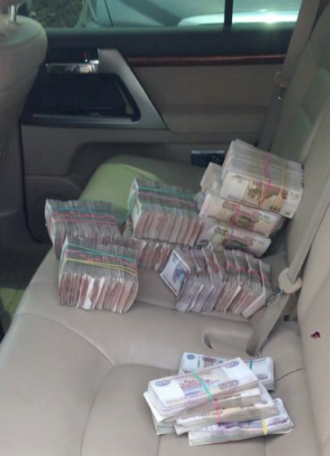
Photo of money taken from Seleznev’s iPhone, which was confiscated upon his arrest in July 2014. In addition, the laptop in his possession at that time contained more than 1.7 million stolen credit card numbers.

As we wrote when Seleznev was convicted on 38 of the 40 counts he faced last year, many of the organizations he targeted were small businesses, and the testimony of seven of those businesses were heard in the court case.

Seattle’s Broadway Grill has perhaps been the most publicized of the point-of-sale breaches. Owner CJ Saretto testified that bad publicity from the breach instantly reduced the restaurant’s revenue by 40 percent and eventually forced him to “walk away from the business, shutter the doors, [and file] personal bankruptcy.” Other owners testified that the effect on business was “horrendous,” that the breach forced them into heavy debt, and that business “has never been the same” since the incident.

It’s no coincidence those that testified in the case against Seleznev were small business owners. Seleznev tended to target small businesses in the restaurant and hospitality industry, particularly if they had poor password security around their point-of-sale devices.

Seleznev “developed and used automated techniques, such as port scanning, to identify retail point of sale computer systems … that were connected to the Internet, that were dedicated to or involved with credit card processing, and that would be vulnerable to criminal hacks,” the indictment stated.

“He quickly learned that many of these businesses’ point of sale systems were remotely maintained by vendors with poor password security,” the government said in its sentencing memorandum. “Because most of his victims were small businesses, they were unlikely to have in-house IT or security personnel. As a result, these companies made extremely attractive targets for someone with Seleznev’s skills as a hacker.”

Track2, Bulba, 2Pac, and POS Dumps

However, Seleznev went far beyond merely stealing payment card information, he also helped to develop and operate websites to market the stolen data and promote more individuals to get into payment card fraud. Seleznev was 18 years old when he began participating in the Russian underground “carding” community under the alias “nCuX,” and seven years later, in 2009 when the U.S. Secret Service tried and failed to coordinate his arrest, he had become a major provider of stolen credit card data, according to court documents.

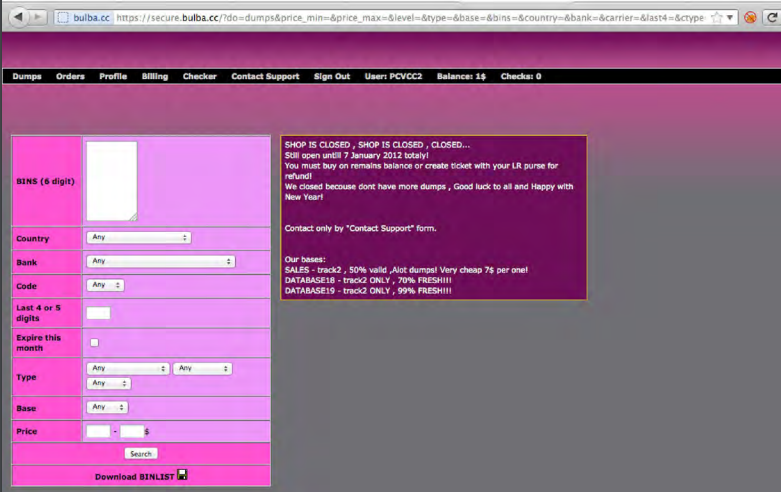
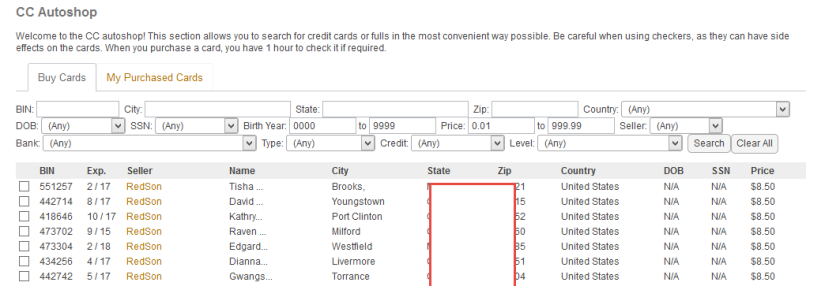
Just three months after being tipped off to the potential arrest by contacts inside the FSB and retiring his “nCuX” alias, Seleznev was back in the game under the name “Track2.” He soon unveiled two new automated vending websites, “Track2” and “Bulba,” which allowed buyers to to automatically search and purchase his stolen credit card data by using filters such as a particular financial institution or card brand.

2017-04-26_SeleznevBulba
Screenshot of Bulba, an automated vending website used by Seleznev to buy and sell stolen payment card information.

Those features have become commonplace now, but as the prosecution noted, it was “a major innovation” at the time and the “Track2 and Bulba websites achieved instant success.”

“[The sites] made it possible for criminals to efficiently search for and purchase stolen credit card data through a process as easy as buying a book on Amazon,” the prosecution wrote. “Automated vending sites increased the efficiency [of] credit card data trafficking, and remain the gold standard for credit card trafficking to this day.”

2017-04-26_AlphaBayCarding

The popular dark web marketplace AlphaBay adopted a similar automated shop for stolen payment card information in May 2015, but it includes more search options and a more user-friendly interface than Seleznev’s 2009 Bulba site.

In April 2011, Seleznev was injured in a terrorist bombing in Marrakesh, Morocco, and hospitalized for several months. His co-conspirators ran the Track2 and Bulba websites in his absence until they closed up shop in January 2012 citing no new dumps to sell.

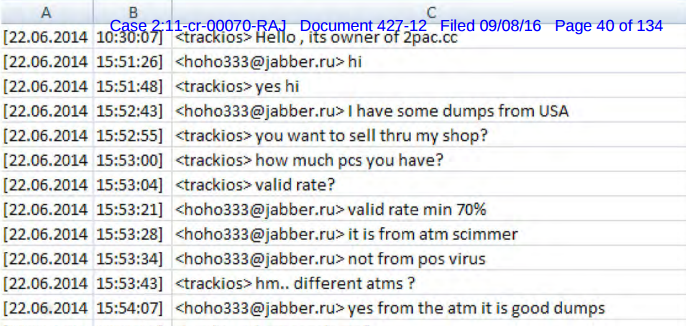
Once again, Seleznev choose to return to cybercrime by innovating his operations. Switching monikers to “2Pac,” he launched a new automated vending site that would not only sell his stolen data but would offer stolen cards from “the best sellers in one place.” Seleznev would take a portion of the proceeds for each sale, and he used this model to resell credit data stolen in popular breaches such as Target, Michaels, and Nieman Marcus on the 2Pac site.

2017-04-26_SeleznevATMDump
Someone chatting with Seleznev trying to get payment card data stolen via ATM skimmers listed on the 2Pac site.

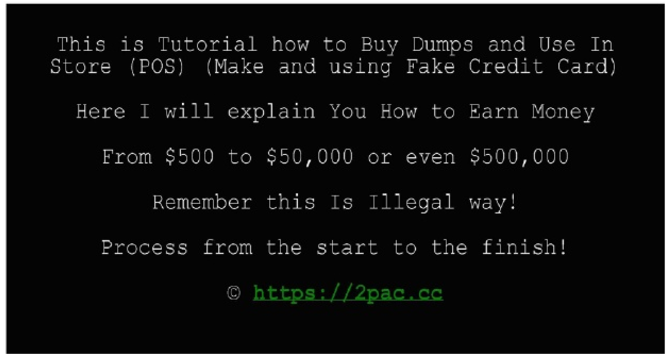
In addition, Seleznev needed a continuous stream of dumps and customers to fuel his 2Pac site, so he began teaching others the basics of payment card fraud via a sister site, called “POS Dumps.”

2017-04-26_Seleznev2PacTutorial
The POS Dumps site linked to the 2Pac site and walked wannabe fraudsters through the steps necessary to become a criminal.

The POS Dumps website contained four categories to teach amateurs how to successfully commit payment card fraud:

  1. Choosing and buying equipment
  2. Choosing and buying dumps
  3. How to generate Track1 and why it is needed
  4. Writing the dumps onto cards

The website even had links to eBay to purchase the necessary equipment (an MSR206 manual swipe magnetic card reader/writer) and custom malware to help write the stolen payment card data onto other cards.

2017-04-26_SeleznevTheJERM
POS Dumps provided a “comprehensive” program to interface with the MSR206 magnetic reader/writer to help wannabe cybercriminals commit fraud.

The prosecution wrote that the POS Dumps website “trained thousands of new criminals in the basics of how to use the data to commit fraud.” Similar types of tutorials related to fraud and cybercrime remain among the most commonly listed items on dark web markets today, according to SurfWatch Labs’ data.

A Record 27-Year Prison Sentence

2017-04-26_SeleznevGuidelines
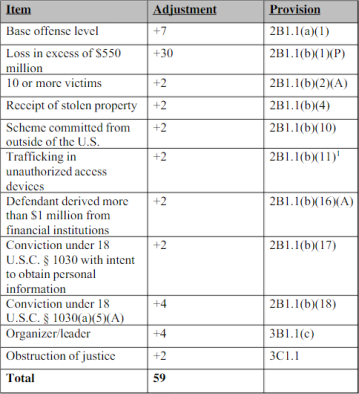
The prosecution argued that the U.S. sentencing guidelines stated that “unauthorized charges … shall not be less than $500 per access device.” Therefore, Seleznev’s 2.9 million stolen credit cards equated to more than $1.4 billion in losses.

Court documents from the defense called the long prison sentence “draconian.” However, Seleznev clearly knew his actions could have serious consequences. He monitored the U.S. court’s PACER system for any criminal indictments against him, and when agents arrested him in the Maldives as he attempted to board a plane in 2014, he immediately asked if the U.S. had an extradition treaty. The U.S. did not have a formal treaty with the Maldives, but an agreement was obtained in the days prior to take custody of Seleznev.

The prosecution described Seleznev’s sentencing guideline calculation as “literally off the charts.” A score of 43 recommends a life sentence, and Seleznev scored 16 points above that — a 59.

The judge agreed with the prosecution and sentenced Seleznev to 27 years in prison last Friday.

“The notion that the Internet is a Wild West where anything goes is a thing of the past,” said U.S. Attorney Annette L. Hayes. “As Mr. Seleznev has now learned, and others should take note – we are working closely with our law enforcement partners around the world to find, apprehend, and bring to justice those who use the internet to steal and destroy our peace of mind.  Whether the victims are multi-national banks or small pizza joints, we are all victims when our day-to-day transactions result in millions of dollars ending up in the wrong hands.”

Weekly Cyber Risk Roundup: Payment Card Data at Risk Due to POS Breaches and Ecommerce Vulnerabilities

Point-of-sale breaches were once again among the week’s top trending cybercrime targets, as InterContinental Hotels Group (IHG) announced that its previously disclosed POS breach had expanded from the dozen properties reported in February to at least 1,175 properties. Affected hotels include popular brands such as Holiday Inn, Holiday Inn Express, InterContinental, Kimpton Hotels, Crowne Plaza, and more.

2017-04-21_ITT.PNGAccording to the company’s press release, the investigation discovered “malware designed to access payment card data from cards used onsite at front desks for certain IHG-branded franchise hotel locations between September 29, 2016 and December 29, 2016.” The release doesn’t directly state the number of properties affected, instead it directs viewers to a cumbersome breach lookup tool that divides the nearly 1,200-strong list of affected properties into countries, states, and even hundreds of individual cities.

The release also states that hotels that upgraded their technology were not affected by the breach: “Before this incident began, many IHG-branded franchise hotel locations had implemented IHG’s Secure Payment Solution (SPS), a point-to-point encryption payment acceptance solution. Properties that had implemented SPS before September 29, 2016 were not affected. Many more properties implemented SPS after September 29, 2016, and the implementation of SPS ended the ability of the malware to find payment card data and, therefore, cards used at these locations after SPS implementation were not affected.”

That’s a sliver of good news; however, nearly 1,200 hotels were impacted and that list may grow in the future as “a small percentage of IHG-branded franchise properties did not participate in the investigation.” The lookup tool will be updated as new properties are added. Unfortunately, for heavy travelers that means returning to the clumsy tool periodically and checking every city they stayed in over the affected period for new breach updates. 

2017-04-21_ITTGroups

Other trending cybercrime events from the week include:

  • More breaches due to poor practices and faulty updates: The accidental posting of a file containing the embedded personal information of 5,600 individuals to Rhode Island’s Transparency Portal and General Assembly website is the third recent data breach tied to UHIP, a new system for state benefits. The cybersecurity company Tanium is apologizing for exposing information related to El Camino Hospital in California in hundreds of presentations for potential customers from early 2012 through mid-2015 as well as several now-deleted YouTube videos. As many as 2,000 individuals in the UK may have had their personal information visible to other customers on the RingGo parking app due to a faulty software update.
  • Former employees continue to cause damage: A former employee of engineering firm Allen & Hoshall admitted to accessing the company’s servers repeatedly over a two-year period as well as accessing the email account of a former colleague hundreds of times in order to download and view data from his former employer. A man was arrested for attempting to steal proprietary computer code for a trading platform developed by his employer, an unnamed financial services firm with an office in New York. The online retailer Black Swallow has agreed to pay $60,000 to Showpo to settle a dispute alleging that a former Showpo graphic designer downloaded the company’s entire customer database and gave it to her new employer.
  • Old data breaches come to light: Allrecipes is warning its users that their email addresses and passwords may have been compromised when logging into their accounts prior to June 2013, nearly four years ago. There is not a lot information on what happened, as the notification email said that the company “cannot determine with certainty who did this or how this occurred.” While announcing a series of automated attacks against its InCircle, Neiman Marcus, Bergdorf Goodman, Last Call, CUSP, and Horchow websites, Neiman Marcus also noted that a similar automated attack in December 2015 provided access to full payment card details — not just the last four digits as initially reported.
  • Physical theft of sensitive data at hotel: Police seized bags of documents containing the personal information of guests staying at the Seasons Hotel at Sydney’s Darling Harbour, and one woman has been charged in relation to the theft, according to police. The information was likely stolen around March 21 and included dozens of guest registration forms, which feature photocopies of passports, driver’s licences, and other forms of personal identification.
  • Other notable cybercrime events: Over 2.4 million email addresses and MD5-hashed passwords were stolen from Fashion Fantasy Game, an online game and social network for fashion lovers, in 2016, and the game’s website appears to contain several existing vulnerabilities that could leak data. Cleveland Metropolitan School District is warning some employees, students, guardians, and affiliates that their information may have been compromised when multiple employees fell for a phishing email that compromised their email account credentials. Security and privacy concerns have been raised after London’s Metropolitan Police apparently gave the addresses of 30,000 gun owners to a marketing agency to help promote the sale of a “firearms protection pack.”

SurfWatch Labs collected data on many different companies tied to cybercrime over the past week. Some of those “newly seen” targets, meaning they either appeared in SurfWatch Labs’ data for the first time or else reappeared after being absent for several weeks, are shown in the chart below.

2017-04-21_ITTNew

Cyber Risk Trends From the Past Week

2017-04-21_Risk

In addition to the wide-reaching POS breach that IHG announced this week, online retailers may also be at risk of potential payment card breaches due to an unpatched zero-day vulnerability in the Magento ecommerce platform.

Security researchers at DefenseCode said they discovered the high-risk vulnerability during a security audit of Magento Community edition. The researchers said the vulnerability “could lead to remote code execution and thus the complete system compromise including the database containing sensitive customer information such as stored credit card numbers and other payment information.”

DefenseCode did not examine the Magento Enterprise version, but a researcher told Threatpost that both versions share the same underlying vulnerable code. The researcher also said that they have made repeated attempts to notify Magento of the issue since November 2016, but it has yet to be patched. In an email to customers, Magento said it plans on addressing the vulnerability soon:

This vulnerability will be addressed in our next release targeted for early May. Until then, we recommend enforcing the use of “Add Secret Key to URLs” to mitigate potential attacks. To turn on this feature:

1. Logon to Merchant Site Admin URL (e.g., your domain.com/admin)

2. Click on Stores > Configuration > ADVANCED > Admin > Security > Add Secret Key to URLs

3. Select YES from the dropdown options

4. Click on Save Config


Magento is used by approximately 200,000 online retailers, so the vulnerability is a cause for concern, particularly since it is now public and likely will not be patched for at least several weeks. In addition, an attack could be carried out by targeting any Magento admin panel user.

“Full administrative access is not required to exploit this vulnerability as any Magento administrative panel user regardless of assigned roles and permissions can access the remote image retrieval functionality [at the root of the vulnerability],” the advisory noted. “Therefore, gaining a low privileged access can enable the attacker to compromise the whole system or at very least, the database.”

Slew of Source Code and Malware Leaks Increases Risk for Organizations

Earlier this month, an undergraduate student in Korea apologized for creating and making public the joke ransomware “Resenware.” The malware didn’t ask for money to decrypt files; instead, it required victims to score more than 200 million points on the “lunatic” level of the shooting game Touhou Seirensen ~ Undefined Fantastic Object.

The student told Kotaku that he released the joke malware on Github before falling asleep and by the time he woke up it had spread and “become a huge accident.” The source code was quickly removed from Github and a tool was released allowing infected users to decrypt their files without having to play the game. The creator then apologized for making a “kind of highly-fatal malware.”

That’s all well and good, but as Will Rogers once said, “Letting the cat out of the bag is a whole lot easier than putting it back in.”

2017-04-18_Resenware.PNG
A warning from Resenware shared by Malware Hunter Team.

The story highlights how quickly publicly available source code can be spread, copied, and potentially repackaged by malicious actors. That isn’t as likely to happen with Resenware due to the lack of a financial component, though it could be utilized by actors looking to cause harm rather than turn a profit. Nevertheless, profit-driven actors have numerous other recent source code leaks they can pull from.

For example, in December 2016, the source code for a commercial Android banking Trojan, along with instructions on how to use it, was released on a cybercriminal forum. Malicious actors quickly used that code to create the BankBot Trojan, which Dr. Web researchers noted can steal login credentials and payment card details by loading phishing forms and dialogs on top of legitimate applications, as well as intercept and delete text messages sent to the infected device. Since then, BankBot has made several appearances in the Google Play store, confirming Dr. Web’s January conclusion that the leak “may lead to a significant increase in the number of attacks involving Android banking Trojans.” In fact, just last week two malicious applications utilizing BankBot, HappyTimes Videos and Funny Videos 2017, were removed from the Google Play store after receiving thousands of installs.

The BankBot Trojan is just one example of the continuing evolution of malware as the stockpile of effective cybercriminal tools continues to accumulate. The leak of these tools, whether made as a joke by amateurs or for malicious purposes by professional cybercriminals, means that more polished malware is now at the fingertips of malicious actors than ever before.

Even if an inexperienced actor is unable to take and modify public malware source code, they can simply turn to professionally run as-a-service malware options that are likely doing so.

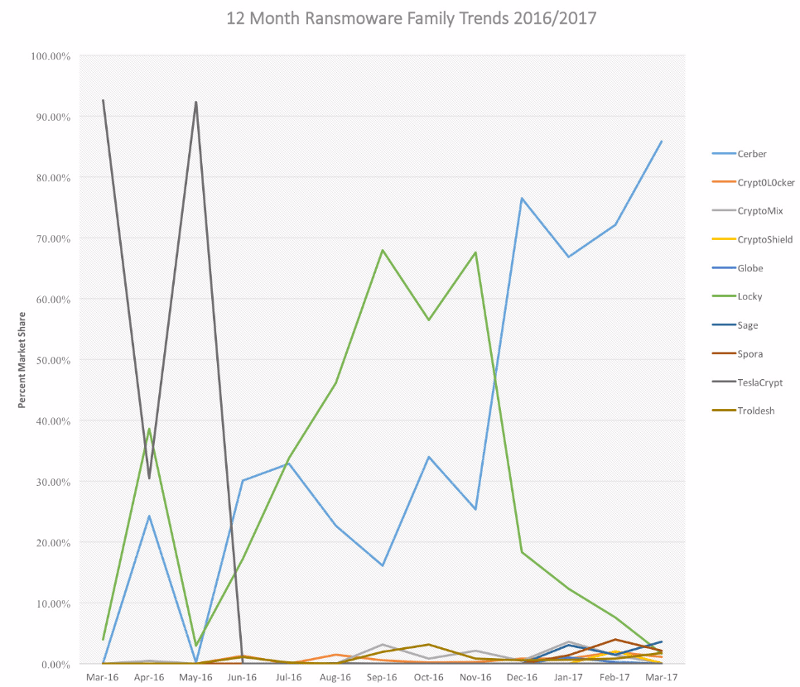
Last week MalwareBytes released a report with an interesting chart on ransomware trends. It shows that the Cerber ransomware-as-a-service (RaaS) has come to dominate the ransomware market with a nearly 90% share as its main competitor, Locky, has declined.

2017-04-19_Cerber
Cerber is dominating the ransomware market as Locky fell off sharply, according to MalwareBytes’ honeypots.

“Cerber [has spread] largely because the creators have not only developed a superior ransomware with military-grade encryption, offline encrypting, and a slew of new features, but by also making it very easy for non-technical criminals to get their hands on a customized version of the ransomware,” the report authors noted.

Those types of criminal operations can greatly benefit from the large amount of exploits and malware source code that has made its way into the public domain this year.

For example, since March 2017 we’ve seen:

  • The release of the source code for the NukeBot banking Trojan, a modular Trojan that comes with a web-based admin panel to control infected endpoints.
  • New allegedly NSA-developed exploits leaked by TheShadowBrokers, including last week’s release of a series of now-patched Windows exploits and a critical vulnerability that can hijack Solaris systems that was released a week prior (and patched today by Oracle).
  • More leaks of alleged CIA exploits and tools, some of which claim the CIA benefited by repackaging components of the Carberb malware source code, which was leaked in 2013, into CIA hacking tools.
  • A report last week claimed that the Callisto APT Group used tools leaked from the surveillance company HackingTeam, which was breached in 2015, in a series of targeted attacks last year.

Whether it’s nation-state actors, cybercriminal groups, or amateur hackers, they can all benefit by the leak of these tools over the past month. If past leaks are any indication, malicious actors will incorporate any effective tools and techniques from the recent leaks into their already-existing cyber arsenals.

As the collective knowledge grows on the cybercriminal side, it’s crucial that organizations harness their own threat intelligence in order to have their finger on the pulse of malicious actors. With that information they can more effectively counter the slew of new vulnerabilities, exploits, and as-a-service tools being used to infiltrate their networks and damage their organization.

Weekly Cyber Risk Roundup: Payment Card Breaches, Malicious Insiders, and Regulatory Action

Gamestop was the week’s top trending cybercrime target as the company is investigating reports that customer payment card information may have been stolen from gamestop.com. In addition to Gamestop, payment card information was also stolen from the restaurant chain Shoney’s and a series of car washes have issued breach notification letters tied to a compromise at an unnamed third-party point-of-sale (POS) provider.

2017-04-14_ITT.PNG

Two sources told Brian Krebs last week that an alert from a credit card processor indicated gamestop.com was likely compromised by intruders between mid-September 2016 and the first week of February 2017. The sources said that card numbers, expiration dates, names, addresses, and verification codes were stolen due to the breach. Gamestop also operates thousands of retail locations, but there is no indication that those have been affected.

However, dozens of Shoney’s locations were impacted by a recent POS breach. A week after Krebs reported the Gamestop breach, confidential alerts from credit card associations stated that similar payment card data was stolen from the restaurant chain. Best American Hospitality Corp., which manages some of Shoney’s corporate affiliated restaurants, later issued a press release saying that remotely installed POS malware led to breaches at 37 Shoney’s locations between December 27, 2016, and March 6, 2017.

In addition, Acme Car Wash, Auto Pride Car Wash, Clearwater Express Car Wash, Waterworks Car Wash, and Wildwater Express Carwash were all notified of a point-of-sale (PoS) malware infection by their unnamed third-party POS provider. The notification occurred on March 27, and customers who used a payment card at those business during various periods in February may have had their data compromised.

2017-04-14_ITTGroups

Other trending cybercrime events from the week include:

  • New data breaches announced: A backup database containing information on 918,000 people and belonging to telemarketing company HealthNow Networks was exposed on the Internet, compromising a variety of individuals’ personal and health information. The payday loan company Wonga is investigating a data breach that may have affected up to 245,000 customers in the UK and 25,000 customers in Poland. As many as 115 families had their private information compromised when the Victorian Education Department mistakenly published documents to its website for 24 hours. At least 83 University of Louisville employees had their W-2 forms accessed when an intruder gained access to W-2 Express, a product of Equifax used by the school to provide employees with access to tax documents.
  • More SWIFT attacks made public: The Union Bank of India faced an attack leveraging the SWIFT system that attempted to perform $170 million in fraudulent transactions last July, but the bank was able to block the transfer of funds, the Wall Street Journal reported. The bank’s SWIFT access codes were stolen by malware after an employee opened a malicious email attachment, and the codes were used to send fraudulent instructions in an attack similar to the one that successfully stole $81 million from the Bangladesh central bank’s account at the New York Federal Reserve in February 2016.
  • Ransomware continues to impact patient care: A ransomware infection at Erie County Medical Center blocked access to electronic patient records and forced the center to reschedule some elective surgeries, sources told news outlets; however, the hospital has yet to confirm the shutdown of its computer was due to ransomware. IT workers have been re-imaging about 6,000 desktop computers that had to be wiped clean as a result of the infection. Ashland Women’s Health reported a data breach affecting 19,727 patients after ransomware encrypted data on the practice’s electronic health record system, including its patient scheduling application. The practice was able to restore the encrypted data using a backup, and patient care was impacted for a couple of days due to the incident.
  • Amazon seller accounts being hacked: Hackers are using previously compromised credentials to hijack the accounts of third-party sellers on Amazon Marketplace, change the bank account information, and then post nonexistent merchandise at cheap prices to defraud customers. The buyers are eligible for refunds from the sellers, which may come as a surprise to the account owners as the hackers are targeting dormant accounts. A company spokesperson told NBC News that it is working to make sure sellers do not have to handle the financial burden of the hacks.
  • Other notable cybercrime events: Five inmates at the Marion Correctional Institution used computers built from spare parts and hidden in a ceiling in a closet to perform a variety of malicious activities while incarcerated. A team of Indonesian hackers gained access to the online ticketing site Tiket.com and stole approximately Rp 4.1 billion ($308,000 USD) worth of airline tickets from carrier Citilink. Dallas officials are blaming a hacker for setting off all 156 of the city’s warning sirens more than a dozen times.

SurfWatch Labs collected data on many different companies tied to cybercrime over the past week. Some of those “newly seen” targets, meaning they either appeared in SurfWatch Labs’ data for the first time or else reappeared after being absent for several weeks, are shown in the chart below.

2017-04-14_ITTNew

Cyber Risk Trends From the Past Week

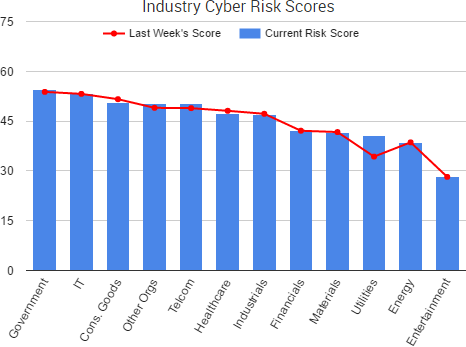
2017-04-14_RiskScoresA variety of stories from the past week once again highlighted threats that originate not from external hackers, but from organizations’ employees and poor risk management practices.

To start, Allegro Microsystems has accused a former employee of causing $100,000 worth of damages by logging into the company’s network multiple times after resigning in order to implant malware. According to court documents, the man allegedly returned a computer meant for personal use rather than his work computer when resigning, and he used that work computer along with system administrator credentials to insert malicious code into Allegro’s finance module. The employee “designed the malicious code to copy certain headers or pointers to data into a separate database table and then to purge those headers from the finance module, thereby rendering the data in the module worthless,” the documents stated.

Another case involved a DuPont employee who admitted to stealing data from DuPont in the months before he retired in order to bolster a consulting business he planned to run. The man allegedly copied 20,000 files to his personal computer, including formulas, data, and customer information related to developments in flexographic printing plate technology. He also took pictures of restricted areas of DuPont’s plant.

On the regulatory side, the FDA sent a letter to St. Jude Medical demanding the company take action to correct a series of violations related to risks posed by the company’s implantable medical devices — an issue that received quite a bit of attention last summer after a report published by Muddy Waters and MedSec shed light on the alleged vulnerabilities. St. Jude must respond to the FDA within 15 days with “specific steps [it has] taken to correct the noted violations, as well as an explanation of how [it] plans to prevent these violations, or similar violations, from occurring again” — or else St. Jude may face further regulatory action, including potential fines.

That is what happened to Metro Community Provider Network (MCPN), which agreed last week to pay $400,000 following a January 2012 phishing incident that exposed the electronic protected health information (ePHI) of 3,2000 individuals. An investigation conducted by the Office for Civil Rights revealed that “prior to the breach incident, MCPN had not conducted a risk analysis to assess the risks and vulnerabilities in its ePHI environment, and, consequently, had not implemented any corresponding risk management plans to address the risks and vulnerabilities identified in a risk analysis.” As a result, MCPN will pay the penalty and implement a corrective action plan to better safeguard ePHI in the future.

New Cryptocurrencies Gain Traction, Spark Concern For Law Enforcement

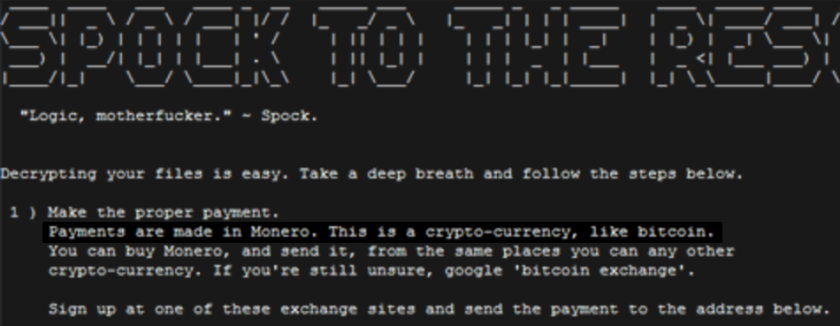
Last month a new ransomware emerged known as “Kirk Ransomware.” The malware was interesting not just because of the Star Trek-themed imagery of James Kirk and Spock that it used, but also because it may be the first ransomware to demand payment via the cryptocurrency Monero.

2017-04-06_KirkRansomware.png
Victims of the Kirk Ransomware are walked through how to make their ransom payments using Monero.

There are literally hundreds of different types of existing cryptocurrencies like Monero that cybercriminals can choose from, but bitcoin is the most well known and has been the most widely used, by far, when it comes to ransomware. Bitcoin’s status as the reigning cryptocurrency king has been driven, in part, by the growth of cybercriminal markets and ransomware actors that greatly benefit by having a semi-anonymous payment option available. However, bitcoin is facing both growing pains and an expanding group of credible challengers that claim to have better answers to some of the current issues facing cryptocurrencies.

Cryptocurrencies are, for better or worse, intertwined with cybercrime, and dark web markets and malicious actors adopting new forms of payment such as Monero and Ethereum are helping push those currencies to new heights. With that growth comes new opportunities for cybercriminals as well as new concerns for law enforcement.

As we noted in a recent blog on AlphaBay’s plans to adopt Ethereum next month, the cryptocurrency has seen a dramatic increase in price on the heels of AlphaBay’s announcement and partnerships with legitimate financial institutions. Likewise, Monero was worth around $2.50 the day before AlphaBay announced plans to adopt the currency, and less than eight months later it has jumped to more than $26.

In December 2016 an AlphaBay support representative told Bitcoin Magazine that Monero accounted for about two percent of its sales, so bitcoin remains king. However,  one can assume that the actors behind AlphaBay have plenty to gain financially by riding the wave created by the largest dark web marketplace adopting new cryptocurrencies — besides simply appeasing their customers.

Monero — which advertises itself as a “secure, private, untraceable currency” — is perhaps the most praised among cybercriminals. Bitcoin was not designed to be anonymous, and every transaction is publicly visible on the distributed ledger known as the blockchain. That’s why malicious actors use third-party tools such as bitcoin tumblers to help hide the origins of bitcoins. It’s also why law enforcement officials and security researchers have been able to “follow” bitcoins to bust those buying and selling illicit goods and services.

Monero, on the other hand, allows users to send and receive funds without transactions being publicly visible on the blockchain, which is one of the reasons some malicious actors prefer it.

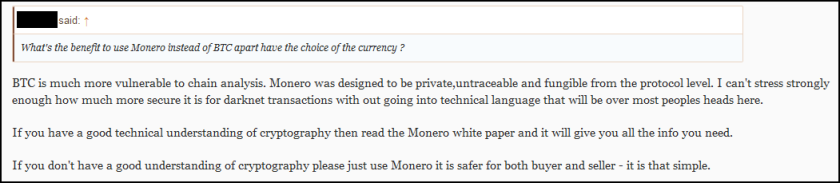
“Bitcoin is much more vulnerable to chain analysis,” advised one AlphaBay member in September 2016, when the dark web market adopted Monero. “I can’t stress strongly enough how much more secure it is for darknet transactions.”

2017-04-06_ABMonero
Monero is safer for both the buyer and seller, wrote one AlphaBay user.

Although cryptocurrencies such as Monero have not been as heavily scrutinized by law enforcement as the more popular bitcoin, their adoption among malicious actors is a concern — even if Monero is not perfect.

“There are obviously going to be issues if some of the more difficult to work with cryptocurrencies become popular,” Joseph Battaglia, a special agent working at the FBI’s Cyber Division in New York City, said at an event in January. “Monero is one that comes to mind, where it’s not very obvious what the transaction path is or what the actual value of the transaction is except to the end users.”

As a case in point, the dark web marketplace known as Oasis, which beat AlphaBay by two weeks to become the first market to accept Monero, suddenly went offline in late September 2016 in what may have been an exit scam. Various users quickly reported that at least 150 bitcoin was lost in the potential scam, but guessing how much Monero currency was stolen proved to be much more difficult.

“If we can’t find out, that’s a good thing,” wrote one redditor.

However, the FBI likely has a different view.

Weekly Cyber Risk Roundup: Scottrade Exposes Data and ATMs Get Blown Up, Drilled and Infected

The CIA remained as the top trending cybercrime of the week as WikiLeaks released a fourth set of documents related to the agency. The new dump includes 27 documents from the CIA’s Grasshopper framework, which WikiLeaks described as “a platform used to build customized malware payloads for Microsoft Windows operating systems.” The leaked CIA tools will likely continue to dominate much of the cybercrime discussion in the coming weeks as WikiLeaks appears to have a slow-drip campaign designed around maximizing the leak’s publicity.

2017-04-07_ITT

The top trending new cybercrime target of the week was Scottrade, which was one of several organizations to experience a data breach due to insecure, publicly exposed data. The Scottrade incident was caused by “human error” at third-party vendor Genpact, which uploaded a data set to one of its cloud servers without the proper security protocols in place. As a result, “the commercial loan application information of a small B2B unit within Scottrade Bank, including non-public information of as many as 20,000 individuals and businesses” was exposed, Scottrade said in a statement.

Security researcher Chris Vickery, who discovered the exposed database, said it contained 48,000 lessee credit profile rows and 11,000 guarantor rows, and that each row contained various types of personal information, including Social Security numbers. The database also contained internal information such as plain text passwords and employee credentials used for API access to third-party credit report websites.

Those who read this roundup each week know that breaches due to insecure databases are common, and in addition to Scottrade, Vickery also discovered “a trove of data from a range of North Carolina government offices, including Dept of Administration, Dept of Health and Human Services, Division of Medical Assistance, Dept of Cultural Resources, Dept of Public Safety, Office of State Controller, Office of State Budget and Management, NC IT Department.”

2017-04-07_ITTGroup

Other trending cybercrime events from the week include:

  • IRS announces another data breach: The IRS is notifying 100,000 people that their tax information may have been compromised due to a data retrieval tool used when filling out the Free Application for Federal Student Aid (FAFSA). Officials first learned of the potential issue in September 2016, but the service was not disabled until suspicious activity was observed in February. Malicious actors could pretend to be students, start the financial aid application with relatively little stolen information, and give permission for the IRS to populate the form with tax data that could then be used for fraudulent returns.
  • Highly sensitive patient data sold on the dark web: A breach at Behavioral Health Center appears to have compromised thousands of patients’ sensitive data, including evaluations, session notes, and records of sex offenders and sex abuse victims. An actor on the dark web claims between 3000 and 3500 unique individuals are in the data, which has since been sold to another actor. “These are not just basic fullz, these are the COMPLETE clinician notes from EVERY session with a patient, sometimes spanning hundreds of sessions over years,” read a listing on the dark web. “Everything confessed/discussed in complete privacy is in here for thousands of patients. All records are from 2007 to current date.”
  • Healthcare organizations targeted: An amateur actor appears to be targeting healthcare organizations with spear phishing messages designed to infect victims with a variant of the Philadelphia ransomware, an unsophisticated ransomware kit that sells for a few hundred dollars. Researchers believe spear phishing messages containing a shortened URL that led to a malicious DOCX file on a personal storage site were used to infect a hospital from Oregon and Southwest Washington. ABCD Pediatrics said that its servers were infected with “Dharma Ransomware” and while investigating the incident the company also discovered suspicious user accounts that suggested a separate incident of unauthorized access.
  • APT10 hacking group makes headlines: The APT10 hacking group has gained access to the systems of an “unprecedented web” of victims by first targeting managed outsourced IT service companies with spear phishing messages and custom malware and then using those companies as a stepping stone into their clients’ systems. The group also inserted malicious links into certain pages of the National Foreign Trade Council’s website in order to target individuals registering for specific meetings.
  • Other notable cybercrime events: The International Association of Athletics Federations said information related to athletes’ therapeutic use exemption applications was compromised due to unauthorized access to its network by “Fancy Bear.” The Dutch National Charity Lotteries said that around 450,000 customers were impacted by a vulnerability in the computer systems of Lotteries’ supplier OpenOfferete. Cybercriminals stole $40,000 of direct deposit money meant for Denver Public Schools after numerous employees fell for a phishing email. A hack of digital content network Omnia affected a variety of popular YouTube channels. The New York Post app was hacked and used to send to out a series of false push notifications. Arrests were made in Dubai related to breaking into the emails of five senior White House officials and attempting to blackmail the officials with what a local law enforcement official described as “highly confidential information.”

SurfWatch Labs collected data on many different companies tied to cybercrime over the past week. Some of those “newly seen” targets, meaning they either appeared in SurfWatch Labs’ data for the first time or else reappeared after being absent for several weeks, are shown in the chart below.

2017-04-07_ITTNew

Cyber Risk Trends From the Past Week

2017-04-07_RiskScores

While business email compromise scams and other digital fraud continues to impact numerous organizations, several stories this week proved that criminals are still attempting to steal physical cash from ATMs around the world.

The flashiest story involved a gang based out England that used explosives and stolen high-powered vehicles to rip ATMs from walls. The gang would then put the stolen ATMs inside a large truck and drive away, in at least one instance right by the very police looking for them. Police announced that several recent raids had led to the arrest of the gang. Less flashy attempted ATM thefts from hotels in Edmonton led police to advise business last month that owners should bolt ATMs to the floor and place them in well lit, high-traffic areas that are monitored by surveillance cameras.

A new, more discreet method of stealing money from ATMs involves emptying the cash stored in certain models by drilling a three-inch hole in its front panel and using a $15 homemade gadget that injects malicious commands to trigger the machine’s cash dispenser. Kaspersky Lab researchers first became aware of the attack in September 2016 when a bank client discovered an empty ATM with a golf-ball sized hole by the PIN pad. Since then, similar attacks using the drill technique have been observed across Russia and Europe. The researchers did not name the ATM manufacturer, but they said the issue is difficult to fix since it would require replacing hardware in the ATMs to add more authentication measures.

Kaspersky Lab also released findings on another series of ATM attacks first hinted at back in February when a series of attacks that used in-memory malware to infect banking networks were reported. Code from the penetration-testing software Meterpreter code was combined with a number of legitimate PowerShell scripts and other utilities to create malware that could hide in the memory and invisibly collect the passwords of system administrators. That access was then used to remotely install a new breed of ATM malware called ATMitch, Kaspersky Lab researchers said in a report issued last week.

The ATMitch malware communicates with the ATM as if it is legitimate software and makes it possible for attackers to collect information about the number of banknotes in the ATM’s cassettes as well as dispense money at the touch of a button. The attackers may still be active, the researchers noted, but it is unknown how many ATMs have been targeted by the malware since the malware self-deletes after the attack. What is clear is that ATM machines remain a popular target for criminals, and businesses should be aware of the evolving methods — both crude and sophisticated — being used to steal the cash inside them.